
IDO LEKOTA
There is a particular kind of moral vertigo that sets in when the machinery built to protect a society is exposed as an instrument of its predation. Over the past year, the Madlanga Commission of Inquiry, convened in the wake of KwaZulu-Natal Police Commissioner Lieutenant-General Nhlanhla Mkhwanazi’s explosive July 2025 disclosures regarding the alleged capture of state structures by the so-called “Big Five” cartel, has forced South Africans to confront precisely that reality.
Yet even against a backdrop of compromised generals, dubious prison transfers, missing dockets, and allegations of institutional sabotage, the evidence presented to the Commission concerning Johannesburg Metro Police Department K9 Unit Warrant Officer Johannes “Johnny” Mokgatle has struck a uniquely unsettling chord. Amplified by the testimony of the protected intelligence operative known only as Witness C, the allegations transform the abstract language of state capture, criminal infiltration, and institutional decay into something far more tangible and disturbing. The image that emerges is not of a distant crime boss or elusive syndicate leader, but of a municipal law enforcement officer allegedly operating as a contract killer and extortionist while maintaining the appearance of public service.
The allegations remain subject to due process and legal scrutiny. Nevertheless, their significance extends beyond the fate of any single individual. What is at stake is the credibility of South Africa’s law enforcement institutions and, ultimately, the integrity of the democratic state itself.
The Weaponisation of Grievance
The most disturbing aspect of the intercepted conversations recounted before the Commission is not merely the alleged criminal conduct, but the rationale used to justify it. According to testimony, Mokgatle allegedly explained his participation in extortion and contract killings as a means of providing for his children and meeting educational expenses. Embedded within that justification was a broader grievance: that South Africa’s democratic promise had failed to deliver meaningful economic opportunity and security for many Black South Africans.
This argument resonates because it draws upon a painful truth. Nearly three decades after the advent of democracy, South Africa remains one of the most unequal societies in the world. Economic growth has been uneven, youth unemployment remains persistently high, and many communities continue to experience poverty, exclusion, and social stagnation. Millions of South Africans have legitimate reasons to feel frustrated by the gap between the aspirations of 1994 and the realities of the present.
But the validity of the grievance does not validate the response.
At the heart of the South African democratic project lies the conviction that historical injustice, however profound, cannot become a licence for contemporary criminality. The alleged attempt to justify murder-for-hire and extortion as acts of paternal responsibility represents not political critique but moral neutralisation. It is a rhetorical manoeuvre that seeks to transform predation into necessity and criminal conduct into sacrifice.
Such reasoning deserves to be rejected unequivocally. Every day, millions of South Africans face economic hardship without resorting to violence, extortion, or organised crime. Unemployment does not compel contract killing. Poverty does not necessitate extortion. Frustration with government failures does not justify participation in criminal syndicates. To argue otherwise is to insult the countless citizens who endure adversity while remaining committed to the law, their communities, and basic ethical principles.
Where the State Ends and the Underworld Begins
Beyond questions of individual culpability lies a more profound institutional concern. The trajectory described by witnesses before the Commission suggests that South Africa is no longer confronted merely with isolated incidents of corruption. Rather, it faces the prospect of criminal networks becoming embedded within key state institutions.
For many years, public discourse on police corruption was framed primarily in transactional terms. Corrupt officers accepted bribes, leaked information, lost dockets, or turned a blind eye to criminal activity. These behaviours were destructive, but they remained conceptually distinct from organised crime itself.
The picture emerging from testimony concerning the alleged activities of the “Big Five”, known in certain underworld circles as “The Firm”, suggests something more sophisticated and dangerous. The concern is not simply that criminals have corrupted state officials. The concern is that criminal networks may have succeeded in integrating parts of the state into their operational architecture.
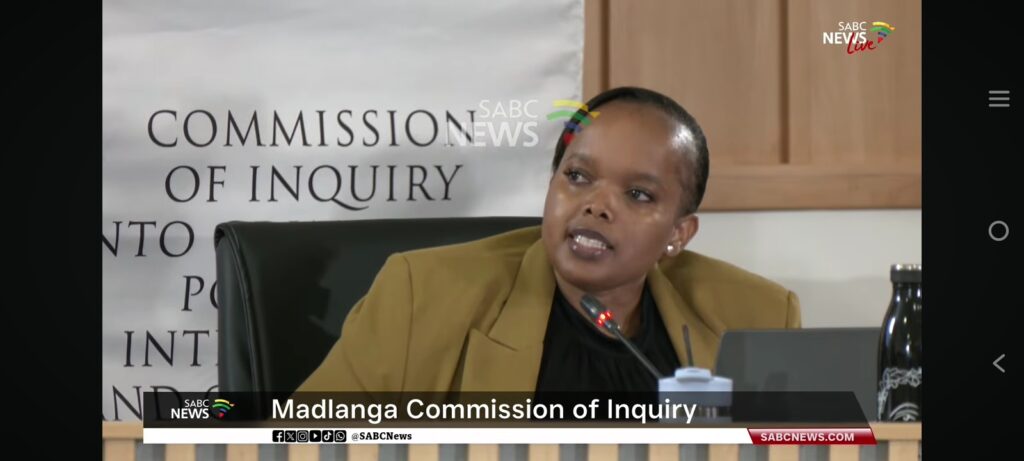
CAPTION: Evidence leader Advocate Thabang Pooe of the Madlanga hearing testimony into the Mokgatle matter
According to testimony before the Commission, Mokgatle’s alleged relationship with individuals connected to the syndicate extended beyond passive association. Witnesses have alleged that he appeared at sensitive operational scenes, interfered with law enforcement activities, and used the authority associated with his official position in ways that advanced criminal interests. Colleagues have further linked his likeness to investigative material connected to other serious criminal allegations.
Again, these claims must ultimately be tested through proper legal processes. Nevertheless, they raise disturbing questions about the permeability of institutional boundaries.
When a police officer allegedly uses state training, official credentials, access to intelligence, government equipment, and professional authority in service of organised crime, the distinction between the state and the underworld begins to collapse. Citizens can no longer determine where lawful authority ends and criminal power begins.
The Commission’s Greatest Contribution
What the Madlanga Commission has accomplished thus far is to force a national reckoning with this reality.
South Africa has become accustomed to commissions of inquiry. From state capture to corruption, numerous investigations have generated extensive reports, compelling testimony, and moments of national outrage. Too often, however, these processes have struggled to translate findings into accountability.
Yet the significance of the Madlanga Commission lies not only in the evidence it has gathered but in the narrative it has dismantled. For years, the country’s escalating violent crime crisis was frequently attributed to inadequate resources, insufficient personnel, weak management, or technical shortcomings within the criminal justice system. While these factors undoubtedly matter, they cannot adequately explain patterns of persistent institutional failure that repeatedly benefit sophisticated criminal networks.
The testimony of protected witnesses and insiders has illuminated an alternative explanation. At least in certain instances, failure may not be accidental. It may be deliberate. Cases may not collapse because institutions are incapable of functioning, but because certain actors within those institutions actively work to ensure they do not function.
That distinction changes everything.
A state struggling with capacity can be strengthened through investment, training, and reform. A state infiltrated by organised criminal interests requires something more fundamental: purification, accountability, and institutional reconstruction.
This is why the Commission represents a moment of irreversible clarity. South Africa can no longer cling to the comforting assumption that organised crime operates exclusively outside the state. The evidence presented thus far suggests that some criminal networks derive part of their strength precisely from their ability to cultivate relationships within state institutions.
Reclaiming the Republic
History offers sobering lessons. Across the world, organised criminal networks have repeatedly sought influence within law enforcement, intelligence agencies, and judicial institutions. Criminal enterprises understand that controlling parts of the state is far more valuable than simply evading it. A captured institution becomes a force multiplier, providing access to information, protection from investigation, and legitimacy.
The first priority must therefore be aggressive institutional vetting and integrity management throughout law enforcement. Continuous vetting, rigorous lifestyle audits, and enhanced oversight mechanisms must become permanent features of public service, particularly within specialised units.
Second, the prosecutorial response must match the scale of the threat. The courage displayed by witnesses means little if their testimony fails to produce credible legal consequences. South Africa’s history contains too many examples of explosive revelations followed by years of procedural delays and eventual impunity. Where evidence exists, prosecutions must follow.
Third, the country must reclaim the moral narrative surrounding crime and governance. South Africa faces genuine structural inequalities that demand urgent policy responses. Economic justice matters. Inclusive growth matters. Social mobility matters. Yet these objectives cannot be achieved through the erosion of legal institutions. The false choice between economic transformation and the rule of law must be rejected because, in reality, the two are inseparable.
No society can create sustainable prosperity while criminal networks exercise influence over policing, intelligence, procurement, and public administration. The poor are seldom beneficiaries of institutionalised corruption; they are usually its primary victims.
A Warning South Africa Cannot Ignore
The allegations surrounding Johnny Mokgatle are ultimately significant not because they describe one allegedly compromised officer, but because they illuminate a broader crisis of institutional integrity. They force South Africans to confront uncomfortable questions about the resilience of the state’s protective structures and the extent to which organised crime may have penetrated them.
In the intercepted conversation discussed before the Commission, a sworn officer allegedly concluded that the promises of democracy had failed him and that selling his services to criminal interests was a rational response. That reasoning represents more than personal betrayal. It reflects a worldview in which public office becomes merely another commodity to be traded for private gain.
If the findings emerging from the Madlanga Commission are met with indifference, delay, or selective accountability, South Africa risks sending a dangerous message: that state institutions can be captured, corrupted, and repurposed without consequence.
The true significance of the Mokgatle revelations, therefore, lies not in the fate of one man but in the choice now confronting the nation. South Africa can either treat these allegations as another scandal to be absorbed into an already crowded cycle of outrage, or it can recognise them for what they may represent: a warning that the boundary between lawful authority and organised criminal power is becoming dangerously thin.
The task before the country is not simply to expose that boundary, but to rebuild it. Failure to do so risks hollowing out the state from within until the institutions designed to defend constitutional democracy become instruments of its undoing. At that point, the greatest threat to public safety would no longer be organised crime operating outside the state, but organised crime operating through it and in it.