

CAPTION: LT-GEN NHLANHLA MKHWANAZI
Cabinet has cleared Lt-Gen Nhlanhla Mkhwanazi to lead the Hawks. With Masemola at SAPS and Khumalo at Crime Intelligence, the men whose evidence anchored the Madlanga Commission now sit atop the state’s core crime-fighting machinery. Here is the context behind the headline.
COMPILED BY LEN KALANE
| Who preceded him? | Lt-Gen Godfrey Lebeya, who ran the Hawks from June 2018 and retired on 31 May 2025 after a seven-year term. |
| Who has been acting? | Lt-Gen Siphesihle Nkosi, Lebeya’s deputy, has led the directorate in an acting capacity since June 2025. Acting Police Minister Firoz Cachalia says Nkosi is himself in the process of retiring. |
| When does Mkhwanazi start? | No start date has been announced. Cabinet concurred on 25 November and Cachalia confirmed this to Parliament. The formal appointment, the report to Parliament and a handover from Nkosi still have to follow. A date had not been published at the time of writing. |
| How long is the term? | Reported as a fixed, non-renewable term of between seven and ten years under section 17CA of the SAPS Act. |
A vacancy that outlasted two recruitment drives
For almost eighteen months the country’s elite anti-corruption and organised-crime unit has had no permanent head. Lebeya’s departure on 31 May 2025 triggered a recruitment process that failed to produce an appointment, and the post was re-advertised in 2026. Cachalia has said that two processes over two years yielded no suitable candidate.
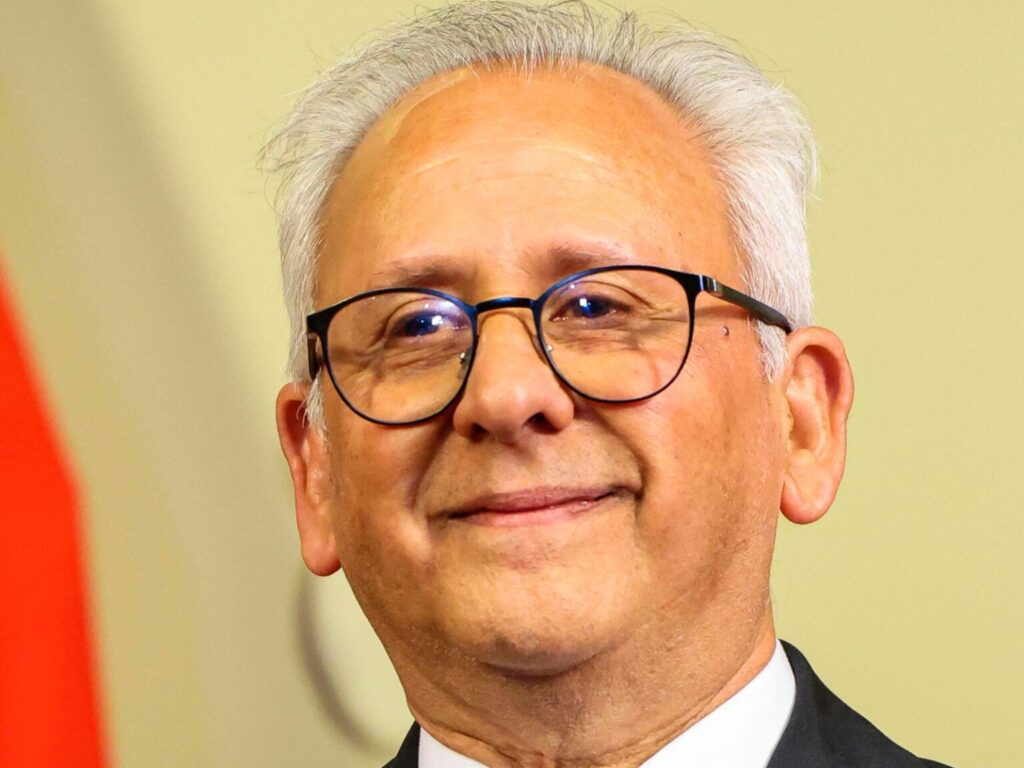
CAPTION: Acting Police Minister Cachalia
Cachalia’s response was to short-circuit the wait. On 29 October he announced his decision and sent a memorandum to Cabinet, saying he was not prepared to wait for the next Cabinet meeting, expected at the end of January. Critics noted that he announced the decision before Cabinet had concurred. Cachalia insists the statutory process was followed, and on Wednesday he told Parliament that Cabinet had concurred. In his words, the appointment is “an important step in fighting organised crime”.
Who Mkhwanazi is, and how the country came to know him
Mkhwanazi is a career policeman and former commander of the Special Task Force. He served as acting national police commissioner between 2011 and 2013, then held a string of senior management posts before returning to KwaZulu-Natal. He became the permanent provincial commissioner in December 2018 and, in March 2026, was reconfirmed in that post on a five-year contract.
For most of the public, though, he arrived on 6 July 2025. At a media briefing in Durban he alleged that criminal syndicates had infiltrated the police and the wider justice system, and that politicians had interfered in investigations. At the centre of his claims was the December 2024 disbandment, by then Police Minister Senzo Mchunu, of the KZN Political Killings Task Team. He said the unit was dissolved as it closed in on syndicates, and that 121 dockets were pulled from it, then returned after he went public. Ramaphosa placed Mchunu on special leave, Cachalia took over the ministry on an acting basis, and the Madlanga Commission was established.
Mkhwanazi was the commission’s first witness in September 2025. He testified that the task team had finalised hundreds of cases and that dissolving it by instruction was “irrational and irregular”. He also told the commission that someone had influenced the decision. Those claims remain contested: Mchunu and former deputy national commissioner Shadrack Sibiya have denied wrongdoing in other forums.
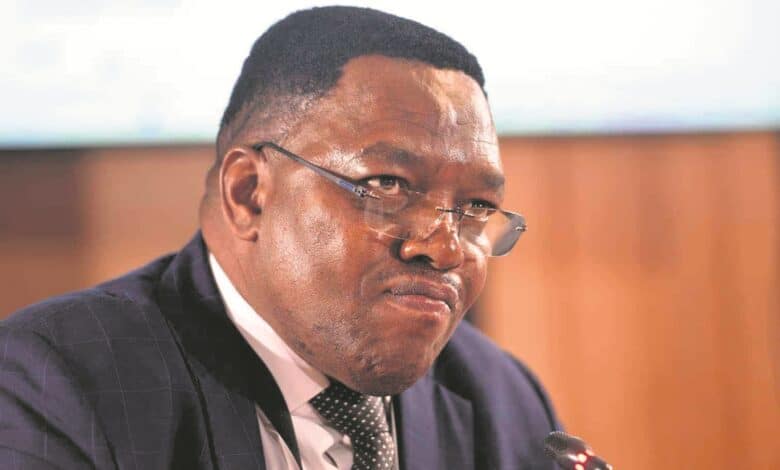
CAPTION: POLICE COMMISSINER FANNIE MASEMOLA
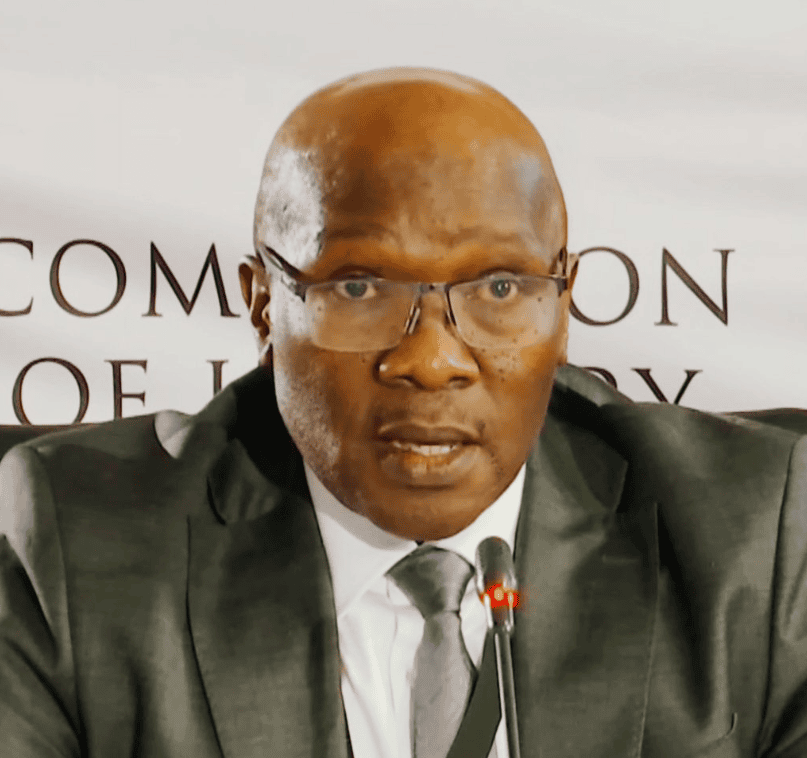
CAPTION: LT-GEN DUMISANI KHUMALO
The corroboration: Masemola and Khumalo
What turned a provincial commissioner’s allegations into the organising narrative of the inquiry was that the two most senior officers above and beside him backed the core of his account.
- Fannie Masemola testified on 22 September 2025 that Mchunu gave the task-team directive without consulting him, and described it as an encroachment on his own duties. He told the commission that phone records seized in the Vusimuzi “Cat” Matlala matter linked Matlala to both Mchunu and Sibiya.
- Dumisani Khumalo took the story from the task team into the underworld. He introduced evidence of a Gauteng-based network known as the “Big Five” cartel and testified about messages that, on his account, showed Mchunu associate Brown Mogotsi acting as a middleman between Matlala and police and political figures. Sibiya has questioned the authenticity of some of those messages.
The pattern matters for what follows. Three men, from three different rungs of the SAPS hierarchy, told a broadly consistent story under oath about how a minister’s office and a deputy commissioner allegedly worked to protect a criminal network. Whatever the commission ultimately finds, that consistency is the reason their names are now spoken together.
They were also targets
The trio’s bond is not only built on shared testimony. It is also built on shared adversity.
Khumalo and several senior Crime Intelligence officers were arrested in June 2025 over alleged fraud and corruption linked to a senior appointment in the division. Mkhwanazi told the commission that the charges were brought to remove Khumalo. In July 2026 the National Director of Public Prosecutions, Andy Mothibi, directed that the charges be withdrawn, and the withdrawal was recorded in court in August.
Masemola’s turn came in 2026. He appeared in court in April on four charges under the Public Finance Management Act, tied to a R360 million SAPS health-services tender awarded to Medicare24, and was placed on precautionary suspension. The NPA withdrew the charges after concluding there was no reasonable prospect of conviction, the court formalised this on 22 September, and Ramaphosa lifted the suspension. Masemola resumed duty on 19 October, saying he was “not out for revenge”.
Both men therefore return to their posts having been prosecuted, and then cleared, in matters that the commission’s evidence cast doubt on. Mkhwanazi’s own testimony had framed such prosecutions as part of the pushback against him and his allies. A reader can accept or reject that framing, but it explains why the three see the same adversaries.
The trio at the helm
Put the three posts side by side and the architecture is striking:
- Masemola runs the SAPS: the uniformed machine, detectives, resources and appointments.
- Khumalo runs Crime Intelligence: informants, surveillance and the pipeline of intelligence that feeds prosecutions. He reports to Masemola.
- Mkhwanazi will run the Hawks: the directorate that investigates organised crime, corruption and other priority offences. The post carries a fixed term and is filled by the minister with Cabinet’s concurrence, which gives it a measure of operational distance from the SAPS command line that Khumalo does not have.
In practice the Hawks cannot do much without intelligence, and intelligence is of little use without an investigative arm able to act on it. Here, both sit under people who have already worked together. Mkhwanazi’s witness statement describes “constant liaison” with Khumalo over the dockets, and Cachalia has pointed to a six-month-old arrangement in which Mkhwanazi chaired the priority and organised-crime committee within the national joint operational structure, reportedly coordinating Crime Intelligence, detectives and tactical units across provinces. His Hawks role formalises something already happening.
There is a sensible argument that this is exactly what South Africa has lacked: a police leadership that trusts one another, shares information and is not divided into factions. The commission’s evidence about dockets removed, task teams disbanded and tip-offs passed to suspects described the opposite. A cohesive trio could mean faster hand-offs, fewer leaks and a clear line from intelligence to arrest.
A note on the framing. The commission has not cast the three as a “good cop, bad cop” double act, and there has not been evidence supporting such a label. What the testimony painted is closer to a contrast between a leadership willing to name the problem and a compromised echelon alleged to have protected it. The “fearsome trio” is a fair description of their alignment, but the interpretation, that it is a force for good, depends on the commission’s findings, which are not yet final.
The case for caution
A close-knit leadership group cuts two ways, and several voices have said so.
- Independence. The Hawks were designed to be insulated from the line command of the police, a principle rooted in the Constitutional Court’s Glenister litigation. A Hawks head who is a close ally of the National Commissioner may be effective, but critics will ask whether the insulation is real in practice. The relationships that make the trio cohesive are the same ones that could blur the lines.
- Legal challenge. Forensic investigator Paul O’Sullivan has threatened urgent court action, arguing that Mkhwanazi is not a “fit and proper person” as section 17CA(1)(b) requires. These allegations have not been established as fact, and some analysts point to a bitter dispute between the two, including rival defamation claims. Supporters include ActionSA and Forum4SA. A Business Day editorial, meanwhile, said the appointment raised more questions than answers.
- Unresolved allegations. A former Ekurhuleni metro police officer, Marius van der Merwe, testified to the commission with allegations about Mkhwanazi’s alleged involvement in a 2022 matter. Mkhwanazi denied them. Van der Merwe was shot dead outside his home in December 2025, and an arrest was made in March 2026. Neither the allegations nor the denial has been resolved by findings.
- Process. The appointment bypassed an open recruitment process after two failed ones, and was announced before Cabinet’s concurrence. It is also being made by an acting minister, in a ministry that has had no permanent minister since July 2025.
- Track record. Commissions produce findings, not convictions. The test for this trio will be arrests, prosecutions and convictions of the people the commission has named, and the NPA, whose own cases against Khumalo and Masemola collapsed, is a necessary partner.
What happens next
- Formalisation. Cachalia must complete the appointment and report it to Parliament. The start date and handover from Nkosi have not been announced.
- A possible court fight. If O’Sullivan follows through, a review application could test whether Mkhwanazi is “fit and proper” and the process lawful.
- A vacancy in KwaZulu-Natal. It is unclear who will succeed him as provincial commissioner, in the province where the political-killings story began.
- The Madlanga Commission. It is still sitting. Khumalo returned on 25 November for in-camera testimony on Crime Intelligence’s rules and safeguards. The commission’s findings will decide whether the trio’s version stands.
- The first targets. Watch for early Hawks action on the “Big Five” network, the Matlala matters and the political-killings dockets. Those cases will show whether alignment at the top becomes results below.
The bottom line
South Africa now has, for the first time since July 2025, a police leadership whose senior members trust each other and have told a consistent story about what went wrong. That is an asset, and it is also a risk, because institutions that are meant to check one another work best when their heads are not too comfortable together. The next twelve months will show whether this trio turns testimony into prosecutions and reform, or whether the same closeness invites the questions its critics are already asking.
Sources and notes: reporting by EWN, eNCA, IOL, Mail & Guardian, Sunday World, Sowetan, Business Day, The Citizen, SAnews, Briefly News and Polity, plus the Madlanga Commission’s public witness profiles, drawn on 25 November 2026. Allegations described here are claims made in testimony or by third parties unless a court or the commission has found otherwise. This is analysis, not a prediction.


