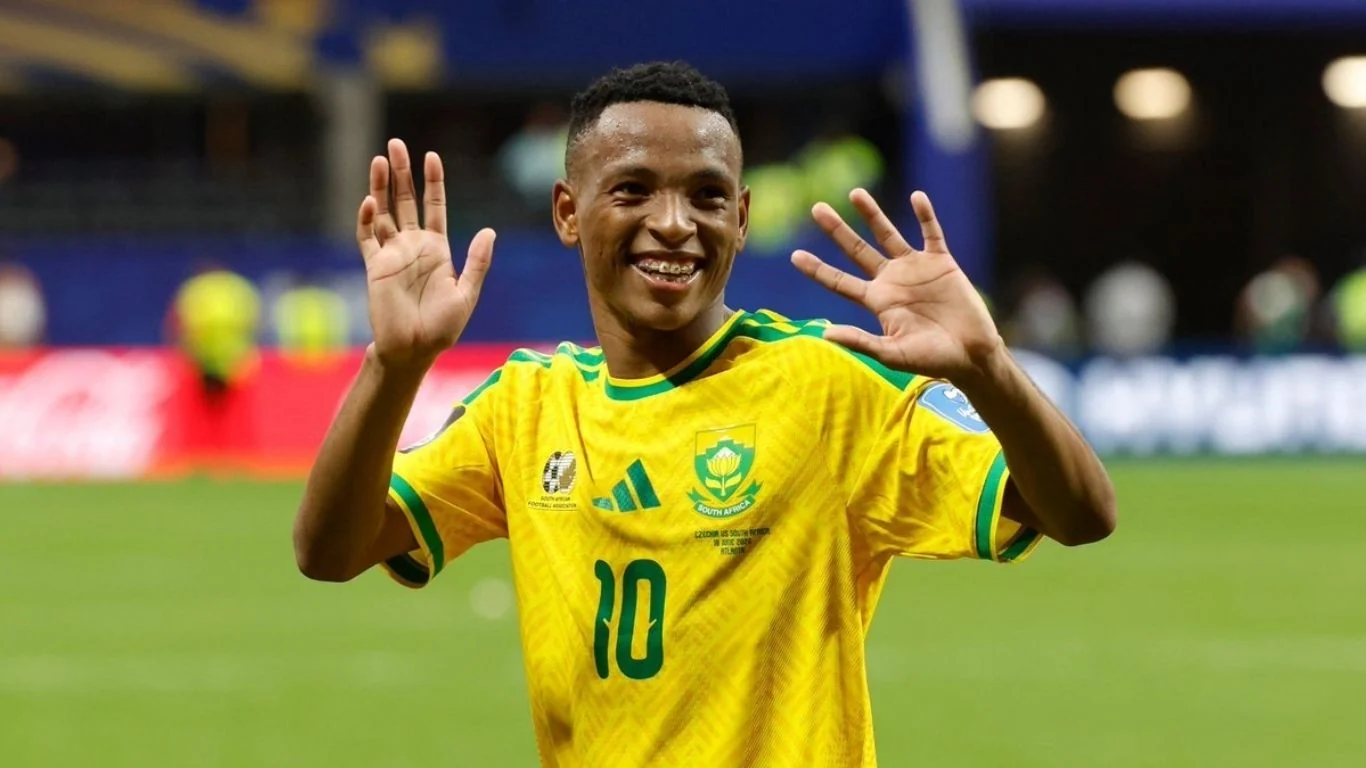

Mofokeng’s brace sends Bafana back to the top of Group D, Amaglug-glug survive a Madagascar scare to keep the Olympic dream alive, and Banyana are next in line on 28 November
PiE SPORTSDESK
Some Tuesday nights ask South African football for one result. This one asked for two, and got both. In Nairobi, Bafana Bafana beat Kenya 2-1 to climb back to the top of their 2027 Africa Cup of Nations qualifying group. Back home in Pretoria, the Under-23 side, Amaglug-glug, beat Madagascar 3-2 to move into the third and final round of qualifying for the U23 AFCON, the pathway to the 2028 Olympic Games in Los Angeles.
Relebohile Mofokeng was the name on everyone’s lips. The 21-year-old scored both goals in Nairobi and, once again, was the man Bafana turned to when the game needed rescuing. And with Banyana Banyana heading to Morocco for their own World Cup battle, November has turned into a month where all three of our football dimensions are on the line.
Bafana Bafana: Kenya 1-2 South Africa
| Match facts | |
| Competition | 2027 AFCON qualifiers, Group D |
| Venue | Nyayo National Stadium, Nairobi |
| Result | Kenya 1 (Ogam 88’), South Africa 2 (Mofokeng 68’, 86’) |
| Coach | Pitso Mosimane (South Africa), Benni McCarthy (Kenya) |
| Group D after the match | South Africa 10 pts, Guinea 9 pts (four games each) |
Bafana arrived in Nairobi with a point of damage to repair. Friday’s 2-2 draw in Soweto, where Kenya equalised in the final minute, had cost them the group lead, and Guinea took full advantage on Monday by beating Eritrea to move top. Dropping points again was not an option.
Mofokeng against the Kenyan goalkeeper. For long stretches, Nairobi was a one-on-one contest. Bafana made the chances and the Kenyan goalkeeper kept answering them. The first half ended goalless, with Mofokeng’s best opportunity, set up by Oswin Appollis, kept out by the keeper. It was the same story that had frustrated Bafana in Soweto four days earlier, where Kenya’s goalkeeper made a string of important saves to keep his side in the game. For 67 minutes, he was the reason Kenya were still level, and the reason this was a nervy night rather than a comfortable one.
Mosimane’s changes tilted it. Substitute Ndlovu created the breakthrough, and in the 68th minute Mofokeng finally beat the man who had been denying him, with Bafana pushing on from there. With four minutes left he struck again to make it 2-0, and this time there was no answer. Quality, in the end, was the difference between the two, and Mofokeng had more of it on the night.
Kenya, who are already through to the finals as co-hosts, did not go quietly. Ryan Ogam pulled one back in the 88th minute, the same player who equalised late in Soweto, and the closing minutes were tense. This time Bafana held on.
The big picture: Mofokeng now has the goals to match his reputation. He scored in the first meeting in Soweto too, and was the standout in a group where Bafana have beaten Guinea 2-1 at Orlando (26 September) and thrashed Eritrea 5-0 in Cairo (30 September).
The Group D permutations
Only one team from Group D will join Kenya at the finals, because Kenya qualify automatically as co-hosts. Eritrea are out of the running, so this is a two-horse race between Bafana and Guinea, and it will be settled in March 2027 with Bafana away to Guinea in Conakry, followed by the final game at home to Eritrea on 30 March.
Bafana in Conakry: three outcomes
| Result in Conakry | Bafana / Guinea | What happens next | Verdict |
| Bafana win | 13 pts / 9 pts | Guinea can reach 12 at most | Bafana qualify, even before the Eritrea game |
| Draw | 11 pts / 10 pts | Bafana must beat Eritrea to reach 14; Guinea max is 13 | Bafana in control, but need a win at home |
| Bafana lose | 10 pts / 12 pts | Guinea beat Eritrea and reach 15; Bafana can only reach 13 | Guinea top; Bafana need Guinea to slip against Eritrea |
Win: Three points in Conakry would lift Bafana to 13, a total Guinea cannot reach even if they beat Eritrea (their ceiling would be 12). Reports have described this as likely to secure qualification, but on the numbers it would settle the group outright.
Draw: A point takes Bafana to 11 and Guinea to 10. A home win over Eritrea, ranked 184th in the world, would take Bafana to 14, beyond Guinea’s maximum of 13. A draw against Eritrea would leave Bafana on 12, and a Guinea win over the same opponents would put Guinea on top.
Loss: This is the one Bafana cannot afford. Guinea would move to 12 and Bafana would stay on 10. A Guinea win over Eritrea would then take them to 15, out of Bafana’s reach, even with a win at home taking Bafana to 13. Bafana would need Guinea to drop points to Eritrea and would have to win their own game. A draw for Guinea would leave the teams level on points and bring tie-breakers into play.
Why Conakry decides it: Both teams have beaten Eritrea or are expected to, so the head-to-head is effectively the whole group. Bafana, ranked 49th in the world to Guinea’s 80th, hold the advantage of having already won the first meeting 2-1 in Orlando, but the March trip is where the group will be won or lost.
Amaglug-glug: South Africa U23 3-2 Madagascar
| Match facts | |
| Competition | 2027 U23 AFCON qualifiers, second round, second leg (also the 2028 Olympic route) |
| Venue | Lucas Moripe Stadium, Atteridgeville, Pretoria |
| Result | South Africa U23 3-2 Madagascar U23 |
| Aggregate | South Africa win 4-2 (first leg 1-0, Plaatjies 73’, on Saturday) |
| Coach | Raymond Mdaka |
Coach Raymond Mdaka had promised an attacking approach and not one built on protecting Saturday’s 1-0 lead from the first leg. The aim, he said, was to win again, not to hold on. The match delivered the drama that comes with that approach. Madagascar, who play their home legs in South Africa because they lack a CAF- and FIFA-approved venue at home, came out fighting in the second half and cut the lead when Raveloarison Brayans pounced on a rebound against goalkeeper Fletcher Smythe-Lowe.
Substitute Mpho Padime then restored the two-goal cushion in the 68th minute with a powerful strike into the top corner after cutting in from the left. Madagascar pulled another goal back late, which set up a tense finish, but the young Bafana held out and booked their place in the third round.
What the U23 win means in real terms
Progress to the third round is a big step, and also a step with a hard edge. Fourteen nations advance from the second round into seven two-legged ties in the final qualifying round, and the winners of those ties join hosts Egypt at the U23 AFCON finals in 2027. The third-round first legs are scheduled for 22 March, with the return legs on 30 March.
- The opponent: Amaglug-glug will face Cameroon. Cameroon took a 3-0 lead from the first leg in Kigali (Patrick Edzimbi scored twice), and the return leg in Yaoundé was also played on Tuesday evening and the result a goalless draw, so Cameroon advances with a 3-0 aggregate.
- The stakes: Beating Cameroon over two legs would take South Africa to the U23 AFCON finals in Egypt, which also serves as the qualifying route for the 2028 Los Angeles Olympics. It is worth confirming the exact number of African Olympic berths with CAF, but the principle is clear: the finals are the gateway to the Games.
- The context: South Africa missed both the 2023 U23 AFCON and the Paris 2024 Olympics, so a place at the finals would end a lean spell. A third-place finish at the 2015 and 2019 editions is the recent benchmark.
- The warning sign: Two goals conceded at home against a side few South Africans knew much about is the kind of detail Cameroon will study. Mdaka himself said after the first leg that the team needed to finish its chances.
One scheduling note worth flagging: the third-round return legs on 30 March fall on the same day as Bafana’s home game against Eritrea, so 30 March 2027 could turn into a very big night for South African football.
November isn’t finished: Banyana Banyana
The men have had their night, but the women’s side are close behind. Banyana Banyana missed out on automatic qualification for the 2027 Women’s World Cup in Brazil at this year’s WAFCON, and now have to take the longer route through an inter-continental play-off mini-tournament in Rabat, Morocco, from 28 November to 5 December.
| Date | Opponent | Kick-off (SA time) | Note |
| Sat 28 November | Chinese Taipei | 16:00 | Opener; ranked 38th |
| Tue 1 December | Ecuador | 21:00 | Ranked 60th |
| Sat 5 December | Uzbekistan | 19:00 | Ranked 51st |
- What they need: Banyana must finish in the top two of their group of four to move on to the final qualifying phase in February 2027. The three winners of that final phase will book their tickets to Brazil.
- The squad: Coach Desiree Ellis named 23 players, with Denmark-based midfielder Sibulele Holweni earning her first call-up since moving to Europe, and Wendy Shongwe, a veteran of the World Cup in Australia, recalled.
- The setback: Captain Refiloe Jane misses the opener against Chinese Taipei, serving a one-match suspension for two yellow cards in the WAFCON play-off against Nigeria.
- The challenge: Three matches in eight days, with no margin for error. Ellis has also spoken about the difficulty of FIFA’s 23-player cap and of players whose passports were not valid.
Three fronts, one November
| Team | Competition | Where they stand | Next date |
| Bafana Bafana | AFCON 2027 qualifiers | Top of Group D, 10 pts (one clear of Guinea) | March 2027: Guinea away; 30 March: Eritrea home |
| Amaglug-glug (U23) | U23 AFCON / Olympic route | Through to third round (4-2 on aggregate) | 22 and 30 March 2027 vs Cameroon or Rwanda |
| Banyana Banyana | World Cup play-offs | Opening the Rabat mini-tournament | 28 Nov: Chinese Taipei |
Tuesday belonged to Mofokeng, to Mdaka’s young side and to a country that does not always get its football nights to line up this neatly. Banyana now have the stage for the next chapter, and Bafana have the chance to finish the job in Conakry.