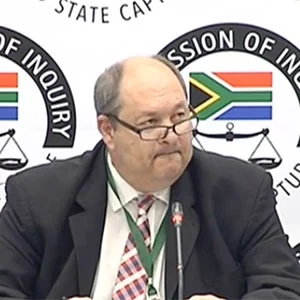

A retired Hawks colonel has told the Madlanga Commission of Inquiry that Andrea Johnson, now head of South Africa’s Investigating Directorate Against Corruption (IDAC), improperly funnelled confidential police docket material to a suspect she was supposed to have no involvement with — a claim that has now triggered a formal prosecutorial review into whether Johnson herself should face charges.
Testifying on Friday at the Brigitte Mabandla Justice College, Colonel Kobus Roelofse, formerly of the Directorate for Priority Crime Investigation, laid out a detailed account of how an eight-year-old assault complaint against senior Crime Intelligence officer Major General Feroz Khan came to be compromised — allegedly with Johnson’s help, at a time when she was a senior NPA prosecutor rather than the anti-corruption chief she is today.
The story begins with an internal Crime Intelligence dispute. In June 2018, Brigadier Leonora Phetlhe accused Khan of assaulting her with a pen and opened a criminal complaint for common assault and intimidation. The two worked in the same office.
According to Roelofse, within days of the complaint being filed, a colonel who also shared office space with Khan was contacted by phone — a call facilitated by Khan himself — and asked for her private email address. Shortly after, an email arrived containing sensitive material from the docket: Phetlhe’s statement, a J88 medical report documenting her injuries, and an audio recording connected to the incident. The sender, Roelofse told the commission, was Andrea Johnson.
The colonel was allegedly instructed to delete the email once she’d passed its contents on to Khan. She didn’t. Instead, she printed the material, handed Khan a hard copy in an envelope, and kept the original — a decision that would later become the paper trail underpinning Roelofse’s entire account.
The significance, Roelofse argued, lies in timing and entitlement. Khan had not yet been formally charged when he received the material, meaning that as a suspect — not yet an accused — he had no legal right to see the contents of an active investigation against him.
He received the documents just one day before Hawks investigators were due to take his formal warning statement. When he arrived, Roelofse said, he came prepared — with a version of events that appeared to have been shaped by the very evidence meant to test it. In the colonel’s words to the commission, this gave Khan the chance to align his account with what investigators already had, and potentially to approach witnesses before ever giving his official version.
Roelofse was also asked about how the leaked material had first surfaced publicly. He told the commission the documents had reached former journalist and now AfriForum spokesperson Barry Bateman via WhatsApp, passed on by a source. He rejected any suggestion that this made the material fair game for further circulation, arguing that a document reaching one person through an unofficial channel doesn’t make it part of the public record — that only happens once documents are formally placed before a court.
One detail Roelofse returned to repeatedly: the channel Johnson allegedly used to send the docket contents wasn’t her official NPA email account, but what he described as an “off-the-grid” Gmail address. His reasoning was pointed — had the exchange been legitimate, he argued, there would have been no need to avoid the official channel, since Johnson was in fact entitled to request such documents through proper means in her prosecutorial role. The choice to go around that process, in his view, suggested she knew the exchange itself was improper.
Roelofse also gave the commission an account of his own position once these allegations began circulating. He said that on 7 September 2022, Johnson — by then head of IDAC — summoned him to her office and told him she had been contacted by then-National Director of Public Prosecutions Shamila Batohi about an affidavit containing allegations against her.
He described this as troubling on its own terms. Prematurely disclosing the identity of a witness in an active investigation, he told the commission, can endanger both the inquiry and the witness personally — a risk he said was heightened here because the complainant and the suspect worked in the same office. When he raised the matter with Johnson directly, she denied any wrongdoing. Roelofse said he could only speculate as to how she had come to see the affidavit against her in the first place.
He added that he ultimately felt unable to approach Johnson about the matter through normal channels, given that she was by then the very allegations’ subject and occupied a position of authority over anti-corruption investigations. Instead, he escalated his concerns to then-Hawks head Lieutenant General Godfrey Lebeya, and told the commission that, given the sensitivity involved, the NPA would need to appoint an independent senior prosecutor to handle the matter.
Commission chairperson Mbuyiseli Madlanga described the conduct outlined in the testimony as “impropriety.”
The most consequential fallout from Friday’s testimony isn’t the testimony itself — it’s what has followed from it. According to News24, a prosecutor has now been formally assigned to determine whether Johnson should face criminal charges over the forwarding of the assault docket to Khan. That marks a shift from commission scrutiny to an active prosecutorial decision with real legal consequences, potentially including defeating the ends of justice or unlawful disclosure of docket information — the same territory Roelofse’s testimony was aimed squarely at.
Earlier witnesses before the commission went further still, alleging that Johnson didn’t just mishandle one docket but actively shielded Khan from prosecution over the years that followed, and that a quid pro quo arrangement existed between them — pointing to the fact that Johnson’s son was later hired into Khan’s office as evidence of an improper relationship.
Feroz Khan has been one of the Madlanga Commission’s most persistent subjects. Beyond the assault case, he has been implicated in an alleged staged drug bust involving 751kg of cocaine in Aeroton, and in a R33 million luxury London trip taken by former Ekurhuleni city manager Imogen Mashazi. He was also named alongside businessman Muhammad Sayed and EFF leader Julius Malema in evidence suggesting a plot to remove a former police inspector-general. Khan is currently unconscious in hospital following what has been described as an apparent assassination attempt, and his legal team has been appearing on his behalf at the commission.
Friday’s testimony lands at a moment when Johnson’s position is already unusually exposed. Over the past several weeks, she has been locked in an increasingly public feud with senior SAPS figures, most notably KwaZulu-Natal police commissioner Lieutenant General Nhlanhla Mkhwanazi, who has warned that police were “facing a war” with “many players in this game” — remarks Johnson publicly characterised as a serious threat against her and her staff.
That standoff has centred on IDAC’s pursuit of senior Crime Intelligence officers, including arrest warrants issued for Lieutenant General Dumisani Khumalo and Major General Nosipho Madondo — warrants that were ultimately not executed and have since been placed under independent review by National Director of Public Prosecutions Andy Mothibi, after Khumalo’s legal team argued the case against him lacked merit and accused IDAC of using arrest threats to derail legitimate SAPS work. Mothibi has said the dispute between the two agencies is damaging public confidence in law enforcement and that he intends to work with the acting police minister to resolve it.
Justice Minister Mmamoloko Kubayi has separately said the infighting is “undesirable” for the justice system, pointing to the newly launched IDAC ombudsman’s office — headed by retired judge Takalani Raulinga — as a necessary check on the directorate going forward.
No figure has yet been reported publicly and explicitly calling for Johnson’s arrest by name in connection with the docket allegations, but the ground for that possibility has clearly shifted. With a prosecutor now specifically tasked with deciding whether she should be charged, this is no longer confined to commission testimony and political sparring — it is now a live prosecutorial question with a formal decision-maker attached to it.
It’s worth stressing that everything outlined above remains allegation. Johnson denied wrongdoing when confronted in 2022 and has not been charged. The Madlanga Commission’s eventual findings, together with whatever the newly assigned prosecutor decides, will determine whether this moves from testimony and controversy into an actual criminal case.