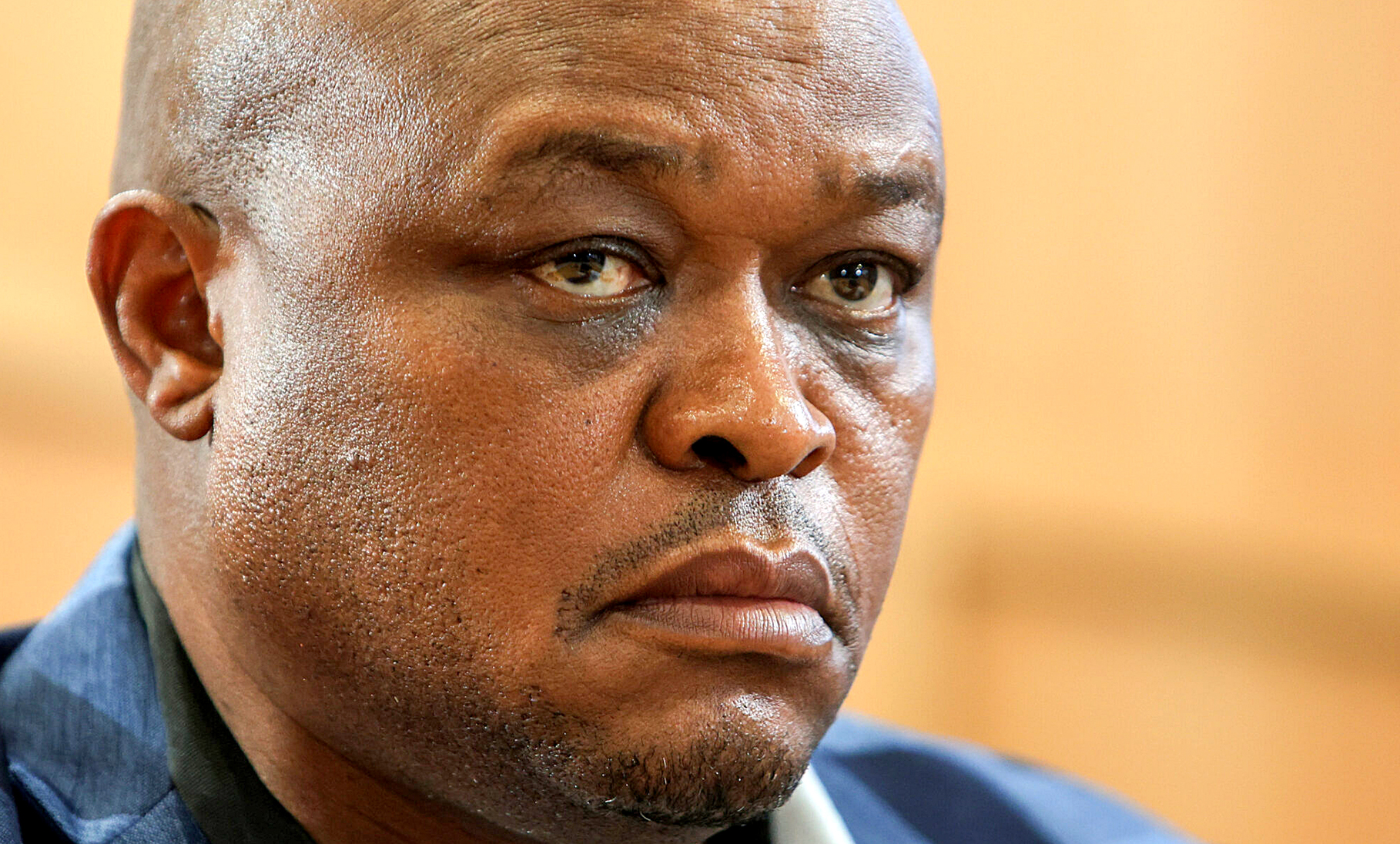

PHOTO: BROWN MOGOTSI
Four bail applications, five addresses, one very patient magistrate — and a man the state says shot up his own car. A tongue-in-cheek look at South Africa’s most geographically confused political fixer.
LEN KALANE
On Tuesday, in a Johannesburg courtroom that must by now have his loyalty card, Brown Mogotsi — alleged political fixer, self-described government agent, and a man whose relationship with residential geography can only be described as experimental — was denied bail for the fourth time. Magistrate Annelise Tlhapi delivered the verdict with the weary precision of someone who has heard this particular argument before, because she has: three times before, to be exact.
The sticking point, as it has been since his very first appearance, was an address. Or rather, the absence of one that actually exists in the way addresses are generally expected to — attached to a building, verifiable by a landlord, and not conjured fresh for each new hearing. Tlhapi noted that Mogotsi had failed from the beginning to be a trustworthy applicant who can provide a reliable and provable residential address, which is either a devastating legal finding or the world’s politest way of saying “sir, where do you actually live?”
A Man of Many Postcodes
By the court’s count, Mogotsi has now offered up five different addresses across his four bail bids — a strike rate that would be impressive in a real-estate portfolio and is somewhat less impressive in a bail application, where the general idea is to name one home and stick to it. His legal team’s latest pitch — a Johannesburg rental undisclosed until now, plus a freshly surfaced Mmabatho address — was waved away by Tlhapi as nothing new, just old shortcomings in a new outfit. She was unmoved by the detail that Mogotsi’s wife had reportedly moved into the Mmabatho property while he sat in custody, finding, not unreasonably, that a man in a jail cell has a fairly weak claim to a house he isn’t in.
It is, by any measure, an unusual defence strategy: rather than one alibi, offer a rotating exhibit of them, like a geography quiz nobody asked to sit.
The Small Matter of the Assassination
None of this address business would matter half as much if Mogotsi weren’t also the man at the centre of an alleged staged assassination attempt on himself — the incident that landed him in the dock in the first place. The State’s version, still to be tested at trial, is that he fired shots at his own vehicle in Vosloorus and then reported it as an ambush by unknown gunmen. Investigators say the ballistics and CCTV evidence don’t line up with his account, and prosecutors have previously called their case against him “overwhelming.” Mogotsi denies all of it and is, of course, entitled to the presumption of innocence and his day in court, whenever that day finally arrives amid the recurring interruption of bail hearings about houses that may or may not exist.
There is a certain dark comedy in a man accused of faking an attempt on his own life being unable to convince a magistrate of something as basic as where he sleeps at night. If Mogotsi truly is the operator some allege him to be, one might expect sharper tradecraft than five addresses and a wife inconveniently photographed moving into one of them.
Enter the Madlanga Commission
Long before the courtroom became Mogotsi’s second home — geographically speaking, the only one he can currently prove — he was already something of a public spectacle. His testimony before the Madlanga Commission, which is probing allegations of criminality and political interference in the justice system, cast him as a self-styled operative whose account of his own importance did not entirely survive scrutiny. The commission has since recommended he face separate criminal investigation over matters unrelated to the bail saga — a reminder that Mogotsi’s legal troubles now run on at least two parallel tracks, neither of which is going his way.
Cannot Be Trusted
Tlhapi’s phrase from Tuesday’s ruling — that the applicant simply “cannot be trusted” — will likely follow Mogotsi longer than any of his five addresses did. The magistrate also gave short shrift to claims that the investigating officer had it in for him, and to reports that he’d been eyeing an escape via correctional-services disguise, which is the sort of detail that sounds like it belongs in a heist film rather than a bail record.
Mogotsi’s lawyers have signalled they’ll appeal, arguing the court has leaned too hard on the address question at the expense of the merits. Whether a higher court agrees remains to be seen. What isn’t in dispute is that Mogotsi will remain in custody until his criminal trial, expected to begin in October — presumably at an address the court can actually find.
Brown Mogotsi has not been convicted of any offence and denies the allegations against him; the matters described are before the courts and the outcome of his trial is yet to be determined.