
T4SD: a matchmaker for municipalities looking to modernise
With South African municipalities thirsting for modern technologies to improve service delivery, CSIR researchers are calling on inventors and technology companies to list unconventional or alternative solutions on a new matchmaking platform.
CSIR senior researcher Sizo Sebake says the Technology for Service Delivery (T4SD) platform was built to link municipalities with novel technologies for water, sanitation, energy, construction, waste, connectivity and other services.
The platform already features technologies like porous paving that allows for better drainage during storms, as well as toilets that are water-saving or off-grid. “There are many other innovative solutions out there, so we are calling on technology owners and inventors to register as users at t4sd.dsti.gov.za. This will enable you to upload information about your solution,” says Sebake.
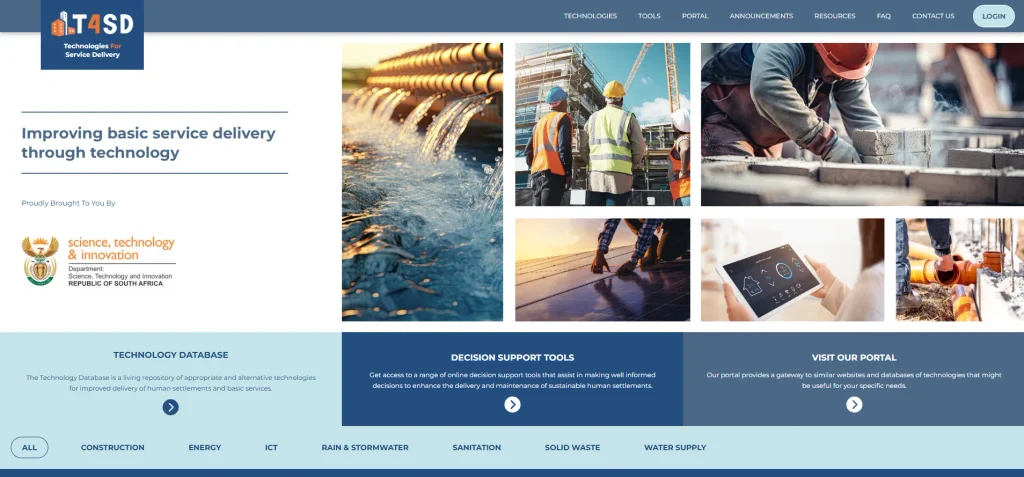
A screenshot of the Technology for Service Delivery portal at t4sd.dsti.gov.za. The platform, which is managed by the CSIR on behalf of the DSTI, was built to link municipalities with novel technologies for water, sanitation, energy, construction, waste, connectivity and other services.
The CSIR manages the T4SD platform on behalf of the Department of Science, Technology and Innovation (DSTI). “Our role as the CSIR was to interpret the vision of DSTI, which was to curate technologies for ease of access for the municipalities who are at the coalface of service delivery,” says Sebake.
Mark Napier, a CSIR expert in urban infrastructure and human settlements, says the platform was borne out of two distinct needs. On one hand, the DSTI is often approached by people with promising ideas, products or early-stage technologies to solve service delivery challenges, but there has not always been a clear public place where these innovators can present what they have developed.
On the other hand, municipalities seeking to take more innovative approaches to water, sanitation, energy, human settlements or connectivity are not always sure where to look for solutions across these different built environment sectors.
“We use the word ‘matchmaking’,” Napier says, referring to how the emerging T4SD platform acts as a kind of “dating app” to link technology developers to municipalities looking for specific solutions.
While the platform lists technologies for construction, ICT, waste management, energy supply and others, Napier says municipalities currently appear keen to “swipe right” on water-related technologies.
“Something we’re picking up on in our interactions with the DSTI and the South African Local Government Association (SALGA) is that there is quite a lot of emphasis on water purification, water treatment and alternative sanitation systems,” he says. “We do know that there’s a big appetite by municipalities to find even international technologies that can make a difference at a city level or even a precinct level.”
One technology already on the platform is a rainwater harvesting tank that relies on water pressure instead of electricity to supply toilets or garden hoses. Others include eco-friendly insulated wall panels and a toilet that uses less than two litres of water per flush thanks to its Arum Lily-inspired vortex design.
For technology developers behind such products, the platform offers a free and practical route into the service-delivery innovation pipeline, even if the product is not quite ready for market.
Sebake oversees the platform’s moderation process using her expertise in the built environment. She ensures that submissions are contextually relevant, appropriately described, and routed to the right place, whether that is a public listing on the T4SD site or further engagement through DSTI-linked support channels to develop a technology further.
The platform also works with national registration bodies in the built environment sector to ensure that municipalities can trust listed technologies.
“We’re not in a position to certify or endorse technologies ourselves. Rather, by curating such certified and endorsed technologies, we support organisations that do the certification or the endorsing by showcasing technologies so that we can collectively amplify their reach and impact,” explains Sebake. “In the case of Agrément South Africa and the National Home Builders Registration Council, we have begun the process of engaging these organisations so that through them, we can begin the process of building trust with the technology owners themselves.”
She adds that the platform also features tools and resources to help city officials make better decisions, including the CSIR’s Red Book (also known as The Neighbourhood Planning and Design Guide).
Napier says that the Red Book was in fact used as a blueprint for structuring the T4SD platform.
“If you’re building a settlement, the Red Book gives you the key elements,” he says. “You can go to the relevant chapter to understand what the approach, the design or the regulations are, and then you can come to the T4SD site to access the technologies, the decision support tools or the support organisations that you could use.”
Napier and Sebake say the CSIR team is now focused on growing the number and depth of technologies on the platform, together with the DSTI.
“The DSTI is especially keen to hear from technology owners who may not yet be connected to established certification, regulatory or innovation-support bodies,” says Sebake.
“If you’ve got an alternative or unconventional technology that can help improve service delivery in the built environment, please visit our website or email us with any questions on how to register or upload your technology. We look forward to including your technology in the broader service-delivery innovation pipeline.”
Visit https://www.csir.co.za/what-we-do/built-environment, https://t4sd.dsti.gov.za/ or email enquiries@csir.co.za for more information.