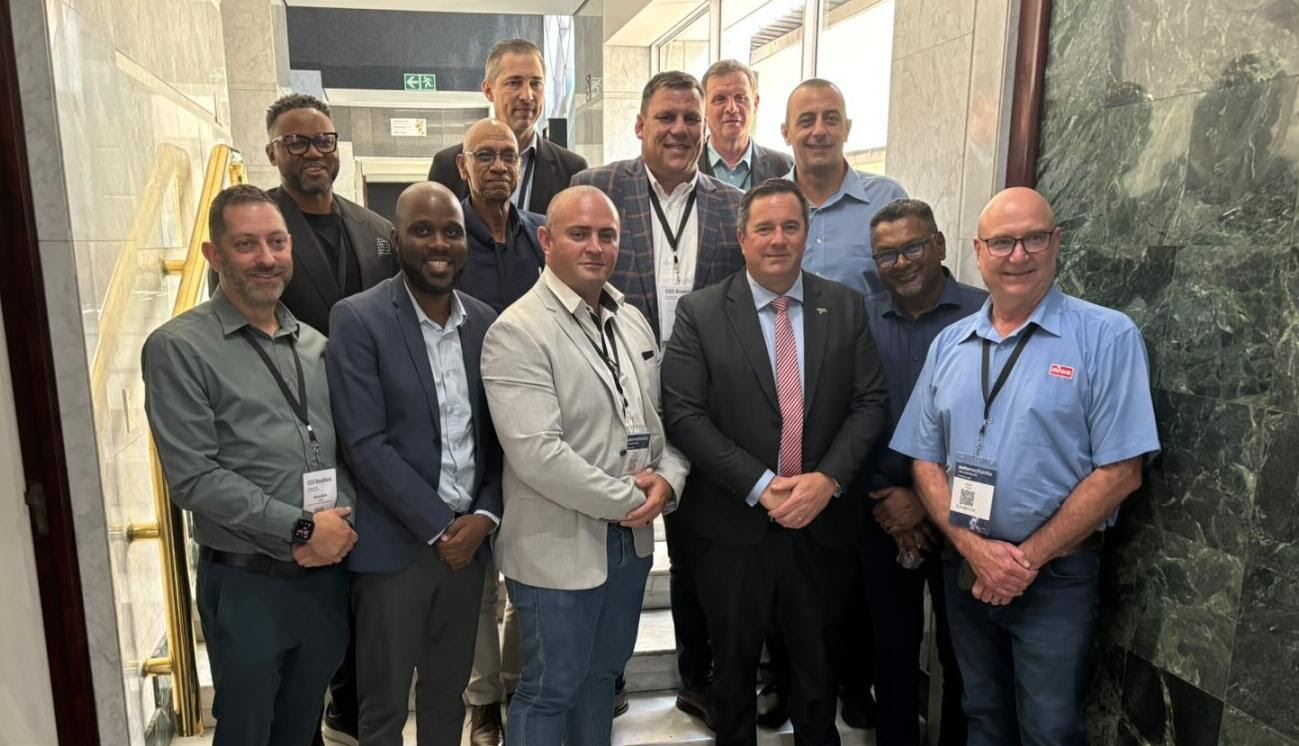

CAPTION: DEPUTY MINISTER JOHN STEENHUISEN WITH A GROUP OF OFFICIALS AT THE AUTOMECHINIKA JOHANNESBURG
The Retail Motor Industry Organisation (RMI) has welcomed the recognition of South Africa’s automotive aftermarket as a significant contributor to the economy, following the opening address by Deputy Minister of Trade Industry and Competition, John Steenhuisen, at the CEO Breakfast at Automechanika Johannesburg 2026 at Gallagher Convention Centre.
Addressing industry leaders, exhibitors and business representatives, Steenhuisen highlighted the aftermarket’s substantial economic contribution, noting that the retail and aftermarket economy traded approximately R933 billion in 2025, contributed R202.6 billion to GDP and supported more than 310,000 jobs – around 70% of total automotive employment. The sector encompasses more than 23,000 businesses, the overwhelming majority of which are small and medium-sized enterprises. He also highlighted its potential to drive localisation, job creation, exports and technical skills development.
These figures underscore the aftermarket’s central role in South Africa’s economic resilience, industrial capability and mobility, with opportunities to build on this contribution through greater localisation and regional trade.
Steenhuisen’s address reinforced the importance of looking beyond new vehicle manufacturing to recognise the extensive network of businesses that keep South Africa’s approximately 13 million vehicles safe, roadworthy and operational throughout their lifecycles.
“If manufacturing is the birth of the vehicle, the aftermarket is the life of the vehicle,” Steenhuisen said, underscoring the essential role played by businesses that service, repair, test, maintain and supply parts for the country’s vehicle fleet.
Henk Ferreira, Chief Operating Officer (COO) of the RMI, welcomed the recognition of the sector’s contribution to South Africa’s broader automotive value chain.
“The aftermarket supports hundreds of thousands of jobs and thousands of businesses, many of them small and medium-sized enterprises. It provides essential services to motorists and businesses while sustaining technical expertise and economic activity across the country.
“We welcome the Deputy Minister’s recognition that the automotive industry’s potential extends well beyond the production line. South Africa’s existing vehicle fleet represents significant ongoing demand for replacement parts, maintenance and repair services, creating opportunities to retain more value locally and strengthen the broader automotive value chain.”
Localisation beyond the factory gate
A key theme of Steenhuisen’s address was the opportunity to expand local production of replacement parts and reduce reliance on imports. He noted that South Africa imported approximately R107.5 billion worth of replacement parts in 2025, while around 76% of vehicles on the country’s roads are outside their warranty period.
“In practical terms, this means the majority of vehicle maintenance and repair activity has already shifted beyond the original manufacturer ecosystem and into the broader aftermarket,” he said.
“The opportunity, therefore, is not limited to the roughly 600,000 vehicles produced annually. The opportunity lies in the 13 million vehicles already on our roads.”
The Deputy Minister said the review of the Automotive Production and Development Programme (APDP2) should consider the broader automotive ecosystem, including the businesses that maintain and repair vehicles throughout their useful lives.
“Localisation must extend beyond the factory gate to include the businesses that keep South Africans moving every day,” he said.
Expanding opportunities beyond our borders
Steenhuisen identified the African Continental Free Trade Area (AfCFTA) as another significant opportunity for industrial growth, pointing to growing demand across Southern Africa for affordable replacement parts, remanufactured components, technical expertise and aftermarket services.
South Africa, he said, was well positioned to build on its established engineering capability, distribution networks and technical expertise to expand its role in regional automotive value chains.
“The export opportunity is therefore no longer confined to complete vehicles and original equipment components. It also includes replacement parts, remanufactured products, vehicle maintenance expertise and specialised services,” he said.
“By strengthening our aftermarket capabilities and supporting localisation, we can position South Africa not only as a manufacturing hub, but also as the leading automotive services and aftermarket hub for the African continent.”
Skills development critical to future competitiveness
The Deputy Minister emphasised that the transition towards electric and hybrid vehicles, advanced driver-assistance systems and increasingly sophisticated diagnostic technologies requires sustained investment in people and technical capability.
While apprenticeship numbers have increased, he noted that South Africa has approximately 31% fewer qualified automotive artisans than in 2009.
“The goal is not simply training more people. It is building deeper technical capability,” he said.
Ferreira agreed that developing future-ready skills was essential to the industry’s ability to adapt.
“Technology is changing the way vehicles are serviced, diagnosed and repaired. Our skills pipeline must keep pace, ensuring that technicians and artisans have the competencies required to work safely and effectively on increasingly complex vehicles.”
He said the RMI welcomed continued collaboration between industry, government, merSETA, TVET colleges and training providers to strengthen apprenticeship pathways, workplace learning and specialised technical training. This would help give young people access to meaningful careers while building the capability the industry needs.
Road safety and sustainability
Steenhuisen also highlighted the aftermarket’s contribution to road safety, pointing to the importance of vehicle maintenance, quality repairs, roadworthiness testing and appropriate standards in reducing risks on South Africa’s roads.
“Proper maintenance is not only good business. It is a public good,” he said, noting that policy, enforcement, maintenance standards, testing and industry collaboration could make a measurable difference.
He also recognised the role of vehicle repair and remanufacturing in supporting a circular economy. Extending the useful life of vehicles preserves value, reduces waste and avoids unnecessary replacement costs, while effective end-of-life vehicle management will become increasingly important as international environmental expectations evolve.
Turning opportunity into action
Concluding his address, Steenhuisen called for a stronger focus on implementation, highlighting the aftermarket’s potential to advance localisation, support small businesses, create jobs, improve road safety, develop scarce skills and expand regional trade.
“What makes me optimistic is that the automotive aftermarket does not require us to start from scratch,” he said. “The businesses already exist. The skills pipeline already exists. The customer base already exists. The demand already exists. The infrastructure is already here.”
Ferreira welcomed the emphasis on practical implementation and sustained collaboration between government and industry.
“The opportunity is to build on the capabilities already within our sector, creating the conditions for businesses to grow, innovate and compete while delivering benefits for motorists, workers and the wider economy,” he said.
In closing, Steenhuisen thanked the RMI, Messe Frankfurt, industry associations, exhibitors and businesses for their contribution to the economy.
“You are not simply servicing vehicles. You are supporting mobility. You are supporting trade. You are supporting livelihoods. And you are helping build a more competitive and resilient South African economy.
“Let us continue working together to ensure that the automotive industry does not only manufacture vehicles for Africa, but services, maintains, innovates and creates value for Africa throughout the entire life of those vehicles,” Steenhuisen concluded.