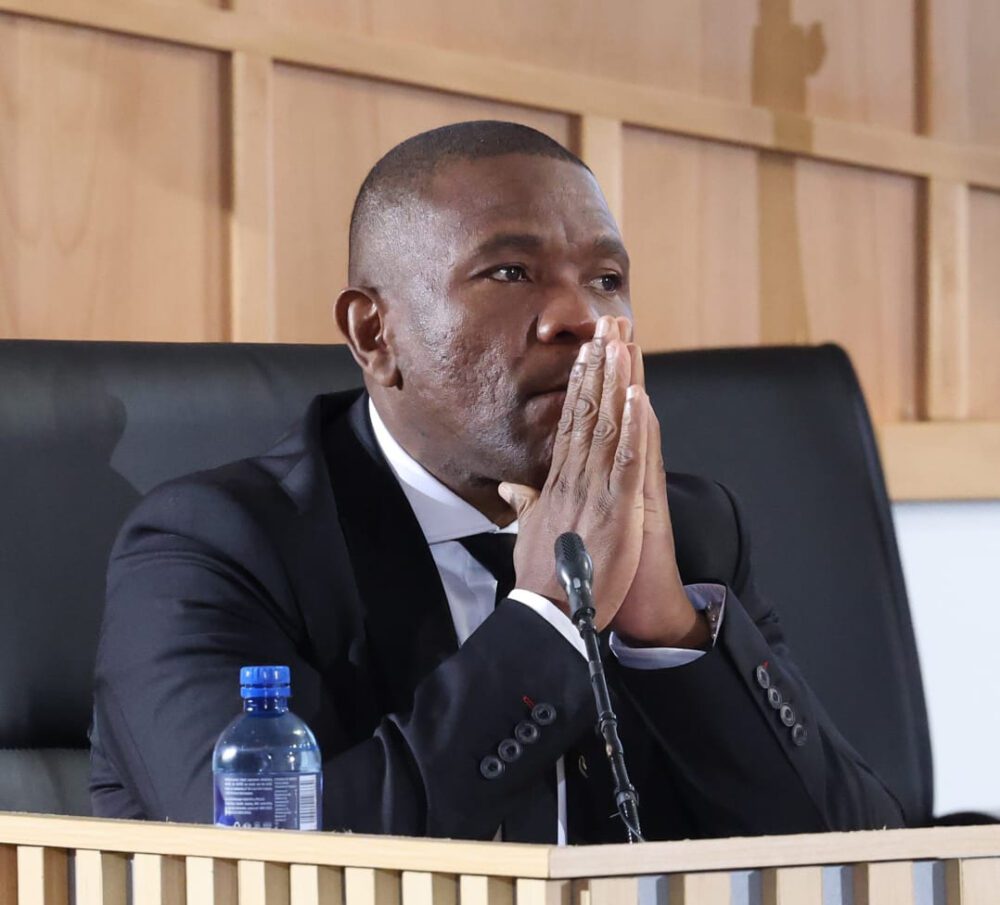

CAPTION: Lt-Gen Nhlanhla Mkhwanazi
Cachalia’s recommendation of Nhlanhla Mkhwanazi is the headline. The harder questions are what still has to happen, and whether the appointment can deliver the confidence it promises.
LEN KALANE
Acting Police Minister Firoz Cachalia has recommended KwaZulu-Natal Police Commissioner Lieutenant-General Nhlanhla Mkhwanazi as the new national head of the Hawks, formally the Directorate for Priority Crime Investigation (DPCI). On the surface it is a straightforward story: the man whose July 2025 press briefing set the Madlanga Commission in motion is being lined up to lead the country’s main organised crime and corruption investigator. Look past the headline, though, and there are three things worth weighing: the process that still has to be completed, what Mkhwanazi is already doing, and what the appointment could and could not change.
What has actually happened, and what has not
It is a recommendation, not an appointment. The Police Ministry says Cachalia has submitted a Cabinet memorandum seeking Cabinet’s concurrence, to be tabled at the earliest opportunity during a Cabinet sitting. Under section 17CA(1)–(3) of the SAPS Act, the Minister of Police appoints the Hawks head with Cabinet’s concurrence, and the appointment must then be reported to Parliament.
In practice the steps are:
- Cabinet considers the memorandum and gives (or withholds) its concurrence.
- The Minister makes the appointment.
- The appointment is reported to Parliament, which is a reporting duty rather than an approval vote, so the Portfolio Committee on Police can scrutinise it but does not hold a veto.
Cachalia told the Daily Maverick on 28 October that the Hawks would have a new head “in days”, which suggests the Cabinet step is expected to move quickly. Two things are not clear from the public statements: when Cabinet will sit on it, and what Mkhwanazi’s start date and handover would look like, given he is still KZN commissioner. The post has had no permanent occupant since Godfrey Lebeya retired in 2025; Lieutenant-General Siphesihle Nkosi has been acting head.
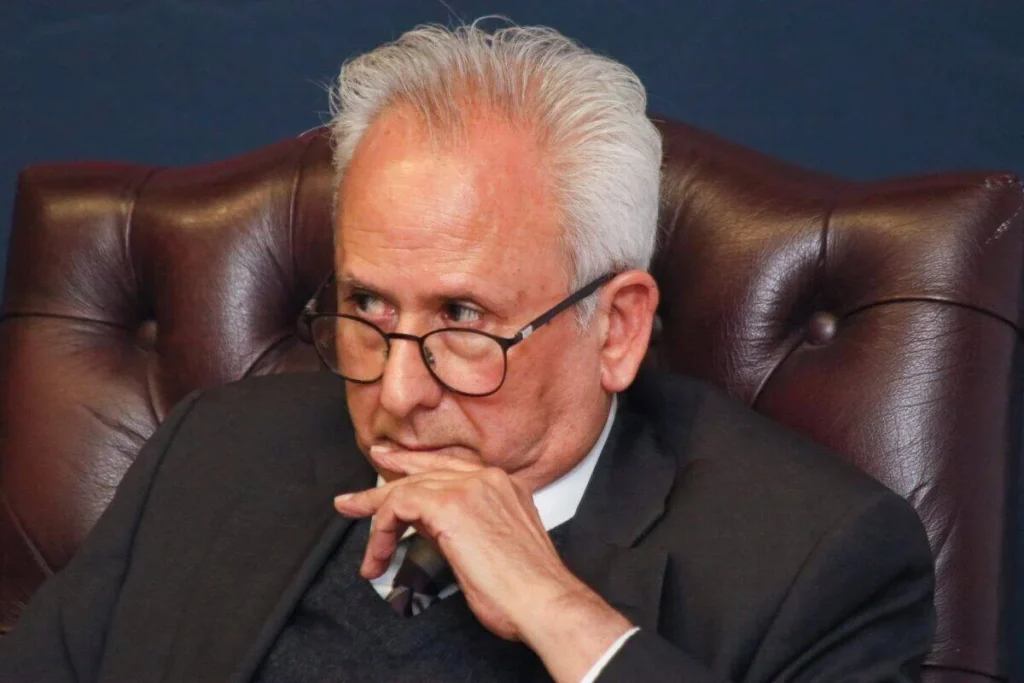
CAPTION: ACTING POLICE COMMISSIONER FIROZ CACHALIA
How Mkhwanazi shot to prominence
Mkhwanazi was already a senior figure: a former Special Task Force commander who, according to IOL, served as acting national commissioner between 2011 and 2013 and returned to KZN as provincial head in 2018. But he became a household name on 6 July 2025.
At a televised briefing in Durban, with members of the Political Killings Task Team (PKTT) beside him, he alleged that then Police Minister Senzo Mchunu had ordered the task team’s disbandment at the end of 2024, and that Deputy National Commissioner Shadrack Sibiya had removed 121 dockets from it in March 2025. He said the team had been closing in on a criminal syndicate with links to politicians, police and the justice system, and he named businessman Vusimuzi “Cat” Matlala as a figure in the story. Mchunu and Sibiya denied the allegations.
The consequences came fast. Within a week Ramaphosa had placed Mchunu on special leave and announced the Madlanga Commission, Sibiya was placed on leave, and Parliament set up its own ad hoc committee. By late August the 121 dockets had been returned to the task team. Mkhwanazi was the commission’s first witness in September 2025, and the National Commissioner’s testimony was widely reported as corroborating key parts of his account.
| Date | What happened |
| 6 Jul 2025 | Mkhwanazi, flanked by Political Killings Task Team members, holds a briefing in Durban alleging the task team was disbanded to shield a criminal syndicate. |
| 13 Jul 2025 | President Ramaphosa places Police Minister Senzo Mchunu on special leave and announces the Madlanga Commission. Firoz Cachalia takes over as acting minister from August. |
| 17 Sep 2025 | Mkhwanazi is the first witness at the Madlanga Commission. |
| Apr 2026 | Masemola tasks Mkhwanazi with a national oversight and coordination role over organised crime, alongside his KZN post. |
| 19 Oct 2026 | National Commissioner Fannie Masemola returns to duty after charges against him were withdrawn. |
| 29 Oct 2026 | Cachalia submits a Cabinet memorandum seeking concurrence for Mkhwanazi as national head of the Hawks. |
| 16 Nov 2026 | Madlanga Commission final report due to the President. |
Vindicated? Mostly, with caveats
A Daily Maverick review 14 months on concluded that the arrests, suspensions and resignations since July 2025 have lent his claims “grim credibility”. That is a long way from a final finding. The Madlanga Commission’s final report is only due on 16 November 2026, and the President has said earlier prima facie findings are allegations rather than conclusions. Sibiya told Parliament the briefing was really about a succession battle in the police, and a competing theory held that the accusations were meant to deflect from Crime Intelligence problems. Daily Maverick judged that his warning had been necessary, but the final report is the test that matters.
It is also worth being careful about the wider story. National Commissioner Fannie Masemola was himself suspended in April 2026 over a tender linked to Matlala, then reinstated on 19 October after the NPA withdrew the charges. The scandal has not been a simple morality tale, and a Hawks head will inherit cases and relationships across that tangle.
What Mkhwanazi is doing now
This is where the recommendation looks less like a reward and more like a continuation. In April 2026, Masemola tasked Mkhwanazi with a national oversight and coordination role against organised crime, on top of running KZN. The idea, borrowed from the PKTT model, is to put intelligence, detectives, tactical units and uniformed police under one central command once a syndicate is identified, so that investigations are not weakened by units working in isolation. Reports at the time said the structure had about R1 billion behind it, would include a counter-intelligence element to guard against infiltration, and would initially target syndicates including the so-called “Big Five” cartel. IOL notes this is the dual role he currently holds.
He is also still running a provincial police service. Alongside Cachalia, he has been involved in securing a reported interim interdict against the group March and March.
Is the new role a natural progression?
In direction, yes. Cachalia’s own framing places organised crime and corruption first among the ten priorities of his Police Reset Agenda, and he has said he wants a stronger elite capability, which he likened to the FBI. Mkhwanazi has spent the past six months building exactly the sort of cross-disciplinary command structure that such a capability would need. Moving him to the Hawks would formalise a role he is already performing informally.
In structure, the picture is less tidy, and this is our reading rather than something the ministry has stated. The current task team sits under the National Commissioner and is a coordinating mechanism. The Hawks is a statutory directorate with its own investigators, budget and legal footing. Two questions follow. First, whether the national coordination role folds into the Hawks or continues separately, and who leads it if he leaves it. Second, who succeeds him in KZN, where he has been a stabilising figure and where political violence is the original subject of the task team’s work.
What it could mean for South Africa
The upside is real. The Hawks have been without a permanent head for about 17 months, during which an inquiry has heard that the criminal justice system was compromised. Putting the country’s best-known policing whistleblower in charge sends a clear signal that the reset is more than a slogan, and it would pair the minister’s agenda with a leader who already has public trust. For many South Africans, it would also be a rare instance of someone being promoted for exposing wrongdoing rather than punished for it.
Whether it restores confidence in the Hawks, and in policing generally, depends on things that a name alone cannot fix:
- Capacity. The Hawks told Parliament in August that roughly 49% of posts are vacant, and investigators are being poached by the NPA, SIU and SARS.
- Integrity inside the unit. A cocaine consignment kept at the Hawks’ Port Shepstone building was stolen in what is widely regarded as an inside job. A new head has to convince the public the unit itself is clean.
- Dependence on one person. Confidence built around a single leader is fragile. Institutional fixes, such as independent selection panels, vetting and lifestyle audits, are what outlast any individual.
- The commission’s verdict. If the final report vindicates his core claims, the appointment gains legitimacy; if it complicates them, critics will say the Minister moved too soon.
- Independence. The Hawks’ distance from political influence has long been contested. A head who is seen as acting at the pleasure of the Executive would undercut the very confidence the appointment is meant to build.
The bottom line
The recommendation is a strong signal and a logical next step for Mkhwanazi, but it is not yet an appointment, and confidence in South African policing will take more than one appointment to rebuild. The next markers to watch are Cabinet’s decision, the naming of a KZN successor and the future of the national task team, and the Madlanga Commission’s final report on 16 November.