

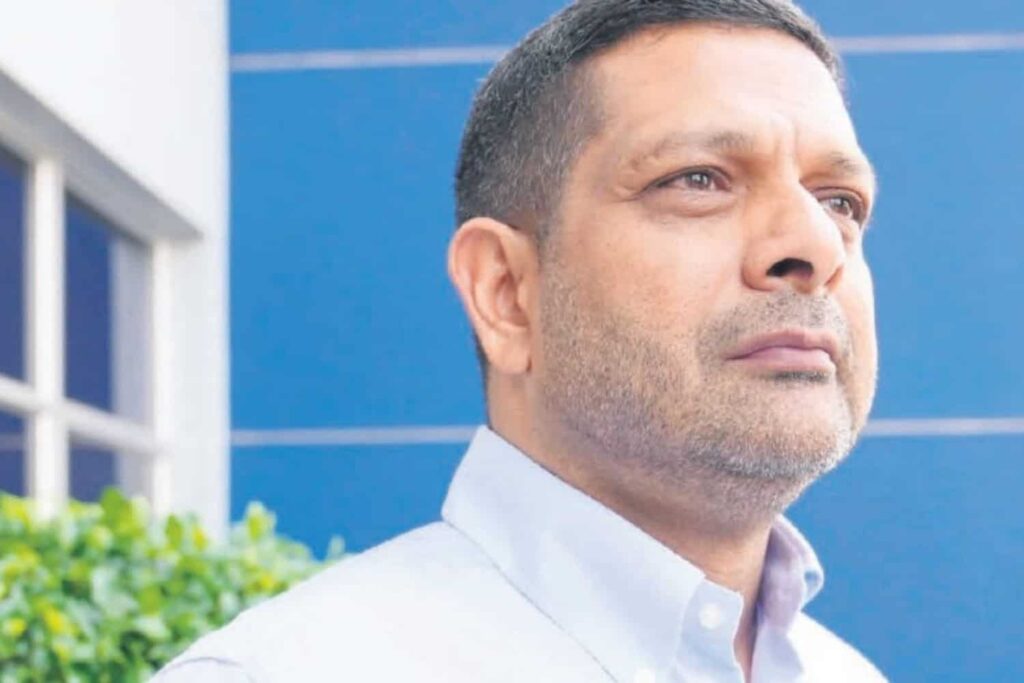
CAPTION: SULIMAN CARRIM AT THE MUSINA BAIL HEARING
Suliman Carrim is free on one case and still in Kgosi Mampuru on another, while Andrea Johnson and Feroz Khan walked out of Pretoria on R10 000 bail each. Separate cases, one common thread.
PiE NEWSDESK
Suliman Carrim will spend at least another ten days behind bars. The North West businessman, who on Wednesday won R100 000 bail in Pretoria and was technically free to go home, remains at Kgosi Mampuru because of a second, separate case in Musina. On Friday, that case got heavier: the State added immigration charges, and his bail application there was postponed to 9 November after the State said it needed time to check his financial records.

CAPTION: ANDREA JOHNSON ARRESTED AND RELEASED ON R10 000 bail
The same day, in the Pretoria court where Carrim had won bail two days earlier, a different pair of Madlanga Commission names had their own moment. Former Investigating Directorate Against Corruption (IDAC) head Andrea Johnson and dismissed Crime Intelligence deputy head Feroz Khan were arrested on Friday morning, appeared in court that same day, and were released on R10 000 bail each.
CAPTION: FEROZ KHAN
The matters are legally distinct, with different charges, different magistrates and different facts. But all of them trace back to the commission chaired by Justice Mbuyiseli Madlanga, and the week offered a snapshot of how its work is now spilling into the criminal courts through the Commission’s Recommendations Task Team (CRTT), the unit behind the arrests.
| When | Who | Where | What happened |
| Wed 28 Oct | Suliman Carrim | Pretoria Magistrate’s Court | R100 000 bail on Commissions Act charge; matter back on 8 December |
| Fri 30 Oct | Suliman Carrim | Musina Magistrate’s Court | Immigration Act charge added; bail bid postponed to 9 November |
| Fri 30 Oct | Andrea Johnson | Pretoria Magistrate’s Court | R10 000 bail; passport surrendered; back on 2 February 2027 |
| Fri 30 Oct | Feroz Khan | Pretoria Magistrate’s Court | R10 000 bail (his second bail); back on 2 February 2027 |
Carrim: from no-shows to the dock
Carrim’s trouble began with the commission itself. He was served with a Rule 10.6 notice on 24 October 2025, and testified in March, telling the commission he lost R8.4 million after funding Vusimuzi “Cat” Matlala’s healthcare company and claiming he was misled by Matlala and Brown Mogotsi. He then stopped coming. In July the commission dismissed his application to delay his testimony indefinitely on medical grounds.
On 15 October the CRTT arrested him at OR Tambo International Airport as he prepared to leave on a one-way ticket to Saudi Arabia via Dubai. He told the court he was going on a religious pilgrimage with his wife. The State pointed to his five large bags and argued he was a flight risk; his lawyers said the bags held snacks and that he intended to return. He is charged under Section 6(1) of the Commissions Act for failing to attend proceedings.
On Wednesday the Pretoria magistrate found that Carrim had contravened the commission’s subpoena without sufficient cause. But the court also found that while the State’s concerns about his future attendance were legitimate, it had not shown he would evade trial under appropriately restrictive conditions. Bail was set at R100 000. The prosecution’s attempt to reopen the application, citing properties owned by his wife and the Musina charges, failed.
What the 48-hour condition means in practice
Among the conditions, Carrim must report to the Madlanga Commission within 48 hours and make arrangements to appear and testify. The full set, as reported:
- Passport: His passport stays with the investigating officer until the trial ends and his commission testimony is finalised.
- Travel: He may not leave South Africa without permission from the court, the investigating officer or the commission. News24 also reports a requirement to report to police daily.
- Commission: He must make contact with the commission within 48 hours of the order, and arrange to testify.
- Next date: The Pretoria case returns on 8 December.
What does that mean in practice? The condition is not an order to testify within 48 hours. It is a requirement to get in touch and fix a date, the very thing he is accused of avoiding. Three consequences follow. First, it puts the commission, not Carrim, in charge of scheduling, so he cannot again plead unavailability without risking his liberty. Second, a failure to make contact is the kind of breach that can see bail revoked and invites further action. Third, because he is in custody in Musina, the contact will in practice have to run through his lawyers, and any appearance would need to be arranged with the authorities holding him. The commission’s own timetable and any steps it takes are matters for it, and we have not seen reporting on how it responded. The bail terms also lean on the lasting leverage of the passport: it is held until the testimony is done, tying his travel to his cooperation.
Musina: the case that keeps him inside
The Musina matter has nothing to do with the commission. It stems from 22 July, when police at the Beitbridge border post intercepted two vehicles said to be bound for Malawi. The NPA alleges Carrim, in collusion with his employees, tried to take two Absa-linked vehicles out of the country on fraudulent documentation. He was added as an accused on 21 October, alongside two co-accused, Musa Phiri and Zakes Ibrahim, who are linked to his company. Reports say they were arrested in July, and that Phiri intends to enter a plea agreement.
The charges include attempted theft, fraud, uttering and money laundering. On Friday the State added a charge under the Immigration Act for allegedly employing foreign nationals not permitted to work in South Africa. Carrim is presumed innocent, and his lawyers have maintained that the Musina case is separate from the Pretoria one. The State asked for Friday’s postponement because it needs to examine Carrim’s financial records to prepare its argument against bail. Until the Musina court rules on bail, however, the Pretoria bail amounts to a door that opens onto another locked one.
Johnson and Khan: a 2018 assault and what followed
The Johnson and Khan case is rooted in an incident on 26 June 2018, when Khan, then serving in the police, allegedly assaulted a brigadier under his command. The State alleges Johnson, then an NPA employee and not yet IDAC head, shared details of the investigation into Khan with him. Testimony at the Madlanga Commission, including WhatsApp messages put to Johnson in late July, brought the relationship under the spotlight.
They face charges of defeating the ends of justice, assault with intent to cause grievous bodily harm, and contraventions of the National Prosecuting Authority Act. The NPA’s Kaizer Kganyago said the NPA Act charge applies because Johnson was not yet IDAC head at the time of the alleged offence. The State did not oppose bail. Both were released on R10 000, Johnson was ordered to surrender her passport, and the matter was postponed to 2 February 2027 for further investigation.
Johnson resigned as IDAC head in July after her commission appearance, in which she reportedly declined to answer certain questions. Khan was dismissed from SAPS in September after failing to attend a disciplinary process. He was shot and wounded in Houghton on 28 June, shortly before he was due before the commission, and was arrested on 10 May over the 2021 gold seizure at OR Tambo, a case in which he is out on R20 000 bail. Friday’s bail is therefore his second. Both are presumed innocent.
The common thread
There is no suggestion in the court record that the Carrim and the Johnson-Khan cases are one conspiracy. What connects them is the commission’s reach. Carrim’s predicament began with how he dealt with its summons; Johnson’s and Khan’s was sparked by evidence aired in its hearings. The CRTT’s arrests suggest that the road from the commission’s witness stand to the criminal dock is now well travelled, and that more cases may follow.
For Carrim, the immediate questions are practical: whether Musina grants bail on 9 November, and whether he makes contact with the commission as required. For Johnson and Khan, the next date is 2 February. The week has shown that the commission’s findings are only part of the story. The courts will write the rest.