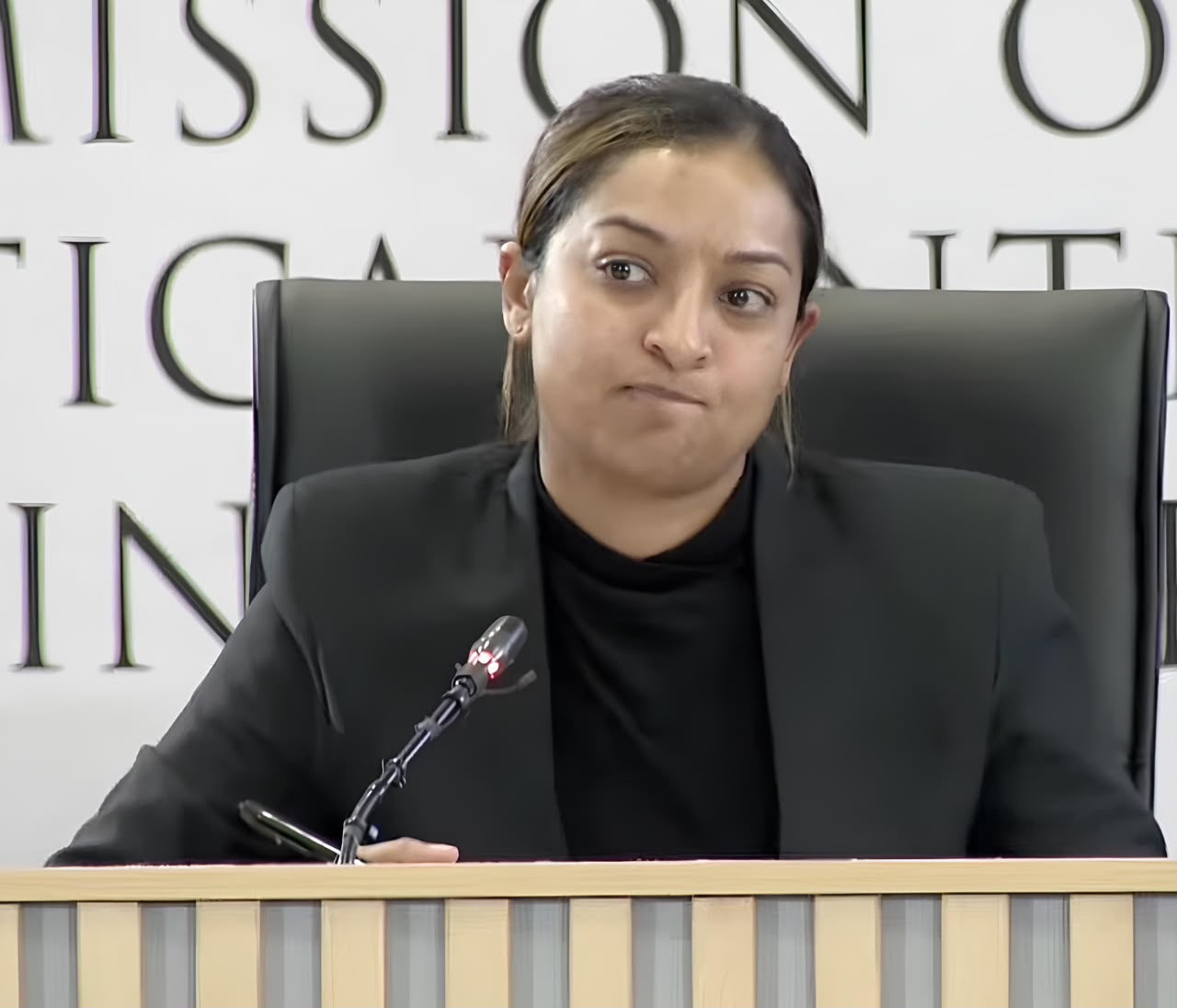

PHOTO SUPPLIED BY MAIL&GUARDIAN
PiE Staff Reporter | 30 July 2026
There is a particular kind of South African political theatre that manages to be both farce and tragedy in the same breath, and Thursday’s proceedings at the Madlanga Commission delivered exactly that. Somewhere between the laughter it provoked in the public gallery and the very serious legal consequences it now threatens to unleash, a secretly recorded phone call has become the day’s defining moment — and possibly the moment that reshapes the remaining life of this commission.
Former Investigating Directorate Against Corruption (IDAC) head Advocate Andrea Johnson had, by Wednesday, wrapped up six gruelling days in the witness box. She must have thought the worst was behind her. Instead, less than 24 hours later, state advocate Drushantha Ramsamy walked into the Brigitte Mabandla Justice College in Pretoria and, in the space of a single day, dismantled Johnson’s version of events, exposed the inner workings of her relationship with former National Director of Public Prosecutions Shamila Batohi, and played a recording that has already outgrown the commission itself.
The Recording: Comic Relief With a Sting in the Tail
The audio at the centre of Thursday’s drama was recorded during a break in Johnson’s own testimony on 22 July, in a call she made to Ramsamy. Unbeknown to Johnson, her former subordinate — who says she had by then lost all trust in her one-time boss after being repeatedly implicated in Johnson’s evidence — hit record.
What followed is, on one level, painfully funny. Johnson can reportedly be heard describing her own command of the law in withering terms, admitting to not knowing basic statutory provisions that had tripped her up under cross-examination, and rating her own performance about as low as a senior prosecutor possibly could. It is the kind of unguarded, self-deprecating outburst that would be relatable — almost sympathetic — from anyone else caught on a bad day. Played back in a commission of inquiry into criminal justice interference, however, it lands very differently.
Because buried in the comic value is the serious part: Johnson allegedly used the same call to disparage the commissioners as unprofessional, to question the conduct of commission chairperson Justice Mbuyiseli Madlanga himself, and — most damaging of all — to advise Ramsamy that if she was ever called to testify before the commission, she should consider leaving the country rather than appear. That is no longer a private moment of frustration. It is, on the face of it, an attempt by a witness under oath to discourage another prospective witness from cooperating with a judicial commission of inquiry — a matter with potentially serious legal and professional consequences of its own.
It is worth sitting with why the tape has resonated the way it has. Commissions of inquiry live and die on the credibility of the witnesses before them. A recording that shows a key witness privately mocking the very process she publicly professed to respect does more reputational damage in twelve minutes than days of hostile cross-examination ever could. The humour is real — but it is the kind of humour that comes from watching someone’s carefully constructed public composure collapse in real time, on the record, with the record now belonging to the commission and, effectively, to the public.
A Recall Now Looks Inevitable
The practical fallout has already begun. Evidence leaders confirmed on Thursday that a Rule 3 notice will be issued to Johnson — a formal mechanism that gives any person implicated in adverse evidence before the commission a fair opportunity to respond, either in writing or in person. Commission chair Justice Madlanga noted that the fresh allegations contained in Ramsamy’s statement were never put to Johnson while she still occupied the witness stand, simply because the commission only received the material after she had finished testifying. Fairness therefore demands that she be given the chance to answer them.
In practice, that almost certainly means Johnson will be walking back into the same room she has only just left — this time not as a witness giving her own account on her own terms, but as someone answering to specific, recorded, and highly personal allegations. That is an entirely different kind of appearance. Where her original testimony allowed her room to explain, contextualise and, where necessary, contest the framing of events, a recall driven by a Rule 3 notice narrows the terrain considerably. She will be responding to her own words, played back to her, in her own voice.
That is a difficult position for any witness, let alone one whose institutional authority rested heavily on being seen as procedurally scrupulous and professionally unimpeachable. Denying the recording is unlikely to be a viable strategy once its authenticity is established; the more realistic paths open to Johnson are to contest the context in which the remarks were made, to argue diminished evidentiary weight because the call was private and unguarded, or to concede the tone while disputing the legal significance attached to it — particularly the suggestion that she attempted to dissuade a witness from testifying. None of these are comfortable options, and all of them will play out in public.
What Ramsamy’s Testimony Means Beyond the Tape
It would be a mistake to let the recording overshadow the rest of what Ramsamy put before the commission, because her broader testimony may ultimately carry more weight for the commission’s findings than the viral moment of the call itself.
Ramsamy told the commission that Johnson had misrepresented her role and knowledge in the investigation into Crime Intelligence head Dumisani Khumalo and the appointment of Dineo Mokwele to a brigadier post, insisting she had raised concerns about procedural irregularities from the outset and repeatedly thereafter — concerns she says Johnson failed to disclose or act on. She also linked Johnson’s conduct to the prosecutions of suspended national police commissioner Fannie Masemola and General Khumalo, suggesting those cases were targeted rather than pursued on a purely evidentiary basis.
Perhaps most significant for the commission’s wider mandate, Ramsamy described a management culture at IDAC under Johnson that she characterised as intimidatory and inconsistent — reasonable one moment, hostile the next, particularly after Johnson had consulted a figure identified as Dylan Perumal, which is how Johnson reportedly earned an unflattering nickname among colleagues. She further alleged that former NDPP Shamila Batohi shielded Johnson from scrutiny throughout.
If those claims hold up, the implications extend well past Johnson personally. A pattern of protection running from IDAC’s operational head up to the office of the National Director of Public Prosecutions would speak directly to the commission’s core inquiry into whether South Africa’s criminal justice institutions have been captured, compromised, or misused to protect or target particular individuals. It would also place Batohi — already a former NDPP but still a significant figure in the recent history of the NPA — squarely in the frame for further scrutiny, whether through her own Rule 3 notice or through questioning of other witnesses.
For others in what has been loosely described as the ‘Johnson group’ — officials and prosecutors whose conduct is said to have tracked closely with Johnson’s — Ramsamy’s evidence functions as a kind of pressure test. Every allegation of irregular process, selective prosecution, or protected non-disclosure that survives scrutiny widens the net of people who may need to explain their own roles, whether through Rule 3 notices of their own or through being named adversely in the commission’s eventual findings and recommendations.
What’s Next
Thursday was, by Ramsamy’s own account, only the opening act. She has indicated her evidence will be delivered in two parts given its scope: the first dealing with her January 2025 consultation with complainant Fadiel Adams and the origins of the Crime Intelligence investigations, and a second — still to come — focused on subsequent developments including further Crime Intelligence matters and a contract linked to Medicare24 in Tshwane. That second instalment is expected when she returns to the stand on Tuesday, and given how much Thursday’s opening salvo has already reshaped the narrative around Johnson, there is little reason to expect Part Two will be any less consequential.
In the meantime, the commission does not pause. From Friday, it moves to hear what has been described as interposing evidence from other witnesses, before Ramsamy resumes on Tuesday. That sequencing matters: it gives the commission, the implicated parties, and the public a few days to absorb Thursday’s revelations before the story picks up again — and it gives Johnson’s legal team a narrow window to prepare a response to a Rule 3 notice that, on the evidence so far, will be difficult to answer comfortably.
The Bottom Line
It is tempting to treat the recording as this week’s viral clip and move on — the self-mockery, the unguarded venting, the sheer audacity of advising a colleague to flee the country rather than testify. It is, undeniably, funny in the way that only spectacularly unguarded honesty can be. But strip away the entertainment value and what remains is a witness who appears to have been saying one thing under oath and something rather different in private, caught on tape advising a subordinate to dodge a lawful commission process. Commissions of inquiry are ultimately exercises in credibility, and credibility, once punctured this publicly, is exceptionally hard to patch.
Andrea Johnson now faces the prospect of a recall on unfavourable terms, a Rule 3 process that gives her little room to manoeuvre around her own recorded words, and a former colleague who has signalled that Thursday’s testimony was only half the story. Whether one finds the recording funny or alarming likely depends on how seriously one takes the commission’s underlying purpose — but for Johnson, and for those whose conduct tracked with hers, the days ahead look considerably less amusing.
This article is based on public reporting of proceedings at the Madlanga Commission of Inquiry as of 30 July 2026. Allegations referenced remain untested and Advocate Andrea Johnson has not yet had the opportunity to respond under the commission’s Rule 3 process.