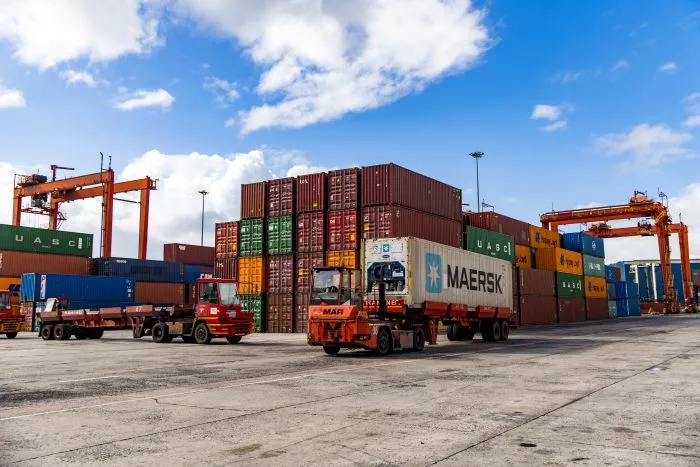

MAIN PHOTO: PortOps enables more proactive operational planning and resource mobilisation – CSIR
PortOps, a decision-support platform developed for the Transnet National Ports Authority, will soon assist the Port of Cape Town in improving container planning and handling operations at the Container Terminal. The tool is designed to support cargo owners, the fresh produce industry and exporters.
The CSIR-developed predictive wind model, scheduled for release later this year, will deliver more reliable wind predictions across two forecast horizons by integrating wind operability forecasts with operational decision support. Both forecasts feed into an operability forecast. These forecasts are integrated with operational data within the PortOps platform to indicate when the port is likely to be wind-bound. This integration provides valuable decision-support for operational planning across the 10-minute to five-day forecast horizon.
The availability of this technology is opportune, as the Port of Cape Town continues to experience extremely strong summer winds that hinder productivity at this critical global trade gateway. “While every effort is made to ensure reliability, forecasts remain subject to uncertainty,” says CSIR engineer Johan Kieviet. “Weather remains one of the biggest operational constraints, as ships cannot be loaded in high winds.”
As global supply chains grow increasingly complex, reliability becomes essential to maintaining steady flows and ensuring the economic competitiveness of regional trade. Delays at ports affect production planning, inventory management and export schedules.
During the pilot phase, validation results achieved up to 85% operability prediction accuracy between September 2025 and January 2026.
The PortOps tool is designed to support logistics efficiency and export performance by integrating measured environmental data, forecasting, operational information and analytics to support more informed decision-making.
PortOps helps port stakeholders anticipate and mitigate operational downtime, vessel delays, crane stoppages and container congestion – issues that can lead to high storage costs and losses in fresh produce exports, ultimately impacting the economy.
The platform is supported by Parliamentary Grant funding and aligns with the CSIR’s strategic priorities to improve efficiency and decision-making in South African port operations. The project is built on collaboration with the Transnet National Ports Authority, Transnet Port Terminals, exporters and logistics stakeholders.
“Stakeholders have shown significant interest in the PortOps tool and it builds on progress with other digital logistics support systems,” says Kieviet.
Challenges encountered in developing the tool include dependence on stakeholder operational data access, the need for additional work on operational hardening and cybersecurity, ensuring communications reliability for remote wind stations and managing resource pressure due to increasing stakeholder demand.
Looking ahead, the long-term ambitions for the tool include expanding to more South African ports, applying the tool to other commodities and logistics sectors, deploying it more widely to stakeholders and integrating it into South Africa’s broader national logistics systems.