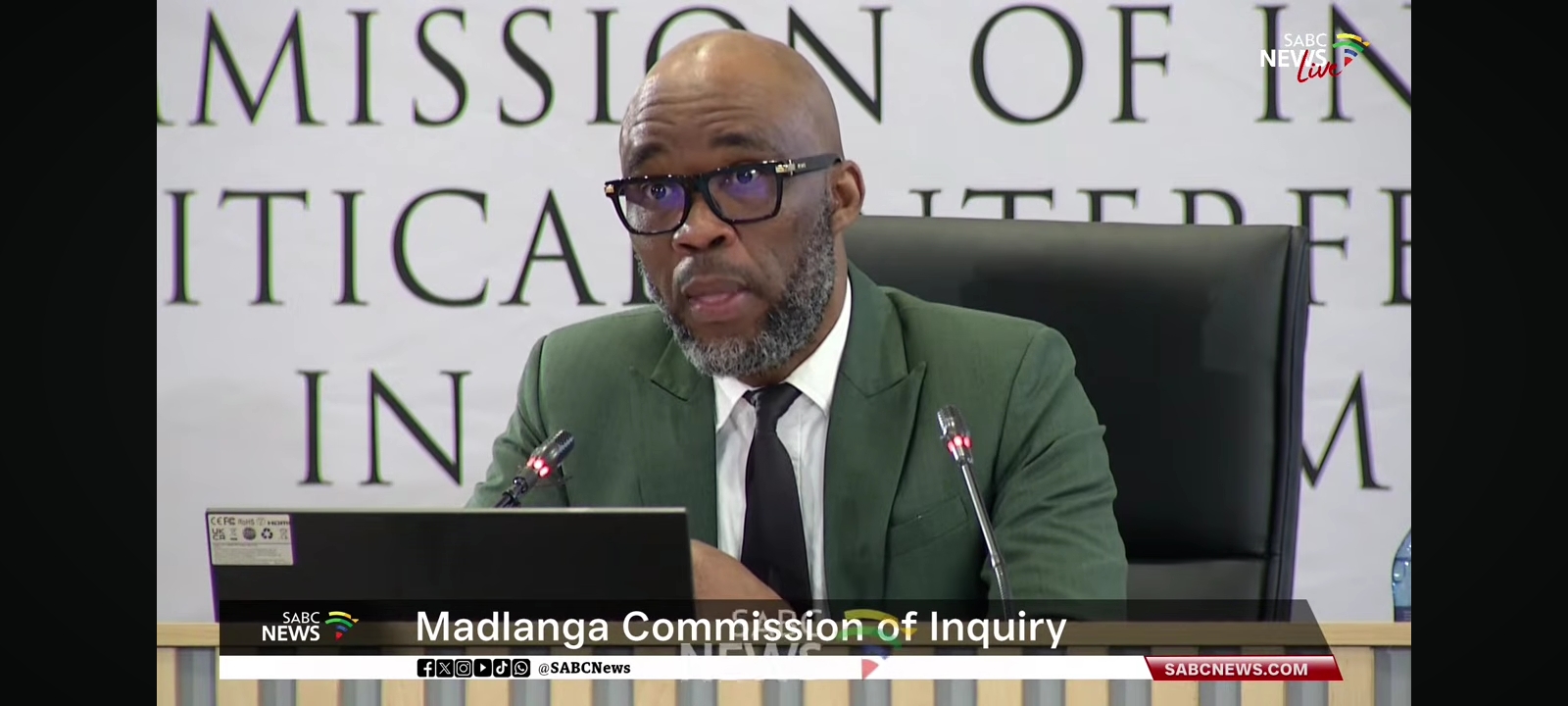

MAIN PHOTO: VUSIMUZI “CAT” MATLALA – COURTESY OF SABC
LEN KALANE – Madlanga Commission Special Report
Vusimuzi “Cat” Matlala did not flinch when the question was put to him at the Madlanga Commission of Inquiry on Monday. Asked to describe the current state of his relationship with Brown Mogotsi, the North West businessman once positioned as his fixer, protector and go-between, Matlala offered no diplomatic hedge. “I actually hate him,” he said. “He caused a lot of problems for me.” It ended, Matlala added, the moment police put him under arrest.
That single line has already made headlines. But reduce the exchange to a soundbite and you miss the more instructive story: how two men with very different reputations, a tender tycoon under suspicion and a self-described political operative and police informant, built a relationship transactional enough to survive scrutiny for more than a year, and volatile enough to collapse into open hostility once the case against Matlala broke into public view.
A knock on the door, and an offer of help
According to Matlala’s own account to the commission, the relationship did not begin with tenders, cartels or party politics. It began with a police raid on his home. Mogotsi made contact days later, introducing himself as someone connected to the office of then police minister Senzo Mchunu, and offering to help Matlala lodge a case against the officers who had carried out the search.
The offer of assistance came with a price. “When they came for the second time for the raid, he asked money from me,” Matlala told the commission. “He said he wants to bring experts from the police to do the investigation to find out who are these people who came to my house. By then he wanted money. Yes, I gave him that money, I think it was R20,000. He said we must book accommodation for those investigators.”
“I gave him that money, I think it was R20,000… That’s when I kept on sending Brown Mogotsi money.” — Cat Matlala
From favour to funder: Cele’s instruction
What turned an isolated payment into a sustained financial relationship, on Matlala’s telling, was an instruction from a far more senior figure. He said that after this initial exchange he came to deal with Mogotsi more regularly, and it was only once he met former police minister Bheki Cele that the relationship was formally weaponised: Cele, he testified, told him to maintain his ties to Mogotsi as a way of establishing whether corrupt links existed between Mogotsi and Mchunu.
From that point, Matlala said, the money did not stop. “That’s when I kept on sending Brown Mogotsi money. I paid R150,000 for that January 8 celebration of the ANC,” he told the commission, referring to funds allegedly used to cover flights and accommodation for ANC members attending the party’s annual anniversary event in Cape Town.
Other evidence placed before the commission earlier in its proceedings has filled in the picture Matlala was reluctant, or legally unable, to complete himself. Crime Intelligence divisional commissioner Lieutenant General Dumisani Khumalo testified in September 2025 that extensive WhatsApp exchanges recovered from Matlala’s phone showed Mogotsi pressuring him to fund political party memberships in two regions, and detailed a further R37,000 payment linked to a Mahikeng travel company, Gotlhe Specialists, of which a portion was allegedly passed on to Mogotsi. Separate testimony placed before the commission, from a protected witness known as Witness C, put a much larger figure on the table: an alleged R500,000 contribution, funnelled through Mogotsi, to support Mchunu’s prospective bid for the ANC presidency in 2027.
Mogotsi’s version: an undercover operative, not a bagman
When it was his turn to testify in November 2025, Mogotsi offered the commission an entirely different frame for the same relationship. He described himself as a Crime Intelligence asset who had worked as a police informant since 1999, a former Umkhonto weSizwe operative recruited as a contact agent, and said his assignment in cultivating Matlala was to infiltrate the businessman’s world and extract information for the state, not to enrich himself or shield criminality.
Mogotsi went further, telling the commission that Matlala had confided in him about an alleged bribe paid directly to KwaZulu-Natal police commissioner Lieutenant General Nhlanhla Mkhwanazi at Matlala’s uMhlanga Ridge home in July, and that his own role in the underworld figure’s orbit stretched back years, including an earlier presentation to then police minister Bheki Cele in 2018 in which Matlala was identified under the alias “John Wick” in connection with intelligence on the banned group Boko Haram. He also confirmed Cele had stayed at Matlala’s Menlyn Maine penthouse in January, and rejected suggestions that Matlala had funded Mchunu’s presidential ambitions, telling the commission it was “too early to speak about ANC presidential campaigns.”
The two accounts cannot be fully reconciled, and the commission has not been asked to reconcile them. What both versions agree on is the shape of the exchange: money flowed from Matlala to Mogotsi, favours and access flowed the other way, and the arrangement was dressed up, depending on who is describing it, as either political patronage, security assistance, or state intelligence-gathering.
The cooling: from generous benefactor to cold shoulder
The commission has also been shown how the relationship soured well before Matlala’s arrest became public knowledge. Khumalo’s September 2025 testimony walked commissioners through the final recorded WhatsApp exchanges between the two men, messages that captured a marked shift in tone. Where earlier chats showed Matlala being, in the commission’s characterisation, generous in bankrolling Mogotsi and his associates, the later messages showed Mogotsi turning cold once a government contract linked to Matlala was terminated and Matlala reacted angrily to the news. By the time Matlala sent Mogotsi a screenshot of a news article about his troubles on the morning of 23 March, the warmth of the earlier relationship had visibly drained out of the exchange.
Why ‘hate’ is the honest word
Journalists covering the commission have already seized on Matlala’s “I hate him” remark as a punchy headline. But taken in the context of his fuller testimony, it reads less like a throwaway insult and more like the final entry in a ledger that began with a knock on the door after a police raid, ran through hundreds of thousands of rands in payments dressed as political and investigative assistance, and was, on Matlala’s account, deployed at a senior police minister’s direction as a tool to probe corruption rather than commit to a genuine friendship. When Matlala says Mogotsi is responsible for “the position he now finds himself in,” he is not describing betrayal by a stranger. He is describing the unravelling of a relationship he says he was instructed to maintain, and that ultimately became inseparable from the criminal case now hanging over him.
Matlala is due to return to the commission on 24 and 25 August, where further questions on his dealings with Mogotsi, and the wider network of police and political figures drawn into the inquiry, are expected to continue.