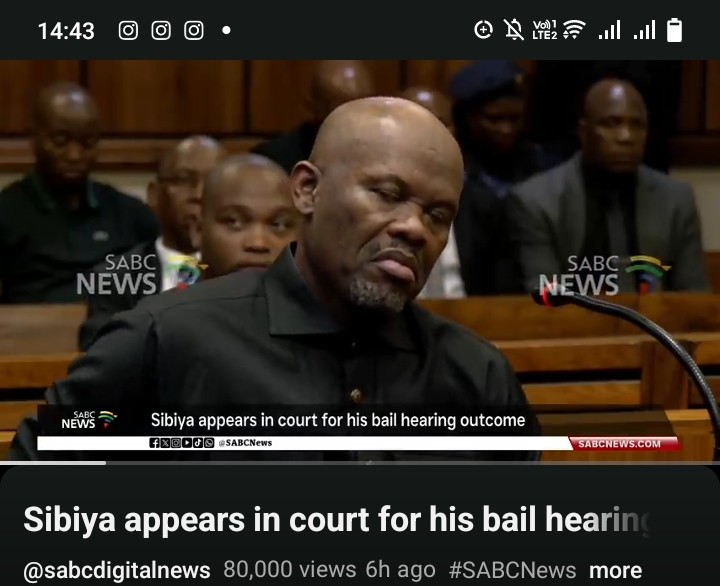

CAPTION: FORMER POLICE CHIEF SHADRACK SIBIYA PICTURED AT HIS BAIL HEARING
With the former deputy national police commissioner refused bail, every key figure in the Matlala–Sibiya orbit is now in custody. For most of them, though, it is not (yet) the Madlanga-recommended charges that put them there.
PIE NEWSDESK
Former deputy national police commissioner for crime detection Shadrack Sibiya will remain in custody. The Randburg Magistrate’s Court on Tuesday refused him bail on charges that include rape, human trafficking and the sexual grooming of a child, with Magistrate Hleziphi Mkhasibe ruling that he had failed to show exceptional circumstances that would permit his release.
Sibiya, 59, denies wrongdoing, calls the charges trumped up, and says his encounter with the 18-year-old complainant was consensual.
That much will be known to most readers. What deserves a closer look is where the ruling leaves the wider cast of the Madlanga Commission. With Sibiya’s bail refusal, five prominent figures in the Matlala–Sibiya orbit, namely Sibiya himself, suspended-then-fired Ekurhuleni metro police deputy chief Julius Mkhwanazi, alleged political fixer Brown Mogotsi, suspended Sergeant Fannie Nkosi and alleged tender kingpin Vusimuzi “Cat” Matlala, are all behind bars. In almost every case, what is keeping them there are matters other than the criminal investigations the commission recommended.
A curious observation
The sequence invites a question that is fair to put to the authorities, even if it cannot yet be answered: is the state keeping these men in custody on charges that are quicker to prove, while the more complex Madlanga investigations are finalised in the background?
The Commission’s Recommendations Task Team (CRTT) has been working on those referrals since the first interim report in December 2025. The second interim report, handed to the President on 29 May, recommended disciplinary proceedings and immediate criminal investigation of Sibiya, Nkosi, Mogotsi and a crime intelligence officer known as Witness G. The commission’s final report is due on 16 November. The criminal charges that flow directly from those recommendations have, for the most part, not yet been laid.
In fairness, there are strong counter-arguments, and a responsible reading must hold them alongside the pattern:
- Several of the arrests were made by the CRTT itself, and flowed from evidence given at the commission. Mogotsi was arrested after testifying; Nkosi after a raid that followed his testimony; Mkhwanazi’s blue-lights corruption arrest was a CRTT operation.
- Each bail refusal was a judicial finding on evidence placed before a court, not a decision of the executive. In Sibiya’s case, the magistrate relied on his alleged conduct after the charges were laid.
- Cat Matlala was in custody before the commission existed. He was arrested in 2025 on attempted murder charges and has been held since, so he does not fit a “pattern” of post-commission arrests.
- Everyone named remains presumed innocent, and each has denied wrongdoing in the matters before the courts.
Still, the observation stands as an observation: the commission’s recommendations are pending, the men are in custody, and the next chapter, if the evidence supports it, is yet to be written.
Today’s verdict: what the magistrate said
Mkhasibe stressed that a bail hearing is not a trial and that Sibiya remains presumed innocent. She nonetheless found the State had led evidence showing its case was strong, and that his release would endanger witnesses and the integrity of the investigation. Her key findings, as reported by IOL, the Mail & Guardian, TimesLIVE and News24, were:
- The threats to a State witness. The father of the 16-year-old complainant, identified only as Mr M and reportedly Sibiya’s former bodyguard and driver, told the court that Sibiya threatened him and his family. The defence said the remarks were not threats and came from a conversation that had never been transcribed. The magistrate disagreed: Mr M had reasonably understood them as threats, and a second threat, made in front of the investigating officer, strengthened his account. “The second threat establishes a dangerous pattern of behaviour,” she said.
- The wiped phone. The court heard that the phone allegedly used to communicate with the teenager had been wiped, that the girl had been asked to delete their conversations, and that Sibiya told officers searching his home he had disposed of the phone because he knew his phones were being intercepted. A former senior police officer, the magistrate said, would have understood the significance of preserving evidence.
- The complainants’ vulnerability. She noted that the 18-year-old complainant, who has been placed in the Witness Protection Programme, expressed fear of his release, and that the 16-year-old had said she would be uncomfortable with it. She was also concerned that the younger girl could be influenced if he were freed. A report that someone had approached a friend of the complainant seeking a contradictory statement could not be attributed to Sibiya, she said, but needed to be investigated.
- The oath. The allegations, she observed, suggest he violated the oath he took as a police officer to protect the public and uphold the highest ethical standards.
- The defence arguments. She found the claim that the charges were fabricated premature, a matter for the trial court. She also rejected defence claims that Mr M had threatened Sibiya’s wife, finding the recordings and messages did not meet the legal definition of intimidation. She found the human trafficking allegation had merit at bail stage. Video footage of a businessman’s murder could not be linked to Sibiya on the evidence presented.
- A rebuke for the State. The magistrate did not let the prosecution off lightly: she called its failure to charge Sibiya under the Firearms Control Act, over an alleged failure to safeguard a firearm, “distasteful” and noted it had offered no plausible explanation.
The defence had proposed R20,000 bail with conditions. The NPA welcomed the outcome. The matter returns to court on 24 November for further investigation, and Sibiya remains free to challenge the refusal on appeal.
Sibiya: how the wheels came off
| Date | Development |
| 6 July 2025 | KwaZulu-Natal police commissioner Lt-Gen Nhlanhla Mkhwanazi’s media briefing alleges criminality and political interference in the police, leading to the Madlanga Commission. |
| September 2025 | National Commissioner Fannie Masemola suspends Sibiya over allegations that he tried to disband the Political Killings Task Team. Commission hearings begin on 17 September. |
| 17 December 2025 | The commission’s first interim report is handed to the President; a special SAPS task team is set up to investigate those it names. |
| February 2026 | Sibiya testifies, denying a corrupt relationship with Matlala and conceding that the documents he relied on did not expressly order the task team’s disbandment. |
| 29 May 2026 | Second interim report recommends disciplinary action and urgent criminal investigation of Sibiya, Nkosi, Mogotsi and Witness G. The Presidency notes it on 6 August. |
| 21 September 2026 | The CRTT arrests Sibiya at a Sandton venue on charges of rape, human trafficking and sexual grooming of a child. He appears in the Randburg court the next day. A firearm-related charge is also reported. |
| Late September 2026 | Sibiya tells the court the task team abused its powers and trumped up the charges. He is served with a disciplinary notice in the court holding cells. |
| 12 October 2026 | As disciplinary proceedings get under way, his lawyers submit his resignation. SAPS treats it as a dishonourable discharge. |
| 20 October 2026 | Bail refused. Case postponed to 24 November. |
The Madlanga recommendations against Sibiya, including his alleged ties to Matlala and his role in the dismantling of the Political Killings Task Team, have not yet produced charges. He denies them all.
The others in the orbit
Julius Mkhwanazi: the sequence of arrests
The suspended EMPD deputy chief, dismissed by the City of Ekurhuleni on 18 September, was arrested four times in as many months, and by mid-September was reported to face five separate criminal cases. He has denied wrongdoing. His arrests, in order:
| # | Date | What happened | Link to Madlanga |
| 1 | 18 April 2026 | Arrested with Ekurhuleni city manager Kagiso Lerutla over an allegation that he helped find a person to impersonate Lerutla in court in 2019. Granted R30,000 bail on 20 April. | Indirect: arrested days after his commission testimony, but the charge itself is unrelated. |
| 2 | 8–9 July 2026 | Arrested in a CRTT operation with former city manager Imogen Mashazi, legal head Kemi Behari and HR head Linda Gxasheka on fraud and corruption charges, over alleged efforts to halt his disciplinary process over blue lights fitted to vehicles of Cat Matlala. Bail of R50,000. | Direct link to Matlala and the commission’s subject matter, though not yet the recommended investigation. |
| 3 | 17 July 2026 | Arrested by IPID with “Witness K” over the alleged R14.9m Killarney precious stones robbery of 2023. Bail granted on 21 July. | Direct: arises from Witness K’s commission evidence. |
| 4 | 5 August 2026 | Arrested with four others over the 2022 torture and murder of businessman Emmanuel Mbense. Bail denied on 15 September; remains in custody. | Direct: arises from the evidence of the late Witness D, Marius van der Merwe. |
Two of his four arrests, the precious stones and the Mbense murder, therefore trace straight back to commission evidence. Mkhwanazi is due back before the Brakpan court on 24 November.
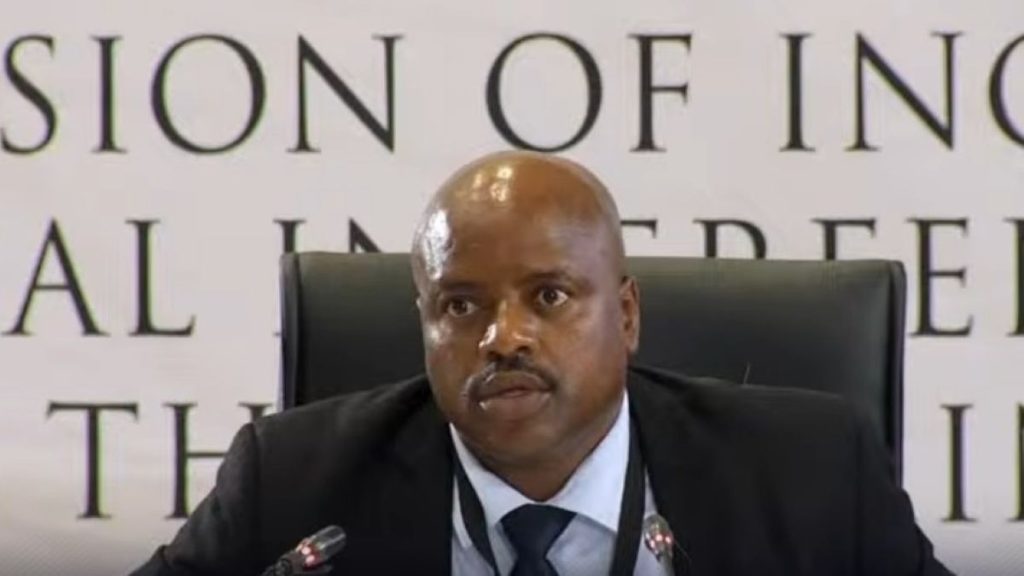
CAPTION: JULIUS MKWANAZI
Brown Mogotsi
The self-described political fixer was arrested on 15 May, shortly after giving evidence to the commission, and charged with perjury, defeating the ends of justice and firearm offences. The State alleges he staged an attempt on his own life in Vosloorus on 3 November 2025, firing at his own car and then reporting it. The firearm is reportedly linked to other murder and attempted murder cases. He has been refused bail four times, most recently on 22 September, with courts citing unreliable addresses; the State has also alleged an escape plan involving a correctional officer’s uniform and an attempt to bribe the investigating officer. The second interim report recommended a criminal investigation of Mogotsi, together with a probe into an alleged off-the-books Crime Intelligence operation involving him and Witness G. That investigation has yet to produce charges.
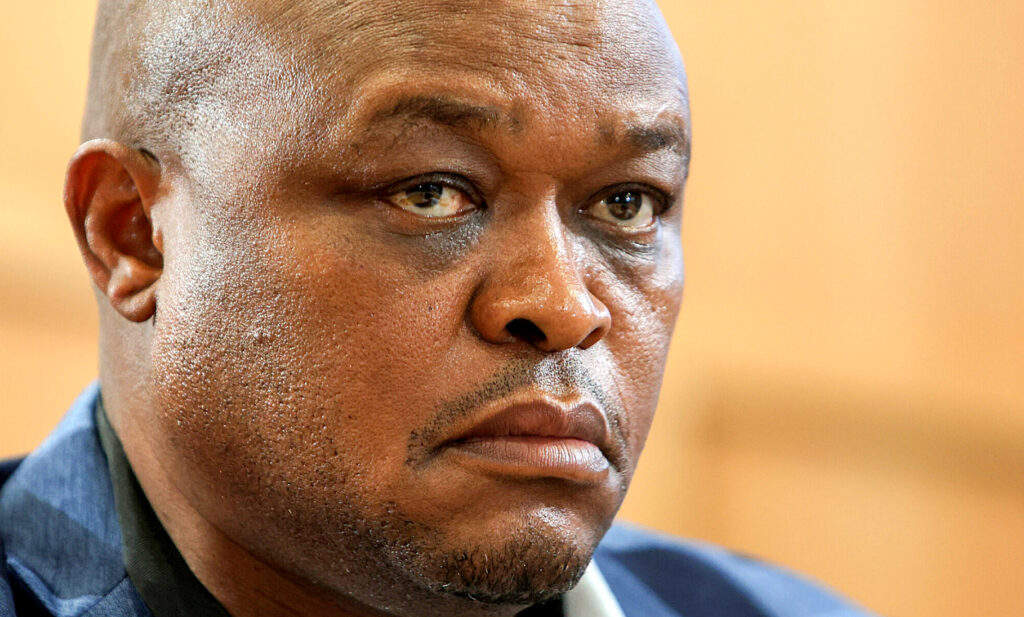
CAPTION: BROWN MOGOTSI
Sergeant Fannie Nkosi
The suspended Organised Crime Unit sergeant was suspended after explosive commission testimony in March in which he described being an intermediary between Sibiya and Matlala. The CRTT raided his Pretoria North home on 2 April and reportedly found a hand grenade, state ammunition, seven unsecured licensed firearms, six case dockets and over R50,000 in cash. He was arrested and charged with unlawful possession of explosives, failing to safeguard firearms and ammunition, defeating the ends of justice and theft, among others, and later with fraud and pretending to be a senior officer in a Thohoyandou case. Bail was refused in April and his bail appeal dismissed by the High Court on 3 June. His lawyers have asked the NPA to reduce or withdraw the charges; the case is back in court on 5 November. He was named in both interim reports, and the recommended investigation of his role in the Sibiya–Matlala dealings has not been concluded.
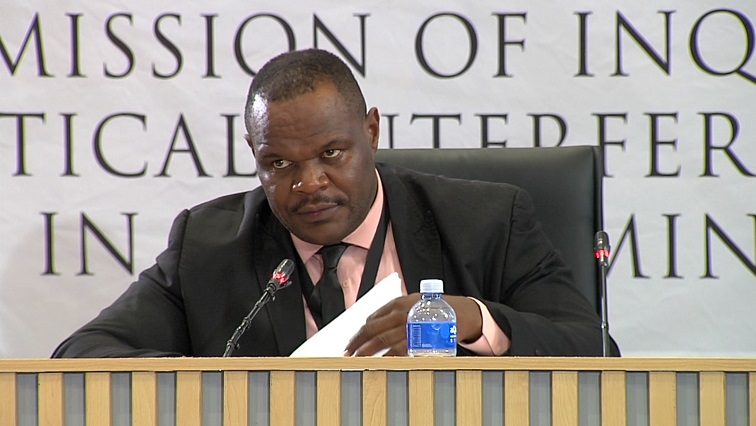
CAPTION: FANNIE NKOSI
Vusimuzi “Cat” Matlala
Matlala is the odd one out in the pattern, because he was in custody before the commission began. Arrested in 2025 and refused bail in September of that year, he faces attempted murder, conspiracy and money-laundering charges linked to alleged hits on his ex-girlfriend Tebogo Thobejane, actor Joe Sibanyoni and DJ Vettys, and a trial-within-a-trial was under way in the Johannesburg High Court in September. He also faces the R360-million SAPS Medicare24 tender corruption case, in which 12 senior police officers have been charged alongside him. Matlala is the figure around whom the commission’s evidence most often revolves, from the blue lights to Sibiya and Nkosi’s alleged dealings with him. He however doesn’t seem to be among those named in a commission recommendation for further investigation, so the line between his existing cases and any future Madlanga-driven charges remains to be drawn.

CAPTION: VUSIMUZI “CAT” MATLALA
What may still be coming
The CRTT has told the public little about where its investigations stand, but the timetable is tightening. The commission’s final report is due on 16 November, Sibiya, Mkhwanazi and Nkosi all have court dates in November, and the second interim report’s call for “immediate” criminal investigation of Sibiya, Nkosi and Mogotsi has not yet been matched by charges. If the evidence supports it, the same men could soon face a second set of serious charges, this time those that the Madlanga Commission set in motion.
Until then, the observation stands: the men at the centre of the commission’s evidence are in custody, but for the most part on charges that are not the ones it recommended.
• Sources: IOL (20 Oct bail ruling), Mail & Guardian, TimesLIVE, News24, Sunday World, The Citizen, SABC, eNCA, EWN, Daily Maverick (18 Oct), the Presidency and SAnews