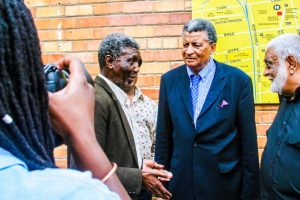

MAIN PHOTO: SOL RACHILO WITH THE LATE MASTER PIANIST ABDULLAH IBRAHIM
Sol Rachilo — actor, playwright, teacher, and one of the last living threads back to the golden era of Sophiatown — has died at the age of 95. He passed away in hospital on Friday, August 14, 2026, days after being taken in following what a source close to the family described only as a tragic incident at his home in Mapetla, Soweto. At the time, he had been recovering from a hip operation at Helen Charlotte Maxeke Hospital.
That he died still recovering, still fighting, feels fitting for a man who spent nearly a century refusing to slow down.
A son of Sophiatown
Rachilo’s story begins in the Sophiatown of the 1950s and ’60s, the freewheeling, doomed neighborhood that produced so much of South Africa’s modern cultural imagination. He came up through Union Artists and Dorkay House, working alongside names like Zakes Mokae, Bess Finney Ricky, Norah Taylor and Cecil Williams — the generation that built Black South African theatre in the teeth of apartheid.
He made his professional stage debut in *No-Good Friday* in 1958, and by 1962 he was in the cast of *Sponono*, a production that eventually toured internationally, including to the UK. Decades later he was still working: he helped shape and starred in Maishe Maponya’s *Gangsters* (1984), playing “Jonathan,” appeared in the film *Game for Vultures*, and took the role of Capone in the SABC1 drama *Lisenethini*. He wrote too — *The Township Housewife* (1972) and *Grounded in Mshenguville* (1989) both carry his name as playwright.
His education mattered to him deeply. He attended the famous Madibane High School, where one of his English teachers was none other than Can Themba, the legendary *Drum* journalist — a fact, those who knew him say, he never tired of mentioning even in his final years. Before acting claimed him, Rachilo had actually trained for a career in social work at the historic Jan H. Hofmeyr School of Social Work on Eloff Street — the same institution that trained Winnie Madikizela-Mandela.
## Passing it on
Rachilo didn’t just perform — he taught. He founded and ran a school of theatre called Children of Soweto, first based in Newtown and later in Yeoville, where for years he poured his energy into passing acting skills on to young people. It was, by every account, his real passion. The school eventually closed in the early 2000s as hard times set in.
Those hard times followed him into old age. In recent years Rachilo faced repeated homelessness, which drew growing concern from the cultural and arts community about his wellbeing. At the time of his death, a group of concerned artists led by veteran actor Sello Maake ka Ncube had already begun a fundraising drive on his behalf.
For anyone wanting the fuller academic record of Rachilo’s place in South African theatre history, researcher Andile Xaba’s unpublished PhD thesis on Soweto-based community plays of the 1980s and ’90s is cited as essential reading on his contribution.
The man who owned the city
What people who knew Rachilo mention first isn’t a role or a play — it’s the walking. Well into his 90s, he moved through Johannesburg with a spring in his step that put people half his age to shame, a familiar figure crossing Mandela Bridge, drifting through Braamfontein, or making his rounds in Yeoville. He was a regular at Niki’s Oasis Jazz restaurant in Newtown and a fixture around the Market Theatre — if a single person could be said to belong to the city, those who knew him say it was Bra Sol.
His contribution didn’t go unrecognized. In 2023, the Siphiwe Msimango Foundation honored him at a well-attended ceremony at MuseumAfrica.
“A walking encyclopedia”
Simnikiwe Sondlo, owner of Niki’s Oasis, knew Rachilo from the moment the restaurant opened in 1995 and saw him there almost daily for more than three decades. She remembers him as a cultural veteran with a generous heart and a fierce commitment to preserving heritage — someone with a sharp mind and an extraordinary memory who knew everyone’s name and carried a lifetime of stories about South Africa’s people, music, theatre and history. To her and the Niki’s Oasis staff, he was family: an older brother to her and to a colleague named Zak, and “Tatomkhulu” — grandfather — to another named Boyza.
Newtown, she says, was his home away from home, and his passing leaves a real void there and across the broader arts community.
—
Memorial and funeral arrangements had not been announced at the time of writing. Lala ngoxolo, Bra Sol.
*Adapted and reimagined from source material originally compiled by Edward Tsumele for CITYLIFE/ARTS.*