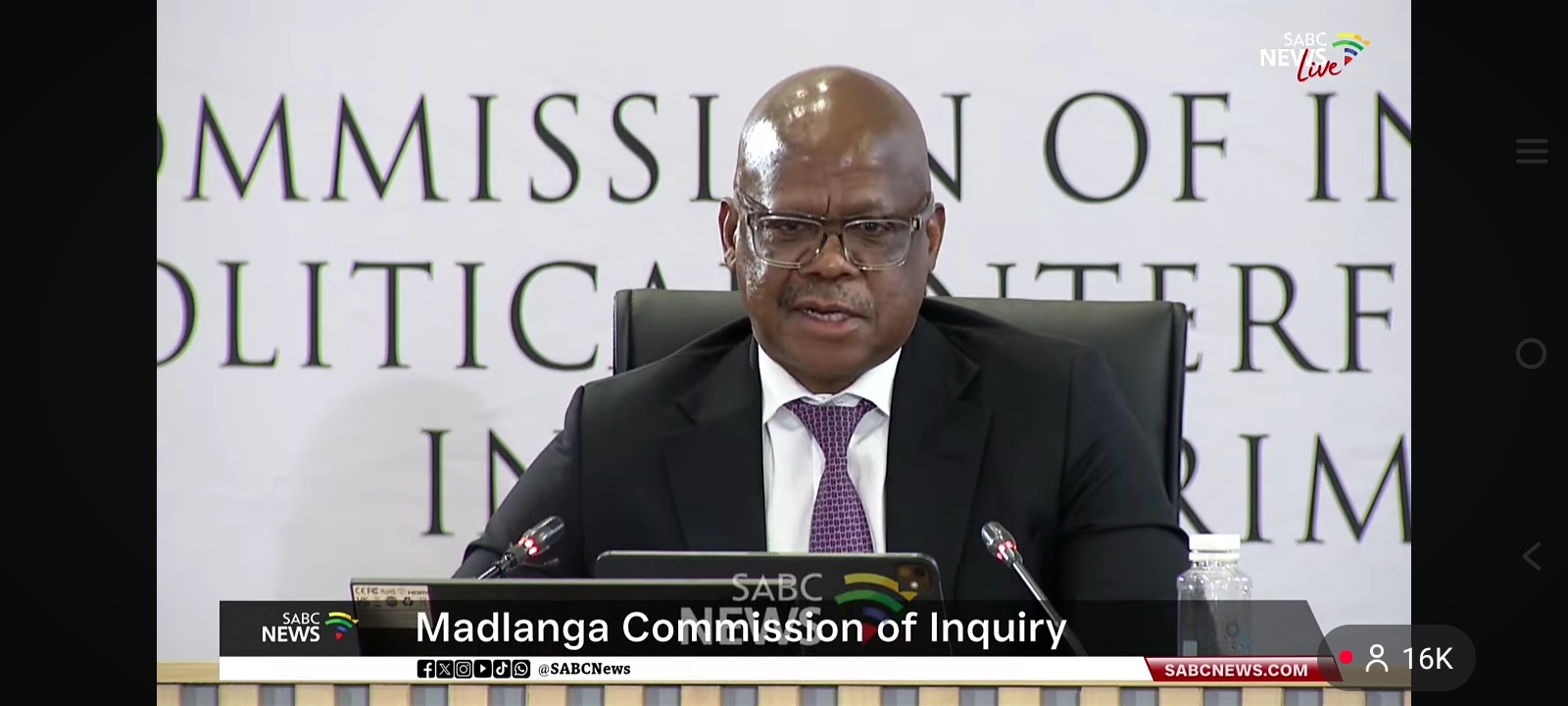

MAIN PHOTO: JOE SIBANYONI AT THE MADLANGA COMMISSION
Matlala, Lebeya and Sibanyoni’s evidence this week, read together, sketches a parallel centre of power that outgrew the taxi industry that built it
Weekend Wrap · A synthesis of testimony delivered before the Madlanga Commission of Inquiry, 24–28 August 2026
There was no single dispatch on Judge Mbuyiseli Madlanga’s inquiry this week — not by accident, but by design. Three witnesses took the stand over four sitting days: Vusimuzi “Cat” Matlala continuing his marathon cross-examination, former Hawks boss Godfrey Lebeya making his first appearance, and Mpumalanga taxi boss Joe “Ferrari” Sibanyoni opening a new front in the inquiry’s reach into the taxi industry. Taken individually, each session made its own headlines. Taken together, they tell one story — about a farm outside Hammanskraal that, on the evidence heard this week, functioned less as a rural retreat than as an unofficial capital where police generals, tenderpreneurs and taxi bosses did business beyond the reach of any institution meant to watch them.
This wrap pulls the threads from all three witnesses into a single narrative, anchored on the property described in testimony simply as the Farm — late taxi boss Jotham “Mswazi” Msibi’s homestead, and, on this week’s telling, the beating heart of the network the commission has come to call “The Firm” or the “Big Five.”
The Farm: Anchor of a Parallel State
If one image defined this week at Madlanga, it was not a courtroom exchange but a place. Sibanyoni, testifying on Friday, told the commission he had come to understand the farm as something far bigger than a hangout for taxi bosses — a hub whose reach, he suggested, extended well past the transport sector and touched the upper levels of government and the state itself. Coming from a man who spent decades inside the industry the farm supposedly served, and who eventually inherited Msibi’s throne at the South African Local and Long-Distance Taxi and Bus Organisation, the claim landed as confirmation of something the country had long suspected but rarely heard said so plainly under oath.
That framing did not emerge from nowhere. It builds directly on evidence Matlala gave earlier in the week, and on weeks of prior testimony that has slowly assembled a guest list for the farm reading like a who’s who of the commission’s central cast. Matlala told the inquiry he became close to controversial North West businessman Suliman Carrim precisely because both men were regular visitors to Msibi’s property, where their paths kept crossing until a friendship — and a R15 million loan — followed. Elsewhere in his testimony, Matlala placed suspended deputy national police commissioner Lieutenant-General Shadrack Sibiya among the senior officers who visited Msibi there, alongside former KwaZulu-Natal Hawks head Lesetja Senona. Earlier commission evidence has also placed businessmen Steve Motsumi and Hangwani Maumela, and arrested police sergeant Fannie Nkosi, at the same address.
Msibi’s farm functioned, on this week’s composite picture, as the one venue where police brass, tenderpreneurs and taxi bosses could all plausibly claim to have met — without any of it looking like a meeting at all.
What makes the farm the right anchor for this week’s wrap is how consistently it resolves an otherwise puzzling question the commission keeps circling: how did a suspended deputy police commissioner, a Crime Intelligence general, a group of Gauteng tenderpreneurs and a Mpumalanga taxi cartel all end up entangled in the same web of favours, cash and contracts? The answer, threaded through Matlala’s and Sibanyoni’s evidence this week, is that they didn’t need a formal introduction. They had a shared address. Once acquaintance was established on the farm, the commission has heard, business — tenders, protection, information, and in some cases violence — followed through ordinary social and criminal channels.
It is this pattern that lets the week’s evidence be read as depicting something closer to a parallel state than an ordinary criminal network: a venue where the boundary between legitimate industry leadership, police authority and organised crime simply stopped applying. Sibanyoni’s Friday testimony was the clearest articulation yet of that idea — not proof in the legal sense, since the commission is not a court and makes no findings of guilt, but a first-hand account from deep inside the taxi industry that the country’s suspicions about a shadow structure sitting above and beside the state were not far-fetched.
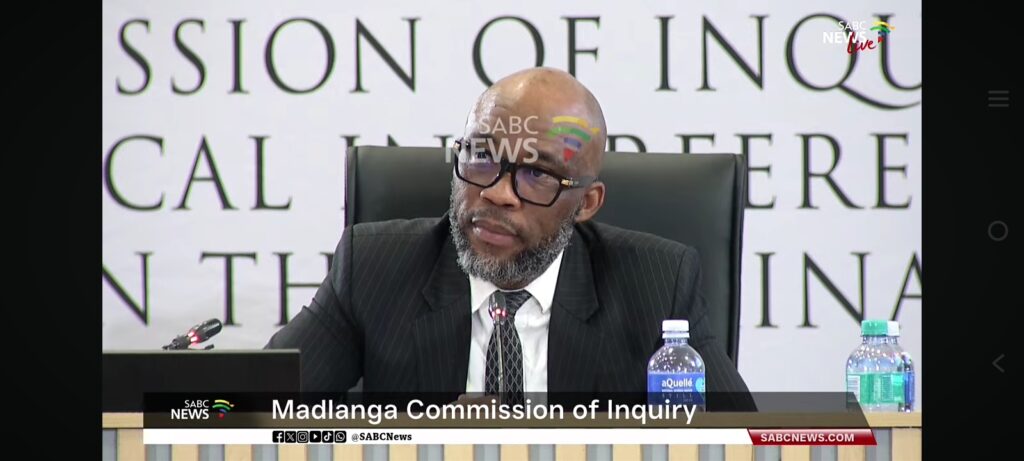
CAPTION: “CAT” MATLALA AT THE C OMMISSION THIS WEEK
Matlala: Naming a Network, Protecting Himself
Matlala spent much of the week walking a narrow line between cooperating with the commission and refusing to answer questions he says could incriminate him in his separate criminal trials — the collapsed R360 million Medicare24 SAPS tender and an attempted murder charge tied to a 2022 ambush on Sibanyoni himself. That tension dominated Monday’s session, when evidence leader Adila Hassim, Matlala’s counsel Annelene van den Heever and Judge Madlanga spent roughly half an hour arguing over the limits of Matlala’s constitutional privilege against self-incrimination.
Even within those limits, Matlala offered the commission a working map of the network around Sibiya. He confirmed a April 2025 meeting with KwaZulu-Natal police commissioner Nhlanhla Mkhwanazi, arranged through former police minister Bheki Cele, at which he discussed allegations that Sibiya had been collecting money from people in the criminal underworld — though Matlala maintained he had not paid Sibiya directly himself. He instead pointed to sergeant Fannie Nkosi, already facing charges after a raid turned up cash, firearms and unlogged case dockets at his home, as the person who allegedly collected money from others in Gauteng on Sibiya’s behalf. Matlala declined to confirm or deny more specific allegations, including a claim that he had arranged for impalas and other gifts to be delivered to Sibiya, citing the ongoing criminal investigation into leaked recordings.
On other relationships, Matlala was more forthcoming, if selectively so. He acknowledged his bond with Carrim traced back to their shared visits to Msibi’s farm, and that Carrim had lent him R15 million he could not say he had fully repaid — an admission serious enough that the commission has since said it will pursue a criminal complaint against Carrim for possible breaches of the Commissions Act. He was firmer on distancing himself from Crime Intelligence officer Feroz Khan, telling the inquiry he had no relationship with Khan and had never met him, despite Khan’s own entanglement in the commission’s evidence and his shooting in June, shortly before he was due to testify.
Read alongside Sibanyoni’s account of the farm, Matlala’s evidence does two things at once. It corroborates the farm’s role as the network’s social glue — he describes his own closeness to Carrim, and by extension to the wider circle, as a direct product of both men’s visits there. And it shows a witness carefully calibrating how much of that network he is prepared to expose, protecting himself in parallel criminal matters even as he confirms enough to keep the commission’s picture of the farm’s guest list intact.
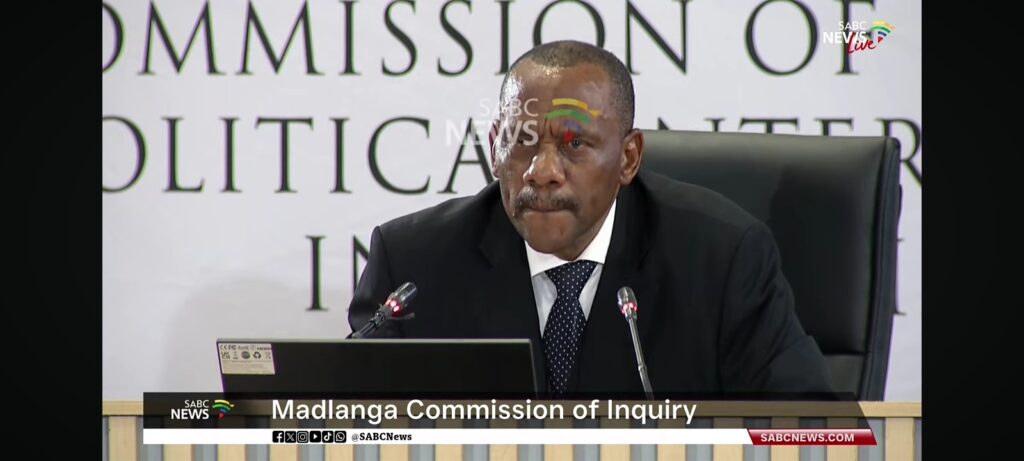
CAPTION: LEBEYA AT THE COMMISSION THIS WEEK
Lebeya: The View From Inside a Fractured SAPS
If Matlala and Sibanyoni supplied the human geography of the network, Lebeya’s Thursday appearance supplied the institutional backdrop against which it operated. The former Hawks national head spent the day defending his conduct during the chaotic December 2024 arrest of murder-accused businessman Katiso “KT” Molefe at a Sandton home, where Hawks officers unexpectedly arrived and were accused of trying to interfere with a legitimate Political Killings Task Team operation already under way.
Lebeya denied ever having met or spoken to Molefe, saying instead that he was alerted to the scene by a Johannesburg businessman known to him as Malcolm X, who reported that unidentified officers claiming Hawks affiliation were on site. Lebeya said he sent two senior managers purely to verify the officers’ identities, not to disrupt the operation, and described a near-miss standoff between rival units — the Hawks’ Tactical Operations Management Section, the Gauteng Organised Crime Unit and the Political Killings Task Team — that he said could have ended in unintended violence had a single phone call not been made in time. He placed responsibility for the confusion on former Crime Intelligence and task team boss Dumisani Khumalo, whom he said had withheld information out of concern that other SAPS units were compromised.
Beyond the Molefe episode, Lebeya used his testimony to sketch a service he described as politically interfered with as far back as 2009, with successive national commissioners — he singled out his own removal by former commissioner Riah Phiyega as one example — using restructuring, redeployment and dismissal to reward loyalists and sideline rivals. He also told the commission he had raised concerns about the Investigating Directorate Against Corruption and its former head, Andrea Johnson, with the National Director of Public Prosecutions, and had asked for an independent prosecutor to be appointed.
Lebeya’s account matters to this week’s wider thread precisely because it is structural rather than personal. Where Matlala and Sibanyoni describe a farm functioning as an alternative meeting point outside formal institutions, Lebeya describes those same formal institutions — the Hawks, Crime Intelligence, the task teams meant to police organised crime and political killings — as already compromised and factionalised from within. The two pictures reinforce each other: a police service riven by internal rivalry and political capture is precisely the kind of institution whose senior figures would find it easier, not harder, to conduct real business somewhere off the books — at a farm, rather than at a police station.
Sibanyoni: The Farm’s Rival, Not Just Its Guest
Sibanyoni’s Friday testimony was billed as evidence about the Kwaggafontein syndicate and alleged criminal networks in Mpumalanga, but its most striking material concerned his own combustible relationship with Msibi — the man he eventually succeeded atop the taxi industry’s leading body. Sibanyoni told the commission that after surviving a 2022 ambush he attributed to Vusimuzi Matlala, he confronted Msibi directly over the attack, having come to believe Msibi’s growing circle of hard men, including murder-accused Katiso Molefe and Matlala himself, made him a live threat rather than a rumour to be dismissed.
That confrontation sits at the centre of what emerges as a genuine turf war rather than a simple falling-out. Sibanyoni described tightening his own security in direct response to intelligence gathered both from industry contacts and from people who had visited Msibi’s farm — using the same property Matlala describes as a site of friendly business as a listening post for a rival bracing for violence. The relationship between the two men, on this account, was never a clean break so much as a long, uneasy cycle of suspicion, cooperation and rupture: taxi associates for years, then estranged rivals whose dispute grew serious enough that peace had to be brokered by SANTACO president Abner Motlhabane Tsebe after taxi drivers were killed on both sides.
Sibanyoni also used his appearance to position himself as a whistleblower rather than a participant, telling the commission he had written to then police minister Bheki Cele during the Covid-19 period warning that senior SAPS officials were embedded in a cabal running the taxi underworld, and asking for an urgent meeting before killings spiralled further out of control. He said Cele’s response, in essence, was dismissive — that taxi operators were already in the habit of killing one another regardless. Sibanyoni also distanced himself from the industry’s hitmen culture, telling the commission that whether an operator kept so-called izinkabi on call depended entirely on the individual, not on any industry-wide arrangement, and cast himself as a man of faith who built his empire over four decades of lawful trade.
The irony evidence leaders did not need to labour is that Sibanyoni’s rise to the top of SALLDTBO came directly on the back of Msibi’s death in January 2024 — meaning the man now describing the farm as a seat of shadow power once feared for his life at the hands of its occupant, and now sits, by the commission’s own account of prior testimony, in much the same structural position Msibi held before him.
Weaving the Thread: What the Week Adds Up To
Set side by side, the three witnesses this week do not tell a single, tidy story so much as they triangulate the same one from different vantage points. Matlala shows how personal proximity at the farm converts into financial and criminal entanglement — loans, unanswered questions about cash for Sibiya, friendships formed simply by being seen there often enough. Lebeya shows the institutional vacuum that made an informal power centre like the farm necessary in the first place — a police service too factionalised and too politically compromised to be trusted with sensitive business through its own formal channels. And Sibanyoni shows what happens when that informal power centre turns on one of its own — a rival taxi boss forced into hiding by information gathered from the very property meant to be neutral ground.
The picture that results is one of a network operating with its own internal logic, resources and enforcement mechanisms — tenders, protection, cash, and when necessary, violence — running in parallel to formal state structures rather than simply corrupting them from outside. That is what makes “parallel state” more than a rhetorical flourish this week: the evidence suggests decisions affecting policing, tenders and taxi routes across Gauteng and Mpumalanga were being made, or at least influenced, at a private farm rather than in any government building.
None of this amounts to a finding — Madlanga’s commission does not convict anyone, and each of this week’s witnesses has either denied wrongdoing outright or carefully hedged around it. Matlala continues to resist answering anything that could touch his own pending trials. Lebeya left the stand still facing further questions on a date yet to be scheduled. Sibanyoni is due back before the commission on 21 September, and separately faces his own extortion and money-laundering case in Delmas. But for a country that has spent a year and a half hearing testimony about compromised generals and murdered whistleblowers in fragments, this week did something new: it gave the fragments a shared address.
At a Glance — This Week’s Witnesses
- Vusimuzi “Cat” Matlala (Mon–Wed): Continued cross-examination; confirmed his April 2025 meeting with Gen. Mkhwanazi, his farm-based friendship with Suliman Carrim and an unpaid R15m loan; repeatedly invoked self-incrimination privilege on Sibiya-related questions.
- Godfrey Lebeya (Thu): First appearance; denied knowing Katiso Molefe or ordering interference in his 2024 arrest; testified to long-standing political interference within SAPS and raised concerns about IDAC’s independence.
- Joe “Ferrari” Sibanyoni (Fri): Described Msibi’s farm as reaching influence beyond the taxi industry into government; detailed his turf war and eventual confrontation with Msibi; distanced himself from the industry’s hitmen culture; returns 2 September.
Compiled from testimony and reporting on the Madlanga Commission of Inquiry into Criminality, Political Interference and Corruption in the Criminal Justice System, sitting in Pretoria, 24–28 August 2026. Sourced from commission proceedings and coverage by SABC News, eNCA, EWN, Daily Maverick, Business Day, Sunday Times, Sowetan and allAfrica.