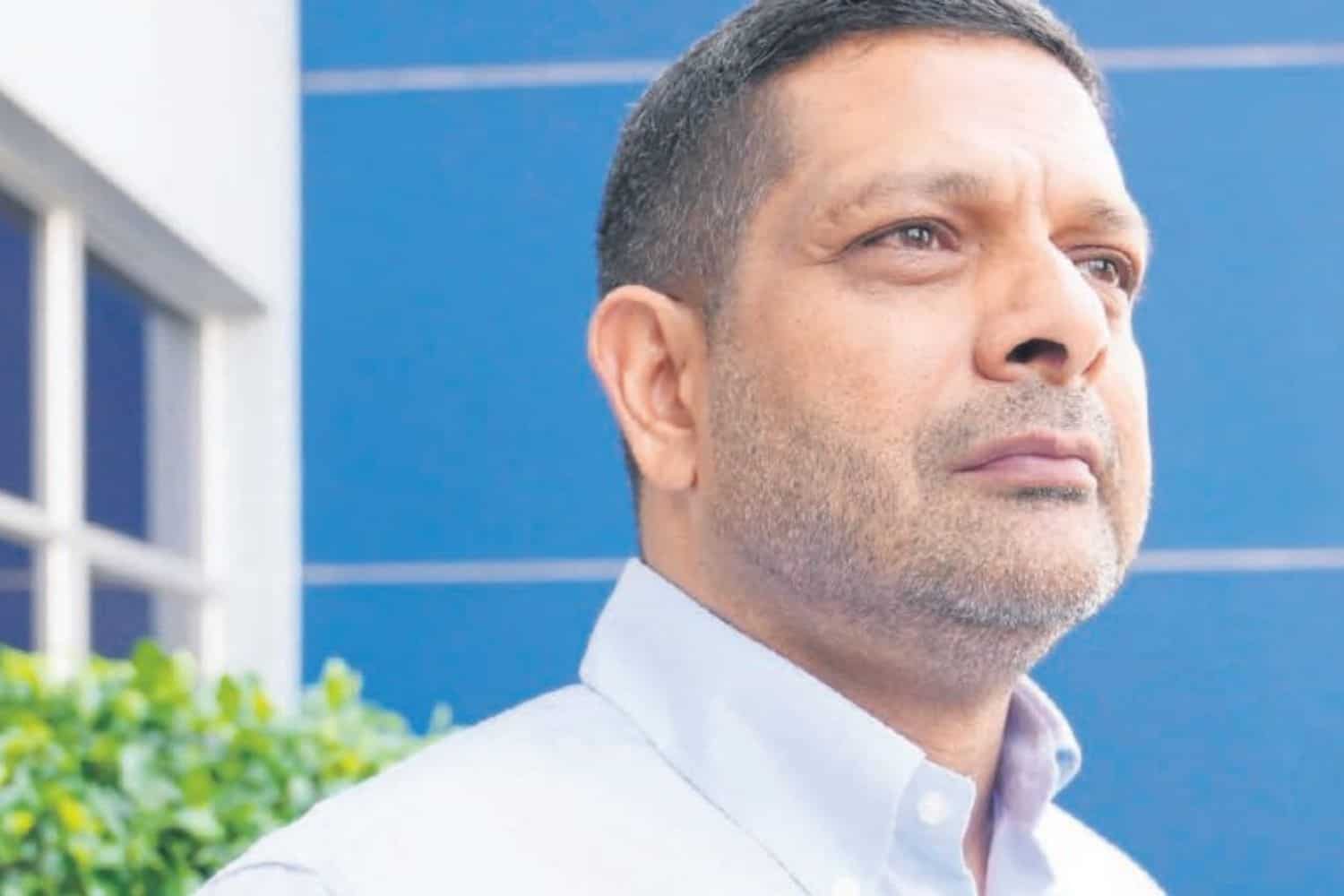

MAIN PHOTO: FEROZ KHAN – COURTESY OF MAIL&GUARDIAN
A PiE SPECIAL REPORT
From crime-intelligence power broker to dismissed general: how a cocaine bust, a commission of inquiry and an alleged assassination attempt brought down one of South African policing’s most talked-about figures.
Johannesburg | 2 September 2026
Major-General Feroz Khan, the suspended deputy head of Crime Intelligence whose name has dominated South African headlines for the better part of a year, has been fired from the South African Police Service (SAPS). The dismissal, confirmed on Wednesday night by police spokesperson Brigadier Athlenda Mathe, was effected “in terms of Regulation 9(7)(b)” of the SAPS Discipline Regulations — the clause that allows the service to deem an officer dismissed when they fail to appear before the senior officer running an expedited disciplinary process.
“No member, regardless of rank or position, is above the law or the applicable disciplinary framework,” Mathe said in the statement announcing the sacking.
It is the most concrete consequence yet in a saga that has run in parallel across a courtroom, a labour tribunal and the Madlanga Commission of Inquiry — and it lands just a day after the commission itself ran out of patience with Khan, warning that his testimony, twice delayed on medical grounds, cannot be postponed indefinitely and ordering an independent medical assessment to test whether his absence is genuine.
A 35-year career, and a name few could place
For a man who has become one of the most discussed officials in the country, remarkably little is publicly known about who Feroz Khan actually is. Even basic biographical details, such as where he was born and grew up, remain obscure. What is on record is that he joined police intelligence structures as a constable in September 1991, rising over 35 years to become deputy head of Crime Intelligence and, more recently, head of counter-intelligence within that division — a position that put him at the centre of the state’s most sensitive operations.
Alongside his police career, Khan was also reportedly a director of a lucrative motor-parts chain, Spares Oasis, valued at roughly R21-million — a business interest that has itself drawn scrutiny given his simultaneous role as a serving general.
Witnesses before the Madlanga Commission have gone further, describing Khan as a “political fixer” who cultivated relationships with senior politicians and used his influence to shape decisions well beyond the bounds of his job description. KwaZulu-Natal police commissioner Lieutenant-General Nhlanhla Mkhwanazi — whose own allegations gave rise to the commission — has described Khan as running a “dirty” office within Crime Intelligence, with reach into external criminal and political networks.
The bust that follows him: Aeroton, 2021
Long before the Madlanga Commission existed, Khan’s name was attached to one of the more contested drug busts in recent South African policing history. On 9 July 2021, police seized a multimillion-rand cocaine consignment from a warehouse in Aeroton, Johannesburg. Khan arrived at the scene and, according to police accounts, assumed control of the operation despite lacking the authority to do so — in the process allegedly interfering with the collection and handling of evidence.
The numbers themselves became a point of dispute. Evidence before the commission indicates the seizure amounted to 541kg of cocaine, yet a WhatsApp message Khan is alleged to have sent on the day of the bust put the haul at 552 blocks worth about R200-million — a discrepancy that evidence leaders say raises questions about what happened to the difference.
Four people, including two police officers and a Gauteng traffic chief, were initially charged over the incident, but the case was later withdrawn. Khan himself faced a disciplinary process over allegations of defeating the ends of justice and bringing SAPS into disrepute — a process chaired by Mkhwanazi, who cleared him in March 2025 for insufficient evidence. Mkhwanazi has since testified that former police minister Bheki Cele pressured him in 2021 to protect Khan during the investigation, an allegation Cele denies.
The Aeroton case would not stay buried. Khan now separately faces prosecution arising from the same episode: he appeared, or was expected to appear, at the Kempton Park Magistrates’ Court on charges of allegedly defeating the ends of justice dating back to 2021 in the OR Tambo International Airport “precious metals” case, a matter revived after testimony before the Madlanga Commission reopened several dormant SAPS dockets.
Where it all began: Mkhwanazi’s press conference
The chain of events that would eventually consume Khan’s career traces back to 6 July 2025, when Mkhwanazi called a dramatic press conference alleging that South Africa’s criminal justice system — police, prosecutors, the judiciary, politicians and intelligence structures — had been infiltrated by drug cartels and organised crime networks. He named senior figures, including then police minister Senzo Mchunu and deputy national police commissioner Shadrack Sibiya, accusing them of disbanding a unit that had been investigating politically motivated killings in KwaZulu-Natal.
President Cyril Ramaphosa responded by establishing the Madlanga Commission of Inquiry, chaired by Justice Mbuyiseli Madlanga, to investigate the claims. Both Mchunu and Sibiya were suspended. It was within this wider inquiry that Feroz Khan’s name began to surface again and again — not as a peripheral witness, but increasingly as one of its central figures.
Testimony placed Khan alongside businessman Vusimuzi “Cat” Matlala, who faces murder-related charges, and self-described fixer Brown Mogotsi. A witness known only as “Witness C” told the commission that Khan had demanded R2.5-million from Matlala at a time when Khan was facing his own disciplinary process; Matlala has separately claimed he paid Khan only R500,000. The two versions remain unresolved. The commission also heard that Khan would occasionally use a penthouse belonging to Matlala in Menlyn, Pretoria.
The Malema connection
Among the more politically explosive threads to emerge has been evidence of a long-running relationship between Khan and EFF leader Julius Malema, reportedly dating back to their shared history in the ANC. A Madlanga Commission investigator’s affidavit alleged that Malema had provided political protection for Khan, while separate testimony described an alleged plot to pressure the then Inspector-General of Intelligence, Setlhomamaru Dintwe, into lying — which would have provided grounds for his removal. Messages allegedly linking Khan, tobacco-industry figure Mohammadh Sayed and Malema were read into the record. Malema has denied involvement.
Khan was also reported to have attended an EFF 10th-anniversary celebration, which he has said was legitimate intelligence work rather than a sign of political allegiance.
The Andrea Johnson affair
If the organised-crime allegations gave the Khan story its stakes, it was his relationship with Advocate Andrea Johnson, the now-former head of the Investigating Directorate Against Corruption (Idac), that gave it its tabloid charge.
WhatsApp messages submitted to the commission in late July revealed an evidently close, personal relationship between the two spanning several years, with exchanges in which they addressed each other as “Hi gorgeous” and “dearest” and spoke of missing one another. Khan had reportedly invited Johnson and her family to dinner, though she said the visit never took place.
The messages point to a relationship exceeding standard professional boundaries — including a message from Khan to Johnson on the very day of the Aeroton cocaine bust.
More seriously, the commission heard uncontested evidence that in 2018, while Johnson was a senior NPA prosecutor, she emailed the contents of a confidential assault and intimidation complaint against Khan directly to him — potentially allowing him to shape his own version of events before providing a statement. Johnson has acknowledged that the NPA is now deciding whether to prosecute her over accusations that she leaked information to Khan, and she has told the commission she stepped back from Idac investigations involving senior Crime Intelligence officers because of the situation.
Johnson has defended Idac’s broader work, telling the commission the directorate had uncovered evidence pointing to a systematic “capture” of Crime Intelligence, and said she received a death threat after the unit began investigating corruption within the division.
A shooting, a burglary, and a sick-note saga
As the commission’s scrutiny intensified, Khan’s own circumstances took a violent turn. On 28 June 2026, days before he was due to testify, Khan was wounded in a shooting in Houghton, Johannesburg, which his legal team has described as an attempted assassination and which reportedly left him unconscious. He was hospitalised, discharged for rehabilitation in mid-July, and has since been readmitted more than once, most recently to Milpark Hospital.
In a separate but eerily-timed incident, journalist Marianne Thamm’s home was burgled after messages allegedly referencing her were exchanged between Khan and a colleague discussing the need to “activate a counter” on someone. An evidence leader told the commission the sequence of events was “alarming”, even if it could not conclusively be linked.
Khan’s repeated absences from the commission became a controversy of their own. His sick notes came under independent scrutiny after a labour dispute revealed that some had apparently been backdated — with one exchange allegedly showing a doctor warning Khan’s son that altering a certificate could amount to fraud. The commission, having run out of patience, ruled on 1 September 2026 that any further postponement of his 28 September testimony would be conditional on an independent medical assessment, to be arranged by 8 September, confirming his genuine inability to appear. Absent that, Khan would be expected to testify in person — the ultimatum now hanging over him even as he is no longer a serving police officer.
The disciplinary road to dismissal
Separately from the commission, SAPS had been running its own expedited disciplinary process against Khan under Regulation 9, which allows serious misconduct cases to be dealt with through an accelerated procedure. Hearings, chaired by KwaZulu-Natal district commissioner Major-General Jabulani Khumalo, took place on 12, 25 and 26 August. Khan’s legal representatives attended the first session and sought a postponement; he was absent from the following sessions despite being offered the option to participate virtually, and the process continued without him.
Khumalo found Khan guilty of misconduct and bringing SAPS into disrepute, with dismissal recommended as the sanction. Khan’s lawyer, Muhammed Vally, disputed that his client had been dismissed at that point, arguing the process had been concluded improperly while Khan was dealing with genuine medical issues. Acting through the Police and Prisons Civil Rights Union (Popcru), Khan took the matter to the Labour Court in an urgent bid to halt the outcome.
That bid failed. On 31 August 2026, Labour Court Judge Connie Prinsloo struck the application off the roll, finding the court lacked jurisdiction to intervene. Popcru was ordered to pay the costs. Two days later, on 2 September, SAPS confirmed Khan’s dismissal was final.
Timeline: How the story unfolded
July 2021 — Controversial R286-million cocaine bust in Aeroton, Johannesburg; Khan takes control of the scene, later accused of interfering with evidence.
March 2025 — Disciplinary process chaired by Mkhwanazi clears Khan over the Aeroton incident, citing insufficient evidence.
6 July 2025 — Mkhwanazi’s press conference alleges criminal-syndicate infiltration of the justice system, prompting President Ramaphosa to establish the Madlanga Commission.
October 2025 — “Witness C” tells the commission Khan demanded R2.5-million from Vusimuzi “Cat” Matlala; dormant SAPS dockets, including the Aeroton case, are revived.
March 2026 — Mkhwanazi tells Parliament’s ad hoc committee that Cele pressured him to protect Khan; calls mount for Khan to testify at Madlanga.
11 May 2026 — Devices are seized in a raid on Khan’s Houghton home; Khan is arrested in connection with the revived Aeroton case.
8–9 June 2026 — Khan abandons his court bid to block investigators from accessing his seized devices; agrees to testify on 1 July.
28 June 2026 — Khan is shot and wounded in Houghton, days before his scheduled commission appearance; hospitalised.
7 July 2026 — Commission hears evidence of an alleged Khan-Malema plot to pressure the Inspector-General of Intelligence.
21–29 July 2026 — Andrea Johnson testifies before the commission; WhatsApp messages reveal a close personal relationship with Khan and a leaked 2018 complaint.
12, 25–26 August 2026 — SAPS expedited disciplinary hearing proceeds substantially in Khan’s absence; he is found guilty of misconduct and disrepute.
31 August 2026 — Labour Court strikes Khan’s urgent bid to halt the disciplinary outcome off the roll for lack of jurisdiction.
1 September 2026 — Madlanga Commission orders an independent medical assessment, warning no further postponement without it; testimony reset for 28 September.
2 September 2026 — SAPS confirms Khan’s dismissal from the police service, with immediate effect.
What happens now
Khan’s dismissal ends his 35-year career in the police service, but it does not end his legal exposure. He still faces a criminal charge of allegedly defeating the ends of justice arising from the 2021 Aeroton bust, and the Madlanga Commission’s ultimatum — submit to an independent medical evaluation or appear in person on 28 September — remains in force regardless of his employment status. The commission has also ordered him to submit a written affidavit responding to its questions by 18 September.
For Andrea Johnson, the fallout is only beginning: the NPA is weighing whether to prosecute her over the same allegations that helped end Khan’s career, and the Idac Oversight Judge’s office has confirmed it is examining complaints against her.
What began as a single press conference by a provincial police commissioner has, fourteen months later, toppled a deputy head of Crime Intelligence, implicated the country’s own anti-corruption chief, and drawn in a former police minister, an opposition leader and a murder-accused businessman. The Madlanga Commission’s work, and Khan’s next legal moves, are far from over.
Sources: Daily Maverick, SABC News, eNCA, Mail & Guardian, TimesLIVE/Sunday Times, EWN, IOL, The Citizen, Corruption Watch, explain.co.za, Joburg ETC. Compiled from public reporting on the Madlanga Commission of Inquiry and related court and disciplinary proceedings, current to 2 September 2026.