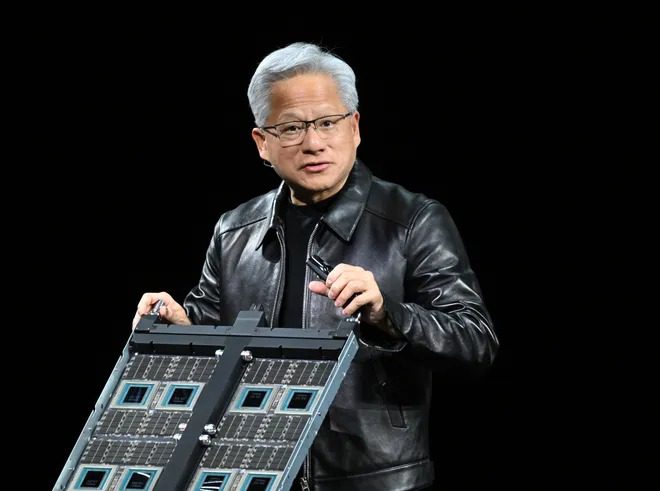

Nvidia’s board has launched an independent investigation after reports that CEO Jensen Huang was targeted by a Chinese intelligence operation. With US authorities examining a major Nvidia customer and a shareholder lawsuit now emerging, the controversy is raising questions about corporate governance, export controls and the security of the global AI supply chain.
PiE+ | Technology | 10 November 2026
Nvidia is facing an extraordinary corporate and national-security controversy after its board announced an independent investigation into reports that its co-founder and chief executive, Jensen Huang, was targeted by a foreign intelligence operation.
The announcement, made on 8 November, followed media reports alleging that a Chinese business executive connected to Singapore-based technology company Megaspeed International had been recruited by China’s Ministry of State Security to gather information on Huang.
The allegations have placed the world’s most valuable AI chipmaker under renewed scrutiny at a time when its processors are central to the global artificial intelligence industry. They have also raised questions about the relationships between technology companies, international customers and governments competing for control over advanced computing infrastructure.
Nvidia has confirmed that its board is investigating the matter. However, the company has also stated that it has no reason to believe that national security information or Nvidia trade secrets were compromised.
Huang remains in his position as chief executive and has committed to cooperating with the investigation.
Why Nvidia’s Board Is Investigating Jensen Huang
In a statement published on 8 November, Nvidia’s board confirmed that it was initiating an independent investigation following reports that Huang had been the target of a foreign intelligence effort.
The review will be overseen by a committee of independent directors, supported by outside independent legal counsel. The board said the investigation would examine all available information, while emphasising that it currently had no reason to believe that either US national security or Nvidia’s confidential corporate information had been compromised.
The statement also expressed confidence in Huang and his leadership team.
The announcement followed reports by The New York Times and the Financial Times concerning Huang’s alleged relationship with Alice Huang, a Chinese businesswoman associated with Megaspeed International. The two individuals are not related.
According to those reports, US intelligence officials believe Alice Huang was recruited by China’s Ministry of State Security and was tasked with gathering information on Nvidia’s chief executive.
These claims have not been independently established. Reuters reported on 10 November that it could not independently verify the intelligence allegations. China has also denied the espionage claims.
The distinction is important: Nvidia has confirmed an investigation into reports of a foreign intelligence effort. It has not announced that its CEO was knowingly involved in espionage or that company secrets were handed to a foreign government.
Who Is Alice Huang and What Is Megaspeed International?
Alice Huang has become a central figure in the controversy because of her reported connections to Megaspeed International, a Singapore-based cloud computing company involved in the AI infrastructure market.
Reuters reported on 10 November that Alice Huang, also known as Huang Le, previously held senior positions in China’s financial sector before becoming the controlling shareholder of Megaspeed. The news agency reviewed corporate filings, financial records and company materials as part of its investigation into her business background.
Megaspeed attracted attention from US authorities over suspicions that advanced Nvidia processors could have been transferred to Chinese customers in violation of American export restrictions.
The company has also been identified as an Nvidia cloud partner, placing it within the wider ecosystem of businesses purchasing or providing access to Nvidia’s high-performance computing hardware.
The New York Times has reported that Megaspeed purchased more than US$4.8 billion worth of Nvidia chips over a two-year period. That figure has become a significant part of the controversy because it illustrates the scale of the commercial relationship and the potential importance of the company to Nvidia’s international business.
However, the size of those reported purchases does not establish that the hardware was illegally transferred to China.
Reuters found records showing that Megaspeed’s Indonesian subsidiary imported Nvidia hardware, including H100 processors and related components, between 2024 and 2026. Those shipments do not, by themselves, demonstrate a breach of US export controls.
The investigation into Megaspeed and the allegations surrounding Alice Huang therefore involve several separate questions: who ultimately controlled the business, where its hardware was going, whether export restrictions were breached and whether any intelligence operation targeted Nvidia’s leadership.
Why Nvidia’s AI Chips Have Become a National Security Issue
The controversy cannot be separated from the growing geopolitical competition between the United States and China.
Nvidia designs some of the world’s most advanced processors for artificial intelligence training and inference. Its graphics processing units, including the H100 family, are used in data centres, cloud computing platforms, scientific research and the development of large AI models.
These processors are particularly valuable because they provide the computing power needed to train and operate increasingly sophisticated artificial intelligence systems.
Washington has introduced export controls restricting China’s access to certain advanced computing chips. The objective is to limit the availability of technology that could strengthen China’s military capabilities or accelerate strategic AI development.
This has created a complicated business environment for Nvidia. China represents an important technology market, but selling advanced processors into restricted destinations can expose companies to significant regulatory and national-security risks.
For US policymakers, the concern is not simply where a chip is purchased. It is also where that chip ultimately ends up, who operates it and whether it is being transferred through intermediaries to bypass restrictions.
The Megaspeed allegations bring those concerns directly into Nvidia’s commercial network.
If the investigation identifies weaknesses in how customers are assessed or how advanced hardware is tracked after sale, the consequences could extend beyond one customer relationship. It could lead to greater scrutiny of international cloud partners, stricter compliance requirements and additional restrictions on AI chip exports.
Jensen Huang Admits Infidelity but Denies No Specific Espionage Allegation
The controversy has also drawn attention to Huang’s personal life after the Nvidia CEO addressed employees in a message published by the company on 8 November.
Huang acknowledged that he had been unfaithful to his wife and apologised to his family and colleagues.
His message said his actions had hurt his wife and children, adding that there was no excuse for his behaviour.
Although the apology confirmed the personal relationship controversy, it did not establish the intelligence allegations against Alice Huang or demonstrate that Nvidia’s confidential information had been compromised.
Huang has expressed support for the board’s investigation and committed to cooperating fully.
Nvidia has maintained that its chief executive’s interactions with customer executives are part of the normal responsibilities of his position. The company has also previously said that its customers receive ordinary business information rather than classified information or US national-security material.
The independent investigation will be important in determining whether those safeguards were sufficient in this particular case.
Nvidia Stock Falls as Investors Assess the Fallout
The controversy has also reached financial markets.
Nvidia shares closed approximately 4.3% lower on Monday, 9 November, according to CNBC reporting. The decline reflected investor concerns surrounding the investigation, the potential implications for the company’s reputation and uncertainty over the developments that could follow.
Nvidia’s position in the AI industry makes the situation particularly sensitive.
The company supplies processors used by some of the world’s largest technology businesses, cloud providers and AI developers. Its products underpin major investments in data centres and computing infrastructure.
Consequently, uncertainty surrounding its leadership or ability to maintain reliable relationships with international customers could attract attention well beyond the company’s shareholders.
However, a short-term share price decline does not necessarily indicate that Nvidia’s underlying business has been fundamentally damaged. Investors will be looking for evidence about the investigation’s findings, the potential regulatory consequences and whether the controversy affects the company’s ability to deliver products and maintain customer confidence.
Shareholder Lawsuit Adds Another Layer to the Nvidia Investigation
The controversy developed further on 10 November after a proposed shareholder class-action lawsuit was reported against Nvidia and Jensen Huang.
According to The Associated Press and The Washington Post, the complaint alleges that Nvidia and its chief executive misled investors about Huang’s relationship with Alice Huang and the potential national-security and business risks surrounding the company’s relationship with Megaspeed.
The lawsuit seeks damages for investors who purchased Nvidia shares during the period specified in the complaint.
These are allegations made by shareholders, not findings that Nvidia or Huang violated securities laws. The claims will have to be tested through the legal process.
The lawsuit nevertheless introduces another challenge for the company. In addition to the board’s independent review and scrutiny of Megaspeed’s activities, Nvidia could now face questions about the adequacy of its disclosures to investors.
For a company whose market value is closely tied to confidence in its technology, leadership and future growth, the handling of the controversy will matter.
What the Investigation Could Mean for the Future of Nvidia
There are three major issues that could shape the outcome.
The first is corporate governance. Huang is not simply another executive at Nvidia. He co-founded the company and has become one of the most recognisable figures in the global technology industry. His influence over Nvidia’s strategy, partnerships and public identity makes any uncertainty surrounding his leadership particularly significant.
The second is export-control compliance. If the investigation reveals weaknesses in how Nvidia evaluates customers, monitors its distribution partners or manages sensitive commercial relationships, the company could face additional regulatory scrutiny. This could make international AI chip sales more complicated, particularly in markets connected to China.
The third is national security. Advanced AI processors have become strategic assets in the competition between major economies. The investigation could intensify pressure on technology companies to demonstrate that their global supply chains are secure and that restricted hardware cannot easily be diverted through intermediaries.
For now, there is no public finding that Nvidia’s trade secrets or US national-security information were compromised. There is also no established finding that Megaspeed illegally transferred restricted Nvidia processors to China.
The board’s investigation, developments involving US authorities and the shareholder lawsuit will determine how much further the controversy develops.
PiE Perspective: Nvidia’s Biggest Test May Be Trust
Nvidia has become one of the defining companies of the artificial intelligence era. Its processors power the infrastructure behind some of the world’s most ambitious AI projects, while its chief executive has become a prominent voice in the future of computing.
That position brings enormous influence, but it also brings greater responsibility.
The Jensen Huang investigation highlights a challenge facing the entire technology industry: the more strategically important a company’s products become, the more closely its customers, executives and international business relationships are likely to be examined.
The issue is bigger than one executive’s personal life. It concerns the security of AI infrastructure, the integrity of global technology supply chains and the ability of companies to maintain trust while operating across competing geopolitical interests.
Nvidia has said it has no reason to believe its secrets or national security information were compromised. The independent investigation must now establish whether that confidence is supported by the available evidence.
For the wider AI industry, the outcome could become an important test of corporate accountability in an era when semiconductor technology is no longer just a commercial product, but a strategic resource.