
LEN KALANE
They weave through Joburg gridlock and hug Cape Town’s coastal bends, a fleet of buzzing two-wheelers carrying everything from burgers to birthday cake. A decade ago they didn’t exist. Today they are rewriting how South Africans eat, shop and move — and putting them on a collision course, sometimes literally, with the country’s most powerful transport industry.
It is 7:42 on a Tuesday night in Sandton. Thabo is on the couch, still in his work clothes, remote in one hand and phone in the other. He hasn’t cooked, hasn’t showered, hasn’t moved much at all since he got home — and within four taps, that is entirely fine. A notification tells him his butter chicken and naan are “on the way,” and a small icon of a scooter begins crawling across a map on his screen, turning left, then right, then stopping outside a boom gate two roads over. Twenty-two minutes later, a rider in a branded jacket hands over a warm paper bag, taps a phone against a phone, and is gone again into the dark, chasing the next order.
Multiply Thabo by several million, several nights a week, across every South African city with a working set of traffic lights, and you begin to understand why the scooter has become one of the most quietly disruptive machines in the country. It is not just a delivery vehicle. It is a new national habit — the physical expression of a simple, seductive idea: that almost anything can arrive at your door before the kettle has finished boiling, and that someone else will brave the traffic, the rain and the taxis to make it happen.
For the consumer, the appeal barely needs explaining. Load-shedding, long commutes and a culture that increasingly prizes convenience over ceremony have made the on-demand economy feel less like a luxury and more like infrastructure. A grocery run that once meant shoes, a trolley and twenty minutes of parking-lot politics can now be a few taps between episodes of a TV show. The scooter, and the person riding it, has become the connective tissue of that convenience — usually invisible, until the doorbell rings.
From Fridge Magnets to Phone Screens
The idea of food arriving at your door is not new to South Africa — it is simply new to being digital. Long before apps existed, a Cape Town company called Mr Delivery was already sending drivers out to fetch takeaways, taking orders the old-fashioned way: over the telephone, from menus stuck to fridges with magnets. It was founded in 1992 by an entrepreneur who, as the story goes, had recently been delivering pizzas himself and spotted a gap for a service that would fetch food from restaurants that didn’t deliver on their own.
That business quietly carried South Africa’s takeaway culture for more than two decades before technology caught up with it. E-commerce group Takealot bought Mr Delivery in 2014, and over the following three years transformed it from a call-centre operation into a smartphone-first one — by 2017, roughly 95% of its orders were coming through an app rather than a phone call, a total reversal from just a year earlier. It re-emerged as Mr D Food, the platform that would go on to become one of the country’s dominant delivery apps.
Global players arrived soon after. Uber, having already established ride-hailing in the country, launched UberEats in the northern suburbs of Johannesburg in 2016, explicitly betting on its existing driver network and app infrastructure to muscle into food. Bolt — then still trading as Taxify — followed with Bolt Food in Cape Town in 2020, undercutting rivals on commission before folding the service in December 2023 after South Africa’s Competition Commission raised concerns about anti-competitive practices in the sector.
“The scooter economy didn’t invent convenience — it digitised a habit South Africans already had, from fridge-menu phone orders to an app that knows your address before you’ve finished typing it.”
An Old Trick, Borrowed from the Backseat
The scooter’s rise did not happen in isolation — it rode in on the coattails of a slightly older revolution. Uber’s ride-hailing app launched in Johannesburg in August 2013, the company’s first foothold on the African continent, followed quickly by Cape Town, Durban and Pretoria. Three years later, once South Africans had grown comfortable watching a car icon crawl toward them on a map, Uber simply repointed the same technology at food instead of people, launching UberEats in 2016. Bolt did the same trick in reverse order in some ways, entering South Africa’s ride-hailing market in 2016 under its former name, Taxify, before expanding into food delivery in 2020.
That is the real engineering behind the scooter boom: it borrows almost everything — the GPS tracking, the driver-partner model, the cashless payment rails, the star-rating trust system — from e-hailing, and simply swaps a passenger for a parcel. Where e-hailing digitised the taxi rank, food and grocery delivery digitised the corner takeaway and the supermarket trolley. Both industries lean on the same pool of drivers and riders, the same apps competing for the same wallet share, and increasingly, the same company badges.
The Numbers Behind the Buzz
It is easy to dismiss the scooter as a novelty until the figures are laid out. South Africa’s online food delivery market was worth an estimated US$1.1 billion (R17,53bn) in 2025, according to industry analysts IMARC Group, with online food and grocery delivery combined projected by Statista to reach US$2.72 billion (R43,35bn) in the same year and grow at more than 7% a year through the end of the decade. Roughly a third of South Africans who shop online now use a meal delivery app at least occasionally.
| ≈US$2.7bn Online food & grocery delivery market, SA (2025) | R11.9bn Checkers Sixty60 half-year revenue (to Dec 2025) | 34.6% Growth in Sixty60 revenue year-on-year |
| ≈10,000 Riders on Shoprite’s Pingo platform alone | 11,681 On-demand delivery jobs created by Sixty60 since 2019 | 50%+ Uber’s estimated share of SA e-hailing & delivery |
Figures compiled from IMARC Group, Statista, Shoprite Holdings and MyBroadband reporting, 2024–2026.
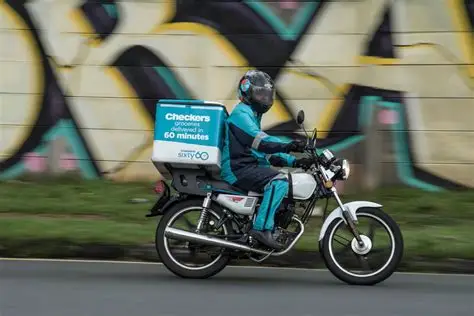
Grocery delivery has, if anything, outgrown food. Checkers Sixty60 — Shoprite’s on-demand grocery service, launched in 2019 and instantly recognisable by its teal-liveried bikes — has become one of the retailer’s fastest-growing divisions, with revenue climbing more than 500% since 2021 and now accounting for over a tenth of the group’s total turnover. To keep pace, Shoprite has been quietly building “dark stores” — warehouses invisible to ordinary shoppers, stocked purely to fulfil app orders — in Cape Town, Gauteng and KwaZulu-Natal.
Who’s Winning the Race
In ride-hailing, Uber remains the dominant force, commanding by some estimates more than half of South Africa’s combined e-hailing and delivery market, with Bolt its most credible challenger — the Estonian firm claimed roughly 40,000 driver-partners on its books as of recent years. In food, the contest is closer: Uber Eats and Mr D Food are widely regarded as the two heavyweights, trading blows on pricing and restaurant partnerships since Bolt Food’s exit left the field to them. Newer entrants — DiDi, inDrive and a scattering of locally owned platforms — have added competition on the ride-hailing side without yet seriously threatening the leaders.
In groceries, however, there is little contest at all. Checkers Sixty60 pioneered on-demand grocery delivery in South Africa and has stayed comfortably ahead of rivals such as Pick n Pay’s ASAP! and Mr D’s own grocery push, which only began piloting deliveries through a Pick n Pay partnership in 2022 — two years behind Sixty60’s head start. First-mover advantage, in this industry, has proven remarkably durable.
Kasi Flavour: When the Scooter Meets Velaphi
Zoom out from Sandton and the southern suburbs, though, and the picture gets patchier fast. The scooter economy has undeniably reached the township, but it arrived later, more cautiously and considerably more unevenly than it did in the leafy suburbs where the apps were first switched on. For years, the big platforms treated the kasi less as a market and more as a liability: food couriers were, by their own admission, sceptical about pushing into townships, wary not only of safety risks to riders but of assumptions about thin demand. Those doubts turned into policy in September 2022, when Uber Eats suspended deliveries to parts of Soweto altogether, citing ongoing safety risks to the people doing the actual riding — a retreat, however temporary, from South Africa’s most famous township.
Yet the retreat has proved to be the exception rather than the rule. Uber Eats has since said its own data pointed to something the caution had obscured: Soweto and townships like it are home to a deep reservoir of middle-class consumers, many with family or memories rooted there, who want a taste of home delivered rather than a 20-kilometre drive to fetch it. That reading has pulled the platforms deeper in rather than out. Uber, working with the Gauteng Department of Economic Development, says it has helped digitise more than 2,000 township enterprises so they can be found — and delivered from — through Uber Eats, while SPAR has struck similar partnerships to extend its SPAR2U grocery service into under-served areas, in some cases replacing a trip to the taxi rank with neighbours simply pooling an order and splitting the delivery fee.
Where the majors hesitated, homegrown operators saw an opening. KasiD, founded during the COVID-19 lockdowns by entrepreneur Freddy Mahhumane, built its entire pitch around the gap Uber Eats and Mr D were leaving unattended — partnering with informal, often unregistered township restaurants and betting that local knowledge of the kasi economy was a bigger advantage than a bigger app budget. It has since grown into a small last-mile ecosystem of its own, running food and grocery drops, parcel collections and rider training across Gauteng’s townships, and has picked up its own retail partnerships along the way. It is a reminder that township delivery, where it has taken root most successfully, has often grown from the inside out rather than been rolled in from Sandton.
In the kasi, the scooter economy answers to two names at once — the brand printed on the rider’s jacket, and the ghost of an old SABC sitcom still riding around in the language.
Language, as ever, has its own way of tracking how deep something has actually sunk in. Most township residents reach for the same shorthand suburban South Africa does, calling any scooter delivery “Uber-Eats” regardless of which app or rider actually shows up at the gate — brand-as-generic-noun, the same linguistic trick that turned any photocopy into “a Xerox.” But a smaller, more playful vocabulary has taken hold alongside it: some township residents call the riders “Velaphis,” a nod to the classic SABC1 sitcom that followed the light-hearted escapades of a scooter messenger, played by the late Ray Ntlokwana, working for a fictional advertising agency called Shukushukuma. Decades after it first aired, reruns of Velaphi still turn up on SABC’s archive channels, and the character’s name has quietly been recycled for the real-life riders doing the same job his fictional messenger did — parking a scooter outside a gate, bag in hand, chasing the next drop.
It is a small piece of nostalgia riding shotgun on a very modern industry — proof that even as branded fleets and dark stores push further into the township, the kasi still finds room to name the phenomenon in its own voice, on its own terms.
Is South Africa Really Leading the Pack?
It is tempting, watching the scooters swarm Sandton or the southern suburbs, to assume South Africa invented this. It didn’t — and the continental picture is more interesting than that. By market value, South Africa genuinely is Africa’s biggest foodservice economy, holding roughly a third of the continent’s total foodservice market and boasting by far its most formalised delivery infrastructure: branded fleets, dark stores, corporate logistics partners and apps that feel indistinguishable from their European or American counterparts.
But value is not the same as scale, and on that measure the story flips. Analysts expect Nigeria’s online food delivery revenue to overtake South Africa’s within the next few years, powered by Lagos’s density and a much younger population hungry for convenience. More strikingly, South Africa is a relative latecomer to the two-wheeler economy itself. East and West Africa were digitising motorcycle transport years before a Sixty60 bike ever left a Checkers parking lot: Nigeria is home to an estimated eight million okada (motorcycle taxi) drivers, and platforms such as SafeBoda, Gokada and Uber’s own Boda product had already turned Kampala, Nairobi and Lagos into two-wheeled ride-hailing markets by 2018 — years before South Africa’s scooters became a familiar sight.
South Africa didn’t pioneer the two-wheeled economy — it borrowed a continental habit and pointed it at your dinner instead of your commute.
The reason for that gap is structural, not accidental. In East and West Africa, motorcycle taxis stepped in largely because minibus and matatu networks couldn’t keep pace with fast-growing, congested cities, so the two-wheeler became a way of moving people. In South Africa, the minibus taxi industry never left that gap open — it remains the dominant carrier of commuters, fiercely and sometimes violently protective of its territory, which is precisely why Uber and Bolt’s e-hailing cars, rather than motorcycles, became the passenger-side disruptors here. South Africa’s scooters, by contrast, found their opening not in moving people but in moving parcels — a niche the taxi industry had little interest in defending. The result is a continent where South Africa leads in polish and revenue, but East and West Africa got there first in scale, informality and sheer number of wheels on the road.
Weaving Through Traffic — and Through Conflict
The romance of the scooter economy has a harder edge once you look past the app interface. South Africa’s minibus taxi industry, which still carries the majority of the country’s commuters, has watched e-hailing and delivery platforms erode its territory since Uber’s 2013 arrival, and the resulting tension has repeatedly turned violent. Reports throughout 2025 documented e-hailing drivers being assaulted, and in some cases killed, in disputes widely linked to taxi association turf wars — a grim undercurrent to an industry consumers experience only as a friendly notification and a smiling delivery photo.
The riders themselves carry much of the operation’s physical risk, and often its financial precarity too. Sixty60 drivers, for example, are structured as independent contractors rather than employees, earning roughly R7,600 a month before fuel and bike-rental costs are deducted — expenses that, by some estimates, can eat away more than half of that figure. Road safety data compiled from major cities has recorded roughly seven delivery-rider crashes a day nationally, with dozens of fatalities logged in 2025 alone, a sobering counterweight to the industry’s convenience narrative and a reminder that the gig economy’s flexibility cuts both ways.
None of this has slowed the platforms’ expansion. If anything, the friction has become part of the story South Africans tell about their cities: a taxi swerving across three lanes, a scooter squeezing past on the yellow line, a delivery bag strapped to a rider’s back, all converging at the same red robot — a small, chaotic tableau of an economy in transition.
Batteries, Bylaws and the Next Chapter
If the last decade of South Africa’s two-wheel economy was about proving the model worked, the next one looks set to be about what powers it and who gets to regulate it. Petrol engines are already giving ground to electric ones: AutoTrader estimated there were roughly 65,000 delivery motorcycles on South African roads by January 2026, and the government is now in talks with investors about establishing local electric delivery-bike manufacturing — treating the sector less as a retail convenience and more as a potential slice of industrial policy. Homegrown hardware is already on the road: the Mellowvan, an electric delivery tricycle designed and built in Stellenbosch, is being used by Takealot, DHL and Spar2U, while battery-swap networks — of the kind Uber has adopted for its new electric offerings — promise to solve the range anxiety that has held e-bikes back on longer delivery runs.
Uber alone says it has committed R5 billion to South Africa’s mobility, delivery and digital economy ecosystem, and its regional leadership has suggested the two-wheel space could create as many as 300,000 new earning opportunities over the next decade. Regulators are, slowly, catching up: the National Road Traffic Amendment Act of 2024 finally created proper legal categories for e-scooters and power-assisted cycles, which had technically been classified in the same bracket as a bakkie, while a National Land Transport Amendment Act gazetted in September 2025 now requires e-hailing and motorcycle-taxi drivers to hold a professional driving permit.
But the road ahead is not a straight line. Uber Moto — the company’s low-cost motorcycle-taxi pilot, launched in Johannesburg in February 2025 at fares as low as R18 a trip — grew quickly enough that Uber’s regional GM called it a potential “core engine” for the next decade of e-hailing. Road-safety advocates were less convinced, with one prominent industry commentator calling the idea of carrying passengers on motorbikes in South Africa’s traffic conditions “absurd” given the country’s road fatality record. By August 2026, Uber had quietly paused the consumer-facing Moto product “as it evaluates the feedback and insights gathered during its pilot phase” — a reminder that not every bet on two wheels lands smoothly, and that South Africa’s appetite for convenience still runs up against hard questions about safety, regulation and who bears the risk when the model doesn’t quite work.
What About Drones?
It is the obvious next leap in anyone’s imagination — a whirring quadcopter dropping a pizza on the lawn instead of a rider ringing the buzzer — but South Africa is, for now, conspicuously absent from that story. Elsewhere on the continent, drone delivery is already routine: Zipline’s fixed-wing drones deliver blood and medicine to more than 80% of hospitals in Rwanda and have expanded into Kenya and Ghana, built on regulators there granting so-called beyond-visual-line-of-sight (BVLOS) approval years ago. South Africa has no comparable commercial delivery network in the air, despite having some of the continent’s most established drone hobbyist and survey industries.
The reason is largely regulatory rather than technological. The South African Civil Aviation Authority treats BVLOS flight — the single requirement any genuine delivery drone needs, since it must fly beyond what an operator standing on the ground can see — as an exception granted case by case, rather than a licensed category of everyday operation. Commercial drones must stay under 120 metres, remain within visual line of sight without special approval, and keep well clear of the airports and dense urban airspace that busy delivery routes would need to cross. For a country whose biggest delivery corridors run straight through Johannesburg and Cape Town’s controlled airspace, that is a considerably higher bar to clear than Rwanda’s rural hospital routes ever needed to.
For now, then, South Africa’s on-demand economy remains a resolutely ground-based affair, and probably will for some years yet: a scooter, a rented electric bike or an underpaid rider on a motorcycle is simply cheaper, more flexible and far less encumbered by aviation law than a fleet of delivery drones would be. If the skies do open up, it is more likely to start with a narrow, tightly regulated corridor — perhaps medical supplies to an under-served clinic, in the Zipline mould — than with your Friday night takeaway.
The Couch Is the New High Street
What began as two separate ideas — a car you could summon, and a meal you could summon — is fast becoming one seamless habit. The same apps that once did only rides now deliver parcels, medicine and furniture; the same companies that once did only food now deliver almost anything a dark store can stock. Bolt has signalled plans to add electric bikes and scooters to its own platform following Bolt Food’s closure, doubling down on last-mile delivery even as it stepped back from restaurant meals. The direction of travel is unmistakable: fewer separate errands, more single super-apps quietly running the logistics of daily life in the background.
It is tempting to reach for the obvious comparison — that this is simply what the telephone did a century ago, collapsing distance into a dial tone — except the ambition here is larger. The telephone let you ask for something. The scooter economy lets you never leave the couch to get it, and if you do eventually need to go out, the very same app that brought your dinner will happily send a car for you too. Whether that convenience comes at a fair price for the people doing the actual riding is a question South Africa is still working out, one delivery, one near-miss and one buzzing scooter at a time.
Sources: IMARC Group, Statista, Shoprite Holdings interim results, MyBroadband, BusinessTech, TechCentral, ITWeb, Daily Maverick, TopAuto, africa.com, Human Rights Research Center, SA People, SABC, Reuters and KasiD, 2016–2026.