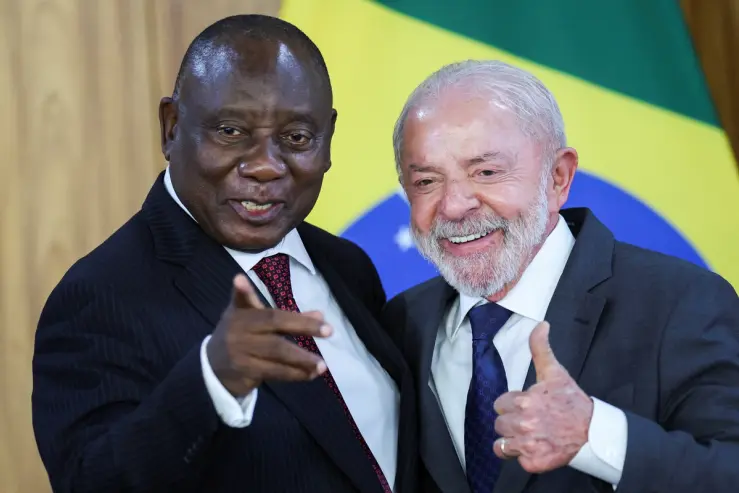

CAPTION: SOUTH AFRICAN PRESIDENT CYRIL RAMAPHOSA SEEN HERE IN AN EARLIER PHOTO WITH RE-ELECTED BRAZILLIAN PRESIDENT LULA DA SILVA
ANALYSIS: IDO LEKOTA
Luiz Inácio Lula da Silva’s return as Brazil’s president for an historic fourth term is more than a personal political comeback. It is a reprieve for progressive forces— an important interruption of the right-wing evangelical tide that has become deeply embedded in Brazilian politics.
Lula’s victory came against a formidable challenger in Senator Flávio Bolsonaro, the son of former president Jair Bolsonaro and the standard-bearer of a movement that has fused nationalism, social conservatism, religious mobilisation and the promise of material success.
Flávio Bolsonaro’s campaign drew strength from powerful evangelical networks, conservative business interests and a close political affinity with the United States under President Donald Trump—an alignment that framed Brazil’s future as part of a broader right-wing, anti-left project in the Americas.

CAPTION: FLAVIO BOLSANARO
That is why Lula’s fourth presidency begins with an unusual contradiction. He has returned to the Planalto Palace, but he has not reclaimed the country’s political culture. The right may have lost the presidency, yet its networks, narratives and religious influence remain powerful.
President Cyril Ramaphosa recognised the wider significance of the result in his message of support:
“On behalf of the government and people of South Africa I congratulate my dear brother and friend, President Lula and the people of Brazil. This victory will echo beyond the shores of Brazil. It is a victory for the global south and progressive forces throughout the world.”
Ramaphosa added:
“We affirm our commitment to continue strengthening bilateral relations between our two countries and working closely together in all multilateral fora to forge a just and better world order underpinned by solidarity and adherence to international law.”
CAPTION: SOUTH AFRICA’S PRESIDENT CYRIL RAMAPHOSA
For South Africa, Lula’s re-election is therefore both a geopolitical opportunity and a political warning. It strengthens Pretoria’s relationship with one of the Global South’s most influential powers, while inviting a harder question:
How does a progressive movement govern a society in which right-wing evangelical politics has become a powerful source of identity, belonging and aspiration?
Lula has won the presidency for a fourth time. The more difficult task will be winning back Brazilians who have come to see the right not merely as a political alternative, but as a moral community and a pathway to success.
The politics of spiritual success
Brazil’s evangelical right has developed an unusually effective political language. It combines religious conviction, social conservatism, personal ambition and material aspiration.
Its message is simple: believe correctly, live correctly, work hard and prosperity will follow. The new house, the expensive car, the sharply tailored suit and the carefully staged social-media photograph become signs of divine favour.
In this political marketplace, success is not merely financial. It is testimonial.
The prosperous believer becomes evidence that the formula works. The entrepreneur becomes a moral example. The pastor becomes a leadership coach. The church becomes a community centre, welfare office, business network, media platform and campaign machine – all before the closing hymn.
Lula’s social-democratic message is more complicated. He speaks about hunger, jobs, inequality and public services. His opponents speak about family, morality, order and victory. One side presents policy; the other presents destiny.
Destiny, unlike a government programme, usually promises immediate emotional returns.
“The church has been slumbering”
The evangelical right does not see its political prominence as an intrusion into public life. It sees it as a correction.
“Christians are becoming more involved, becoming activists. I think that is a good thing, because the church has been slumbering,” evangelical activist Lance Wallnau has said.
The quotation comes from an American religious and political context, rather than from Brazil itself. But it captures an argument that has travelled well: Christians, its advocates maintain, are not trying to politicise religion; they are simply refusing to remain politically passive.
Wallnau’s wider “Seven Mountains” framework calls on conservative Christians to influence major institutions, including government, education, media, business, family, religion and culture. That ambition helps explain why the evangelical right cannot be understood merely as a voting bloc.
It is an organised social ecosystem, with churches, media platforms, business networks, youth programmes and political campaigns reinforcing one another.
The political message is unapologetic: if religious believers represent a large and organised part of society, why should they not seek influence over the institutions that govern it?
The answer from the secular left is usually that democracy must protect the state from religious capture. The answer from the evangelical right is that democratic politics cannot exclude citizens because they are religious.
Lula is caught between those two arguments—and both sides believe they are defending democracy.

CAPTION: EVANGELICAL ACTIVIST LANCE WALLNAU
Faith as political infrastructure
The influence of evangelical politics cannot be explained only by manipulation or electoral opportunism. Churches are present in people’s daily lives in ways the state often is not.
They provide food, counselling, childcare, transport, social connections, emergency support and opportunities for leadership. For many young people, they offer a sense of belonging in an economy defined by insecurity and limited prospects.
The church can also function as a networking space. A young person may enter through worship and find music, media, business contacts, mentorship, political education and a route into public life.
This is why the evangelical right has been able to insinuate itself into so many sectors of Brazilian society. It has not simply asked people to vote for a candidate. It has helped shape how they understand success, morality, family, nation and social responsibility.
It has offered a complete worldview and, occasionally, a business opportunity with a worship team.
The youth and the performance of prosperity
Young Brazilians have been especially important to this transformation. They are navigating unemployment, inequality, social-media pressure and an economy that often demands entrepreneurial optimism from people who cannot find stable work.
Evangelical networks give many of them an identity that is not defined by poverty or exclusion. They can become singers, influencers, entrepreneurs, motivational speakers, youth leaders or aspiring politicians.
Their public image is often built around discipline, aspiration and visible advancement. Religion becomes intertwined with branding. Faith is not only something to practise; it is something to display.
The message is attractive because it recognises a genuine desire among young people to escape deprivation and become symbols of achievement. The difficulty is that it can turn structural problems into personal tests of faith and effort.
If you are poor, the implied question is not always, “What has society denied you?” It may be, “Have you believed, worked or given enough?”
That is a powerful way of converting inequality into an individual moral drama.
Lula’s delicate task
Lula cannot afford to treat Brazil’s evangelical voters as a single reactionary bloc. Many are poor, working-class citizens who support churches because those institutions provide solidarity, services and dignity.
Nor can he afford to wage war on religion. Such a strategy would strengthen the right’s claim that the left is hostile to faith and family.
His task is more difficult: to defend a secular democratic state while respecting religious belief; to oppose the political capture of institutions without dismissing religious communities; and to argue that social justice is not an attack on prosperity.
This will require patience and political intelligence. Lula must show that government can protect families without allowing any religious group to define citizenship. He must demonstrate that public education does not threaten faith, that gender equality does not destroy society and that economic inclusion is not a conspiracy against successful people.
In other words, he must conduct a national conversation in which everybody believes they have been personally summoned.
The right has not disappeared
The narrowness of Lula’s victory should discourage triumphalism. The right remains deeply rooted, and its political infrastructure survived the defeat of its preferred presidential candidate.
Lula may have won the executive branch, but conservative forces retain influence in Congress and across state institutions. They also possess churches, media channels, social-media networks and a compelling narrative of cultural grievance.
Their appeal is not based only on opposition to the left. It is also based on fear: fear of crime, family breakdown, moral decline, communism, economic insecurity and loss of cultural control.
The right tells voters that it understands what is being taken from them. The left often tells voters what is wrong with their understanding.
That is not usually a winning communication strategy.
The Brazilian lesson for South Africa
South Africa should study Brazil carefully. The political environment is different, but several underlying dynamics are familiar.
Faith-based organisations often provide services where the state is weak. Young people combine religion with entrepreneurship, digital influence, fashion and aspirational consumer culture. Political movements that fail to offer employment, dignity and belonging leave space for other institutions to define the future.
The lesson is not that religion is inherently right-wing. Nor is it that young people are being duped. The lesson is that political influence belongs to those who organise communities and give people an explanation of their lives.
South African political parties should therefore pay attention to the institutions that shape everyday identity. Churches, social-media networks, business forums, youth movements and informal community organisations can be as politically important as formal party structures.
A party that appears only during elections will struggle against institutions that are present every Sunday, every weeknight and every time a young person needs advice, opportunity or support.
Ramaphosa’s message—and its challenge
Ramaphosa’s statement about strengthening relations with Brazil is important. South Africa and Brazil can cooperate on BRICS, climate policy, agriculture, digital transformation, development finance and reform of international institutions.
But the deeper value of Lula’s re-election lies in the political questions it poses for South Africa.
Can a liberation movement remain relevant without relying on historical legitimacy? Can democracy be defended while government fails to deliver? Can progressive politics speak to young people who want prosperity, status and recognition—not only redistribution? Can the state build communities of belonging as effectively as churches and digital influencers?
These questions cannot be answered through diplomatic language alone.
Ramaphosa was right to call Lula’s victory a victory for the Global South and progressive forces. But Brazil’s political landscape reminds us that progressive victory is never secured by an election result. It must be sustained through competent government, economic opportunity and a persuasive account of the future.
Lula now faces the difficult task of persuading Brazilians that democracy, social justice and material success belong in the same sentence.
The Brazilian right has already made its pitch: prosperity as proof, faith as identity and politics as spiritual combat.
Lula’s challenge is to offer something equally powerful without turning the presidency into a pulpit.
And South Africa’s challenge is to learn from both sides before its own voters decide that the sermon elsewhere sounds more convincing.