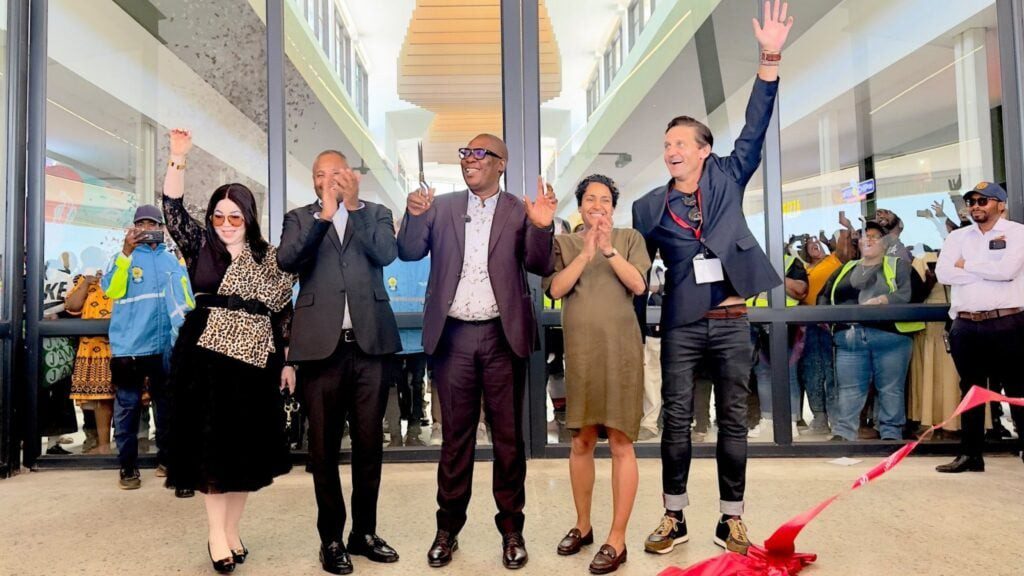

CAPTION: GAUTENG PREMIER PANYAZA LESUFI (CENTRE MIDDLE IN SUIT) WITH MOGALE CITY EXECUTIVE MAYOR LUCKY SELE ON THE LEFT AND GAUTENG MEC FOR HUMAN SETTLEMENTS TASMEEN MOTARA ON HIS RIGHT AT THE LAUNCH OF THE KAGISO MEGA CITY – PICTURE SOURCED FROM BUSINESS TECH
LEN KALANE
A ribbon, a mall and a big promise
On Thursday 29 October 2026, Leratong City Shopping Centre opened its doors in Kagiso, the West Rand township whose name means “peace” in Setswana. Behind the doors sit 42,000 square metres of retail space, 89 tenants, and anchors that include Shoprite, Pick n Pay, Boxer, Clicks and a DStv outlet, with McDonald’s, KFC and an Absa branch among the others. Across the road stands Leratong Hospital, a fixture of the area since the 1970s.
The mall is the first finished piece of something much larger: the Leratong Smart City Development, a roughly R5-billion partnership between the Gauteng Provincial Government, Mogale City Local Municipality, Trendville Investments and McCormick Property Development. Gauteng Premier Panyaza Lesufi called it a “new post-apartheid city”. Mogale City’s Executive Mayor, Lucky Sele, spoke of a vibrant urban hub where residents reach services close to home.
It is a moment worth marking. It is also a moment worth questioning, because the word doing the heaviest lifting in the project’s name is “smart”, and so far the public paperwork says very little about what is smart about it. This feature looks at both sides: what Leratong is, what a smart city actually requires, where the project stands against its peers, and what it could mean for how South Africans live.
What is actually being built
Leratong sits on about 350 hectares at a junction of major roads linking Mogale City, Randfontein, Merafong, Roodepoort, Florida and Johannesburg. It is one of Gauteng’s “Mega Cities”: planned, self-sufficient developments along transport corridors that combine housing, commerce and services, instead of isolated housing projects scattered across existing urban areas. The province’s argument is that building the bulk infrastructure once, and building the economy alongside the houses, is a better way to tackle the housing backlog.
| Leratong at a glance (as publicly reported) Investment: about R5 billion; partnership of province, municipality and two private firms Phase 1 delivered: Leratong City Shopping Centre, 42,000 m², 89 tenants, opened 29 October 2026 Jobs: 1,096 during mall construction; about 2,500 permanent jobs expected once the full development is complete Housing: about 15,000 units announced at launch; Mogale City’s draft 2026/27 plan says “potential for 16,000”, with roughly 5,000 in Phase 1 Near-term target: Gauteng Human Settlements MEC Tasneem Motara says the developer aims to deliver 3,500 homes before the end of 2027 Still to come: a private hospital, a commercial precinct with government support services, schools, parks, early childhood centres and public transport nodes Extras flagged at launch: Kasi CoLAB (a township design and entrepreneur incubator), market gardens and sports facilities |
Why the numbers keep moving
Readers following the project will notice that figures shift between documents, and it is worth saying so plainly. Mogale City’s 2021/22–2025/26 Integrated Development Plan (IDP) described a first phase of 1,900 homes and a second of 13,000. The draft 2026/27 IDP now speaks of 16,000 homes, with about 5,000 in Phase 1. The mall itself was announced at 35,000 m² in 2025 and opened at 42,000 m². The project has also been described variously as a “smart city”, a “nodal development” and a “mixed-use urban node”.
None of this is unusual for a large, multi-year development, where plans are refined as financing, land and demand firm up. But it does mean the end-state is still a moving target, which matters when we ask whether the “smart” promise will be honoured.
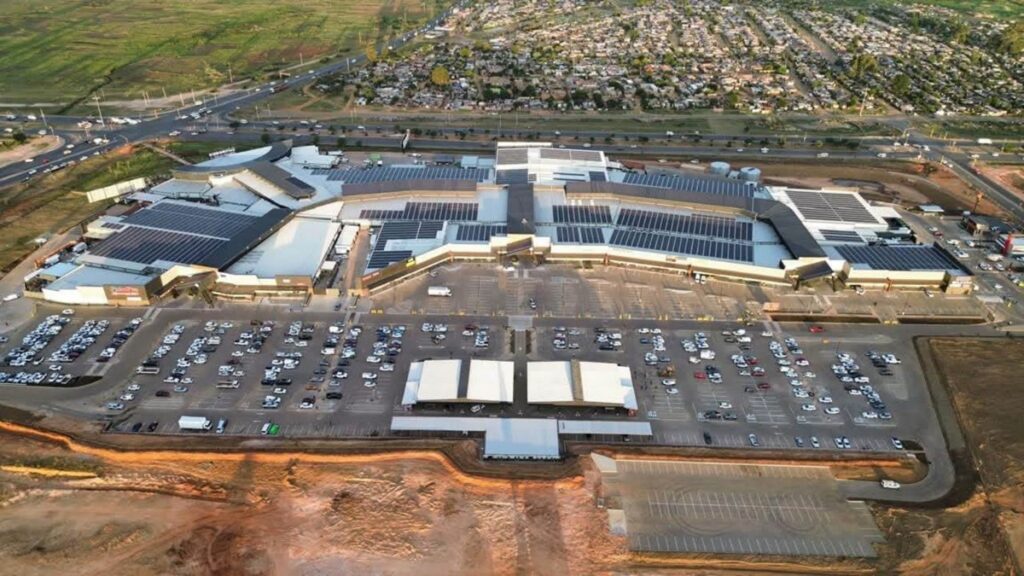
CAPTION: THE PROJECT LAYOUT ADJACENT LERATONG HOSPITAL – PIC: BUSINESS TECH
In the officials’ words
The politicians and planners have been consistent about the ambition, even if the detail is still emerging.
“A new City! A new Gauteng economic node!” — Premier Panyaza Lesufi, on X
Lesufi framed Leratong as a new centre of economic gravity for the province and a break with the spatial legacy of apartheid. Sele has tied it to a wider revival of Mogale City, pointing to the city’s ageing centre.
“My ambition is to see a single crane multiply across our CBD.” — Mayor Lucky Sele, at the launch
He added that he wants old buildings renovated and under-used properties redeveloped, which suggests the mall is meant to be a catalyst, not an island. Mogale City itself describes Leratong as part of a “longer-term vision” for a mixed-use urban node combining homes, commerce and essential services. When the nodal development was launched in June 2025, the municipality said it aligned with a vision of equity, redress and inclusive growth.
Our reading: the officials are selling a place, a self-contained node where people can live, work, shop and be treated at a hospital without a long commute. That is a legitimate and valuable urban idea. Whether it is also a smart idea is a separate question.
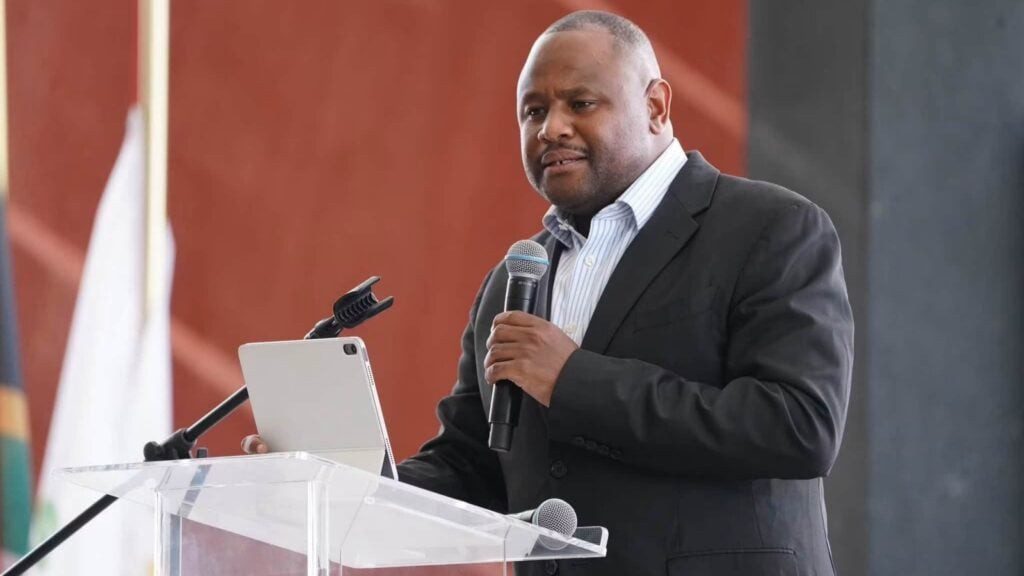
CAPTION: MOGALE CITY EXECUTIVE MAJOR LUCKY SELE SPEAKING AT THE LAUNCH – IMAGE BUSINESS TECH
So what is a smart city, really?
There is no single legal or technical definition, and that is part of the problem. The International Telecommunication Union (ITU) studied more than 100 definitions and settled on this idea: a smart sustainable city is an innovative city that uses information and communication technology (ICT) and other means to improve quality of life, the efficiency of urban operations and services, and competitiveness, while meeting the economic, social, environmental and cultural needs of present and future generations.
Two things stand out. First, technology is a means, not the goal. Second, the goal is a better city for its people, not a gadget-filled one. Academic frameworks commonly break this into six dimensions: smart economy, smart mobility, smart environment, smart people, smart living and smart governance. South Africa’s own Smart Cities Framework, issued by the national Department of Cooperative Governance, treats data as a central element of smart-city development.
In practice, most credible smart cities share an enabling layer and a set of services that run on it:
- Connectivity built in from day one: fibre ducting, public Wi-Fi and 5G-readiness laid before roads are tarred, because retrofitting later is far costlier.
- Smart utilities: smart electricity and water metering, leak detection, renewable generation, waste systems that report when they need collecting.
- Connected mobility: integrated public transport, smart traffic signals, safe walking and cycling, and links to rail or bus corridors.
- Digital government: services that residents can access online or at a local one-stop point, with transparent, open data.
- Safety and resilience: monitoring, emergency response and disaster planning that actually use the data collected.
- People and inclusion: skills, local enterprise, affordability and public participation. A smart city that only the wealthy can afford is not smart in the sense the ITU means.
Notably, Mogale City itself makes this point. In its draft precinct plan for the Muldersdrift–Lanseria area, the municipality wrote that a smart city should not be seen simply as a “tech-heavy” intervention, but as a holistic system. We agree, and we think the same yardstick should be applied to Leratong.
The scorecard: where Leratong stands today
Technology reporter Myles Illidge, writing for MyBroadband, pointed out that although the municipality’s planning documents refer to a smart city, they offer little detail on the ICT and other infrastructure that would justify the title. That is a fair observation, and our own review of the public record reaches the same conclusion. But “no published detail” is not the same as “nothing planned”, and the project is in its first phase. The table below is our attempt at a fair, dimension-by-dimension reading.
| Dimension | What the public record shows | What is not yet disclosed | Our reading |
| Smart economy | 1,096 construction jobs; 2,500 permanent jobs expected; Kasi CoLAB incubator; commercial precinct planned | Skills programmes, local-supplier targets, tenant mix beyond retail | Promising |
| Smart living | Mall open; Leratong Hospital adjacent; private hospital, schools, parks and early childhood centres planned | Delivery dates for hospital and schools | Partly there |
| Smart mobility | Sited on a major road junction; public transport nodes planned for later phases | Integrated ticketing, traffic management, rail or bus-rapid links | Early stage |
| Smart environment | Reports say renewable energy generation capacity is planned; market gardens flagged | Capacity, technology, water reuse and waste plans | Not yet shown |
| Smart governance | Commercial precinct to include government support services | Online services, open data, any city operations platform | Not yet shown |
| Digital backbone | Described as “advanced digital infrastructure” in coverage | Fibre, Wi-Fi, 5G readiness, data platform, who owns and operates it | Biggest gap |
| Inclusion | Mixed-income housing intended; township-based enterprise support | Price bands, rental share, affordability safeguards | Promising |
Source: our assessment based on Mogale City, Gauteng Provincial Government and trade-press disclosures to 7 November 2026. Verdicts are editorial judgements.
The honest summary is this. Leratong today is a very good integrated, mixed-use township node in the making. It is not yet demonstrably a smart one, and the missing piece is the digital backbone and the data layer that would let everything else be “smart”.
How Leratong earns the name
Here is the more hopeful half of our argument. Smart cities are rarely smart on opening day. What matters is whether the foundations are poured in the right order. Because Leratong is a largely new build on 350 hectares, it has an advantage that older suburbs do not: it can embed smart infrastructure in the ground while the ground is still open. Based on the project’s own stated components, we see a credible path across the later phases:
- Phase 1 (done): the economic anchor. Retail, jobs, a banking presence and foot traffic. This de-risks everything that follows, because developers and lenders need proof of demand.
- Housing phases (3,500 homes targeted by end-2027): the moment to lay fibre ducting, smart meters and solar-ready roofs. Doing it while homes are being built costs a fraction of retrofitting later.
- Services phases (hospital, government precinct, schools): the moment for digital government and connected health. A one-stop precinct with online access, shared data and open reporting would be a genuine smart-governance feature.
- Transport and public realm: the moment for integrated mobility. The planned public transport nodes are the natural hook for smart ticketing, real-time information and safe pedestrian links to Leratong Hospital and the Chamdor precinct.
To be clear, this is our reading of the opportunity rather than a published programme. And it carries a challenge: the developers and the municipality will need to publish a smart-city specification and report against it. Until they do, critics have a point, and the label risks becoming marketing. Our recommendation to Mogale City is simple: put the digital and sustainability blueprint in the public domain, with dates.
Leratong among South Africa’s big urban projects
Leratong is not alone. South Africa has spent more than a decade talking about new cities, with mixed results. Here is how the main projects compare, based on what has been reported to date.
| Project | Where / who | Promise and status (Nov 2026) | Smart credentials |
| Leratong Smart City | Kagiso, Mogale City. Province, municipality, Trendville, McCormick | R5bn; 15,000–16,000 homes; mall open since 29 Oct 2026; 3,500 homes targeted by end-2027 | Stated ambition; little published detail yet |
| Lanseria Smart City | North-west Johannesburg, bordering Mogale City, Tshwane and Madibeng. Led by the provincial government | Announced 2020 for 350,000–500,000 residents; planning dates to 2007; visible progress minimal | Draft precinct plan sets out shared digital backbone, fibre ducting, 5G enablement and a Gautrain station |
| Mooikloof Mega City | Pretoria East. Baldwin Properties | Gazetted Strategic Integrated Project in 2020; targets about 50,000 sectional-title homes for the “missing middle”; first phase complete; R517m Garsfontein Road upgrade due mid-2027 | Marketed as a “green” mega city; smart detail limited |
| Lufhereng | West of Soweto. City of Johannesburg and province | Mixed-income mega project of about 22,500 homes, valued at about R22.3bn; completion targeted for 2029 | Framed as an integrated human settlement rather than a smart city |
| Modderfontein New City | East of Johannesburg. Zendai | Announced in 2014 as an R84bn, 1,600-hectare city; later plans collapsed and the land was put up for sale | Billed as South Africa’s first smart city, but a cautionary tale |
| Menlyn Maine / Waterfall | Pretoria and Midrand. Private developers | Mature, upmarket mixed-use nodes (Menlyn since 2010, Waterfall since 1997) | Menlyn pitched as a “green city”; both prove large nodes can work when demand exists |
Sources: MyBroadband, BusinessTech, Gauteng State of the Province Address 2026, SAnews, municipal statements. Figures as reported.
Two lessons leap out. First, scale is not the same as delivery. Modderfontein’s R84 billion headline never materialised because the financing and demand did not. Leratong’s R5 billion is smaller, but it is anchored by a public-private partnership, an operating mall and a clear housing target. Second, Leratong may be the first of the “Mega City” cohort to open a major commercial component, which gives it momentum that others, Lanseria especially, still lack.
CAPTION: PRESIDENT CYRIL RAMAPHOSA
The long wait for Lanseria
No account of South African smart cities is complete without Lanseria. President Cyril Ramaphosa announced it in his February 2020 State of the Nation Address as a “truly post-apartheid city” for 350,000 to 500,000 people within a decade, “smart and 5G-ready”. The idea itself is older: plans for a city around Lanseria airport go back to 2007, and the City of Johannesburg adopted the provincial framework in 2021.
Almost seven years after the announcement, visible progress is thin. MyBroadband has visited the site repeatedly, most recently in 2026, and found little more than an incomplete fence along Ashenti Road, an informal settlement within the planned boundary, and solar streetlights that the airport says belong to a separate City Power project. Obstacles include bulk infrastructure that requires heavy investment (the former human settlements minister told Parliament as much) and land occupation.
There are signs of life on paper. Mogale City’s draft Muldersdrift–Lanseria Precinct Plan proposes a shared digital backbone with common ducting and fibre, 5G enablement and a “Smart City” Gautrain station, as MyBroadband reported in August. In February, Premier Lesufi told the provincial legislature that Lanseria Smart City had secured R4 billion for Cradle Film Studios, a facility projected to create 15,000 jobs. Those are meaningful, but they are plans and pledges, not streets and homes.
This is where Leratong’s significance sharpens. If Lanseria is the vision, Leratong is the proof of concept. A working mall, rising homes and a funded housing target in the same municipality could give Mogale City real credibility, and possibly practical lessons, as the Lanseria precinct plan moves from draft to delivery.
A first for the township, and could every race group move in?
This is the question our editors find most intriguing: is Leratong the first smart-city initiative in a historically Black residential area, and could it become the first to draw residents from every racial group into a former township?
Is it a “first”?
Partly. As far as our research shows, Leratong may well be the first development in a historically Black township to carry an explicit “smart city” label, and that is a defensible claim of novelty. But we would caution against going further. Mixed-income, state-backed mega-projects in and around townships already exist. Lufhereng, west of Soweto, is a mixed-income development planned for about 22,500 homes. Cosmo City, north-west of Johannesburg, was launched in the early 2000s and is widely described as South Africa’s first fully integrated mixed-income settlement, with about 12,000 units ranging from subsidised homes to bonded houses and rentals. Fleurhof, between Soweto and Florida, uses a similar model. So the first is the smart label, not the mixed-income idea.
Where Kagiso starts from
Kagiso is the product of segregation. At the 2011 census it was 99.3% Black African, and its neighbouring area of Krugersdorp was about 50% white and 42% Black African. Mogale City as a whole was roughly three-quarters Black African and one-fifth white. Leratong sits on the boundary of these worlds, with road links to Krugersdorp, Roodepoort, Florida and Johannesburg. That geography is an opportunity.
What the evidence says about integration
Here we should be careful and honest, because the track record is sobering. Research on Cosmo City found that its design aimed at social cohesion primarily across income levels rather than race groups. A 2024 study of South Africa’s new developments found that expansion projects near townships remain home mostly to poor Black African residents, whereas suburban expansion for wealthy residents tends to be racially mixed but economically unequal. In other words, mixed-income and mixed-race are two different goals, and the first does not automatically deliver the second.
We also note that no official has so far publicly set racial integration as a stated target for Leratong. The language is about “opportunities for all”, equity and redress. That leaves the door open without promising to walk through it.
So could Leratong attract all racial groups?
Yes, it could, but it will not happen by default. Our view is that people move for services and certainty first and symbolism second. If Leratong delivers the things all households weigh, then a diverse set of buyers and tenants becomes plausible:
- Quality healthcare and schooling: the planned private hospital and schools are potentially the strongest draw for middle-income families of any background.
- Reliable services: water, electricity and maintained roads, which are Mogale City’s responsibility and which any resident, anywhere, will judge first.
- Safety and good design: secure, walkable streets and well-run public spaces.
- Real digital connectivity: fast, affordable fibre is a major draw for remote workers and young families, and it is one place where the “smart” promise can directly shape who moves in.
- A genuine price and tenure mix: bonded homes, rentals and subsidised units, placed so that neighbourhoods are integrated rather than segregated by income pockets.
- Access to jobs and transport: a short, reliable commute to work.
Our honest forecast is that diversity, if it comes, will be gradual, beginning with a modest number of non-Black households among the later housing phases, and tied closely to how well the services above are delivered. The telling signals will be who buys or rents in the 3,500-home first tranche, who is served by the new hospital, and which families choose Leratong’s schools. If, in five years, the development has pulled in a visibly mixed community, it will have achieved something no township-based project has yet done at this scale, and it will deserve the “post-apartheid city” label far more than the marketing does.
South Africa’s residential landscape after the dream is delivered
Imagine, for a moment, that Leratong, Lanseria, Mooikloof and Lufhereng all deliver substantially what is promised. What might South African urban life look like by the early 2030s? Based on the direction of policy and the projects above, we see five shifts:
- Cities replace scattered projects. The Gauteng model of integrated nodes with bulk infrastructure installed first should replace the older pattern of isolated housing developments on the urban edge, with their long commutes.
- Mixed income becomes the default. Subsidised homes, rentals and bonded housing will sit side by side. Mooikloof’s pitch to the “missing middle”, people who earn too much for a state house and too little for a bond, signals how large that market is.
- Transport anchors development. Rail and bus corridors, including the proposed Lanseria “Smart City” Gautrain station, will decide where growth lands.
- Connectivity becomes a utility. Fibre and wireless coverage will be planned as carefully as water and electricity, closing part of the digital gap between suburbs and townships.
- The township becomes a node, not a dormitory. Places like Kagiso, Soweto and Mamelodi will increasingly host jobs, healthcare, retail and government services, not only housing.
Now the reality check. South Africa’s history with mega-projects is mixed. Modderfontein shows how quickly financing can evaporate. Lanseria shows how long land, bulk services and politics can stall a flagship. Mooikloof’s developer was, as of 2025, still awaiting reimbursement from government for completed work, a reminder that public-private partnerships are only as strong as the public side’s ability to pay. And across all of these, municipal capacity to maintain what gets built remains the quiet make-or-break factor.
What to watch: our Leratong checklist
| Milestone | Why it matters | Timing |
| Publication of a smart-city specification | Turns a label into a commitment with measurable features | As soon as possible |
| Fibre ducting and metering in housing phases | Shows whether the digital backbone is real | During home construction |
| First 3,500 homes delivered | Proves the residential engine, not just retail | Before the end of 2027 |
| Who actually buys, rents and moves in | The truest test of the inclusion and integration promise | From first handovers |
| Private hospital and schools break ground | The services that make a node a city | Subsequent phases |
| Transport nodes and links to the corridor | Determines whether residents can reach jobs | Later phases |
| Permanent jobs reaching the 2,500 target | Confirms the economic case | On full completion |
Our verdict
Kagiso deserves its moment. A R5-billion investment, more than a thousand construction jobs, a functioning mall and a credible housing target in a township long overlooked by big capital is progress, and the critics should say so. Mogale City, the province and the developers have done the hard part of getting the first phase built and opened on time.
But a shopping centre does not make a smart city, and the public record does not yet show what will. The project’s promise will be proved not by the opening ceremony but by what is laid underground, what is published openly, and who ends up living there.
Leratong is a very good township node. Whether it becomes a smart city is a promise still to be kept, and the next phases are where it will be kept or broken.
If Leratong gets its digital backbone right, publishes its blueprint, delivers the homes and lures a genuinely mixed community, it could become the template South Africa has been looking for: a place that is smart, integrated and rooted in a township. If it does not, it will join the long list of projects that promised a future and delivered a mall. We will be watching, and we invite readers to do the same.
Sources and editor’s notes
Reporting drawn from MyBroadband (Leratong, Lanseria and precinct-plan coverage), Daily Investor, Infrastructure News, Property Wheel, the Mogale City media release of 29 October 2026, Gauteng State of the Province Address 2026, BusinessTech, SAnews, the ITU Focus Group on Smart Sustainable Cities, the national Smart Cities Framework, Census 2011 data and academic research on Cosmo City and Lufhereng.
Quotations from Premier Lesufi, Mayor Sele and Mogale City are as reported at the 29 October opening and in the original launch communications, integration forecast and the checklist are editorial opinion.