
Women in South African Jazz — A Tribute
LEN KALANE – A consolidated feature, drawing on reporting by Tseliso Monaheng (The Floor Magazine) and further research
South African jazz has always had a mythology built largely around its men — Abdullah Ibrahim (Dollar Brand) , Kippie Moeketsi, Hugh Masekela, Jonas Gwangwa, the Jazz Epistles. It’s a mythology that’s earned, but incomplete. Behind, beside, and often ahead of that story is another one: women who sang the music into being, who wrote its harmonic language, who broadcast it into townships and suburbs, who photographed it, taught it, and — quietly, insistently — kept it honest. This Women’s Month, on Women’s Day itself, that story deserves its own stage.
The Ones Who Opened the Door
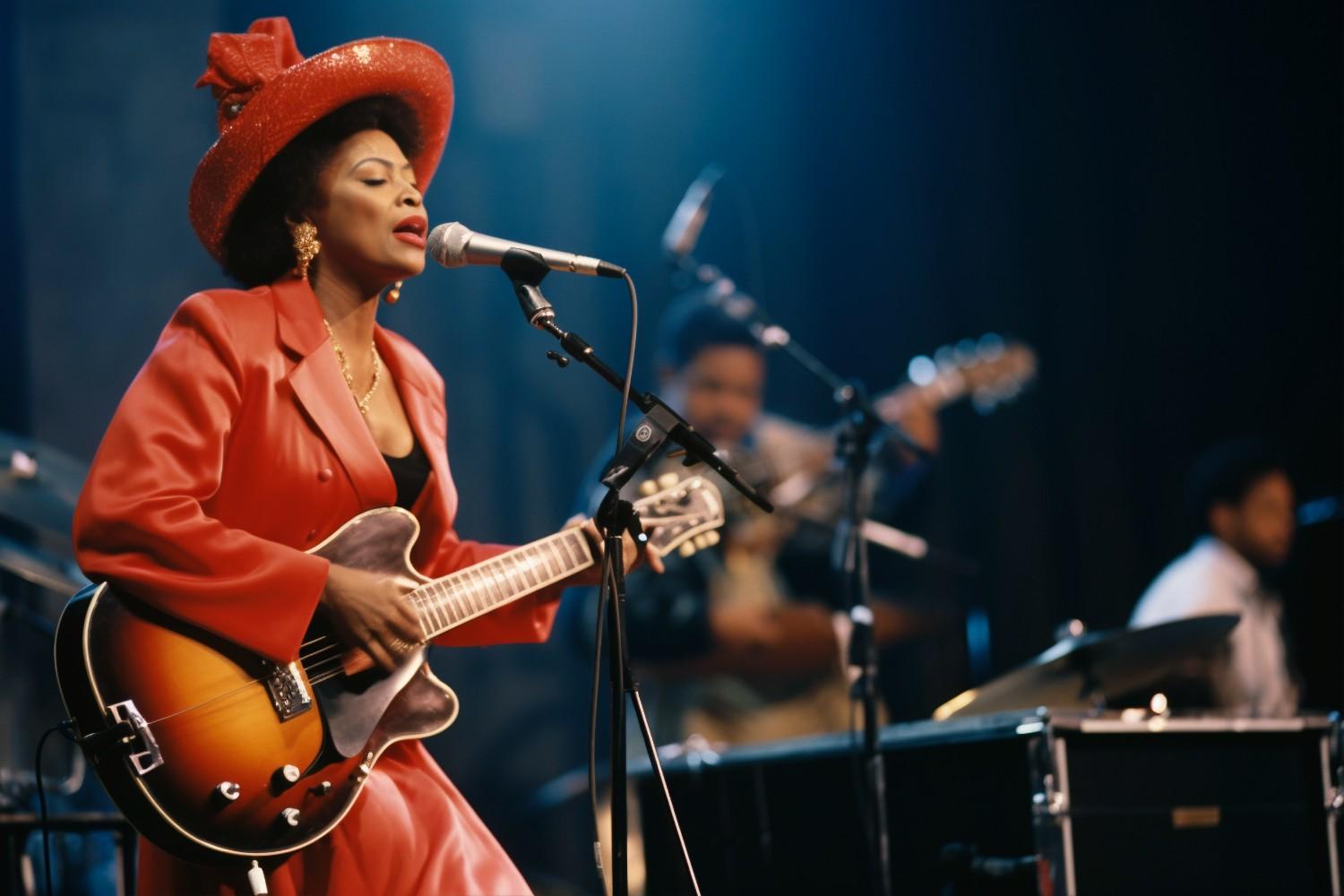
Long before anyone called it a “scene,” there was Dolly Rathebe, whose screen presence in the 1949 film Jim Comes to Jo’burg made her one of the first Black South African stars, and whose voice carried the swing and marabi sounds of 1950s Sophiatown. There was Dorothy Masuka, composer and vocalist, whose songs became so entangled with anti-apartheid politics that some were banned outright — and who kept performing, in exile and at home, for over six decades.
And there was Miriam Makeba, “Mama Africa,” whose voice became inseparable from South Africa’s own liberation story. Before her solo career took her around the world, she led The Skylarks, an all-women vocal group she formed with Letta Mbulu, Abigail Kubeka, Mary Rabotapi, Sanna Mabusela, and Thembi Mathe, among others — a group that fused jazz harmony with local idiom and, in doing so, helped invent a new sound altogether.
Alongside them worked Sophie Mgcina, an actress, singer, and stage force whose generosity as a mentor would ripple forward for decades — she is remembered by name, still, by the women she taught.
The Bridge Generation
If the pioneers built the house, Sibongile Khumalo (1957–2021) furnished it and threw open every window. A classically trained vocalist as comfortable in opera as in jazz and traditional song, she sang at Nelson Mandela’s 1994 inauguration and was honoured with the Order of Ikhamanga for her contribution to South African music.
But her legacy isn’t only in the recordings — Ancient Evenings, Live at the Market Theatre, Breath of Life — it’s in the women she personally drew into what broadcaster Brenda Sisane calls “that place of women,” introducing younger artists to Dorothy Masuka and Sophie Mgcina, building a living lineage by hand rather than leaving it to chance.
“I was inducted into that place of women by her.”
— Brenda Sisane, on Sibongile Khumalo
That same era produced Thandiswa Mazwai, whose work — solo and with Bongo Maffin — has made her one of the defining voices of post-apartheid South African music, and Simphiwe Dana, whose genre-crossing songwriting draws deeply on jazz’s improvisational spirit.
Both are cited by the current generation as touchstones — artists whose influence functions less like a reference point and more like a school of thought. And there was Busi Mhlongo, whose fusion of Zulu maskandi with jazz phrasing shaped a generation of musicians who came up listening to her.
The scholarship around all of this owes a great deal to Vuyiswa Rebecca “Sis’ Viva” Ngcwangu Mbambisa (1941–2024), a hugely popular performer in her day, and to researchers like Professor Lara Allen, whose work on South African women in jazz remains a foundational text, and Dr Lindelwa Dalamba, a senior lecturer at Wits University whose scholarship keeps this history in active conversation rather than archived silence.
Dalamba has pointed out something easy to miss: that when jazz moved from dancefloor to stage, the physical separation between performer and audience made those spaces measurably safer for women to occupy — a small architectural shift with an outsized social effect.
The Present Tense
At the centre of today’s generation sits Zoë Modiga — vocalist, songwriter, and 2024 Standard Bank Young Artist for Music — whose two albums, Yellow: The Novel (2017) and Inganekwane (2020), have established her as one of the most complete artists of her cohort.
Modiga has spoken about her own musical education as an act of listening across generations, naming Mazwai, Dana, and Mhlongo among her teachers-by-osmosis, and framing herself as a link in a chain she’ll eventually hand off herself.
She trained at the University of Cape Town’s South African College of Music, the same institution that has produced pianist and composer Thandi Ntuli — one of the most searching voices in the current scene, known for treating songwriting as a genuine act of accountability — and vocalist and multi-instrumentalist Spha Mdlalose, whose creative partnership with Ntuli has been singled out as a model of women supporting women both on stage and off it, doing the unglamorous work of production and logistics that rarely gets applauded.
Behind the microphone, Brenda Sisane has spent close to three decades making the case for South African jazz on air, most recently through The Jazz Standard on Kaya FM (successor to her long-running The Art of Sundays).
Her advocacy isn’t just curatorial — she has been explicit about the need for a different vocabulary altogether, one that properly credits the invisible labour women do to hold the ecosystem of music together.
The Ones Coming Up
A new cohort is already pushing through: instrumentalists Nobuhle Ashanti and Thembelihle Dunjana, and vocalists Thandeka Dladla and Bokang Ramatlapeng — artists reshaping what an instrumentalist in South African jazz is assumed to look like, in a field where, as Sisane notes, young women are still too often steered toward the front of the stage and away from the band.
And the story isn’t only sonic.
Photographers Vuyo Giba and Lerato Pakade are doing the equally vital work of documentation — making sure the visual record of this era doesn’t, once again, erase the women in it.
What the Work Still Is
None of this is offered as a finished victory lap.
Sisane herself is wary of easy optimism, pointing out how quickly a scene can feel emptied out when a single towering figure — Khumalo, for instance — is gone.
The structural issues are real: performance spaces that have historically been unsafe, an instrumental tradition still coded as masculine, an industry that hasn’t built the infrastructure to let women be more than the exception that proves representation is “improving.”
South African jazz was never a story with one gender in it.
But on a day set aside to honour women, it’s worth naming plainly what’s true: it was built, note by note, generation by generation, by women who sang it, wrote it, funded it, broadcast it, taught it, and photographed it into permanence — often without the credit the men beside them received automatically.
This Women’s Month, that ledger is worth correcting out loud.
Sons of the soil, indeed — but the daughters kept the lights on.
Sources and Further Reading
Tseliso Monaheng, “Women in South African Jazz,” The Floor Magazine (31 January 2024); Gwen Ansell, tribute to Vuyiswa Rebecca Ngcwangu Mbambisa; Cape Town Swing, “A Homage to South African Women in Jazz”; additional biographical research.