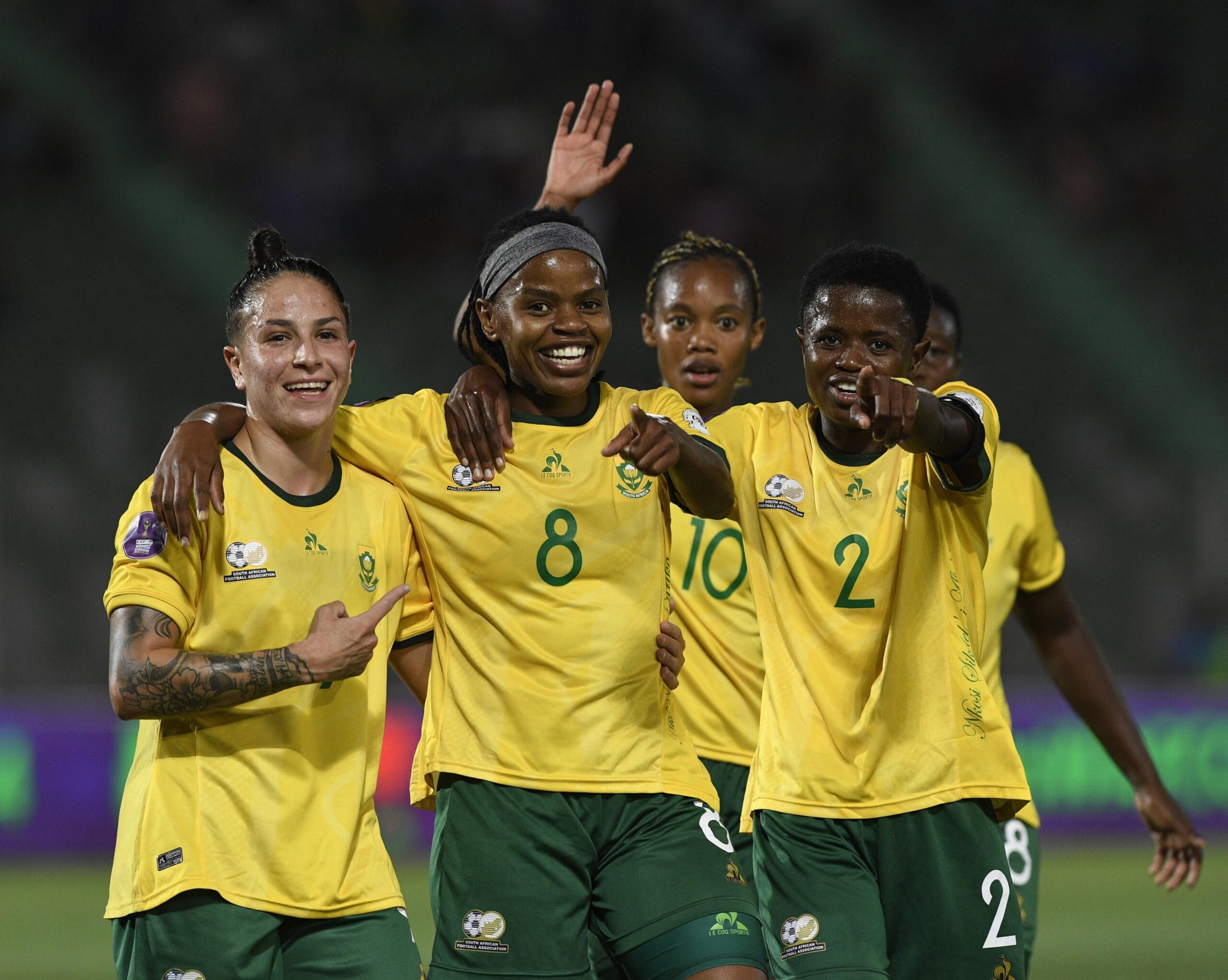

South Africa 2-1 Nigeria — Casablanca, Morocco
13 August 2026 | 2027 FIFA Women’s World Cup Play-Off
Banyana Banyana kept their 2027 FIFA Women’s World Cup dream alive on Thursday night, edging arch-rivals Nigeria 2-1 in a tense continental play-off at the Moulay Rachid Stadium in Casablanca. Goals from Thembi Kgatlana and captain Refiloe Jane were enough to see off the Super Falcons, who pulled a stoppage-time consolation back through a converted penalty after Jane was sent off in the dying seconds.
The win rescues South Africa’s World Cup ambitions after a bruising Women’s Africa Cup of Nations (WAFCON) 2026 campaign in which both continental heavyweights were eliminated in the quarter-finals — Banyana falling 2-1 to hosts Morocco, and Nigeria stunned 1-0 by Cameroon. Thursday’s meeting was effectively a knockout decider for one of Africa’s two remaining routes to Brazil 2027.
HOW THE GAME UNFOLDED
Banyana dominated possession in the early stages but struggled to break down a well-organised Nigerian side happy to sit deep and absorb pressure. The breakthrough finally came just after the hour mark, in the 56th minute, when Kgatlana turned home the opener to send the South African bench into raptures.
Nigeria searched for a response, but it was Banyana who struck again with 13 minutes to play. Captain Refiloe Jane pounced on a loose ball on the edge of the box and drove a shot that took a wicked deflection past the Nigerian goalkeeper, making it 2-0 in the 77th minute.
The match ended on a sour note for the hosts of the celebration. Deep into stoppage time, Jane was dismissed for handling the ball inside the box, gifting Nigeria a penalty which Uchenna Uchiebe duly converted for a 90+3′ consolation. It mattered little — the final whistle confirmed a famous 2-1 victory for Desiree Ellis’s side.
A RIVALRY CUT FROM THE SAME CLOTH AS BOKS V ALL BLACKS
There are few fixtures in African football that carry the weight, history and sheer theatre of South Africa versus Nigeria. In women’s football specifically, it is the continent’s defining rivalry — Banyana and Nigeria are the last two nations to win the WAFCON title, and this was their 13th meeting at the tournament or in tournament-adjacent qualifiers. For South African supporters, facing the Super Falcons carries the same knot-in-the-stomach anticipation that a Springboks-All Blacks Test brings: two proud, historically dominant sides, a fierce continental pecking order at stake, and a head-to-head record that has, for years, tilted painfully in the other side’s favour.
Nigeria arrived in Casablanca having won 15 of the previous 25 meetings between the two nations, with South Africa managing just four victories and six draws. The Super Falcons had also delivered some of Banyana’s most heartbreaking recent defeats — beating them on penalties in the 2018 WAFCON final, eliminating them from Paris 2024 Olympic qualifying, and knocking them out in the semi-finals of the 2024 WAFCON. Every one of those scars made Thursday’s win taste sweeter, and for a South African team that has so often stood in Nigeria’s shadow continentally, beating the ten-time WAFCON champions when it mattered most is the kind of result that changes how a rivalry feels.
MILESTONE NIGHT FOR DESIREE ELLIS
The victory also carried personal significance for coach Desiree Ellis, who took charge of her 137th match as Banyana boss and recorded win number 68 — and by her own admission, there is unlikely to be a sweeter one than getting the better of Nigeria with a World Cup lifeline on the line. Ellis, who has led Banyana to their first-ever WAFCON title in 2022 and a historic run to the last 16 at the 2023 World Cup, once again showed her side’s resilience by bouncing back from the disappointment of the Morocco loss within days.
“It’s not a place we want to be, but we have been given another opportunity,” Ellis said in the build-up. “It’s a very big opportunity to go on a very long journey, so we have to grab it with both hands.” Her players did exactly that.
WHAT HAPPENS NEXT: THE LONG ROAD TO BRAZIL
Beating Nigeria does not hand Banyana a World Cup spot outright — it earns them one of CAF’s two places in FIFA’s ten-team intercontinental play-off tournament, a gruelling two-phase gauntlet that will run from November 2026 through to February 2027 before the final three World Cup berths are decided. Here is how it unfolds, step by step:
- Phase One – Preliminary Round (November–December 2026): Banyana enter a six-team group at a centralised venue, made up of two teams from Asia (AFC), two from Africa (CAF, including South Africa), one from South America (CONMEBOL) and one from Oceania (OFC). Each side plays three matches against three different opponents from other confederations. Only the top two finishers in this six-team group advance — a demanding, compressed round with almost no margin for error.
- Phase Two – Final Play-Off (February 2027): The two survivors of the preliminary round are joined by four fresh teams — two from CONCACAF, one from CONMEBOL and one from UEFA — to form a six-team knockout stage at a centralised location. From here, single-elimination matches decide the final three teams to book their place at the 2027 FIFA Women’s World Cup in Brazil.
In short: Banyana must win their way through a three-match round-robin in November/December just to reach the business end, and then survive a knockout tie in February to actually qualify. It is a long, unforgiving route, with two genuine hurdles rather than one.
THE SILVER LINING
As tough as the road looks on paper, there is a case that this extended campaign could actually benefit Ellis and her squad. Rather than the team’s season ending after a single WAFCON exit, the play-off route keeps this core group of players together, training and competing at the highest level, for several months longer. International windows in November, December and February give Ellis further opportunities to fine-tune combinations, integrate squad depth, and keep the momentum and camaraderie built during WAFCON 2026 intact, rather than letting the group disperse back to their club sides for half a year with no clear collective target.
It also gives Banyana repeated high-pressure knockout experience against unfamiliar opposition from other confederations — valuable preparation should they ultimately book their ticket to Brazil. Ellis has previously spoken about the value of adversity in building this squad’s identity, and a fight for World Cup qualification stretching into 2027 is exactly the kind of shared mission that has defined her most successful Banyana sides.
Banyana Banyana now await the draw for the November/December 2026 preliminary play-off phase, where they will discover their three opponents on the road to Brazil 2027.