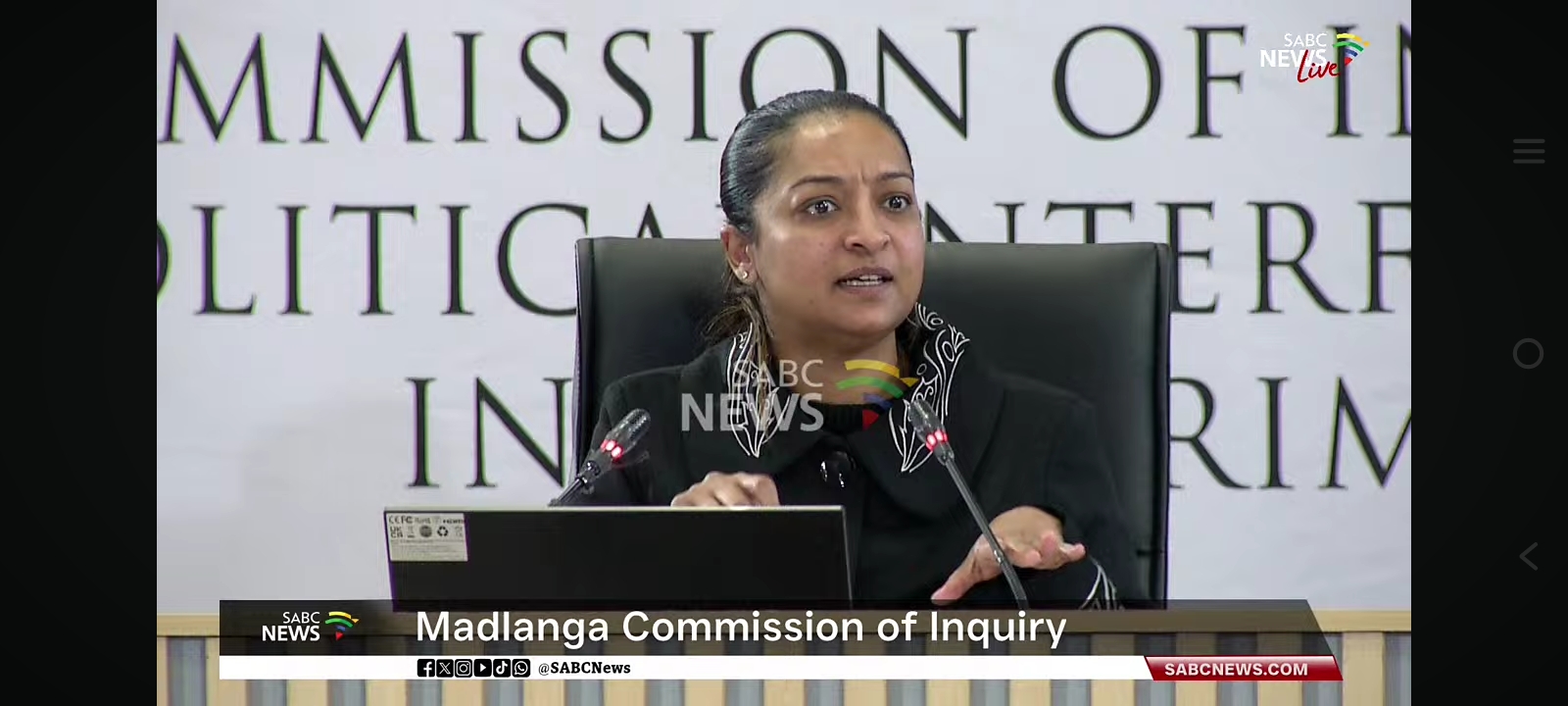

MAIN PHOTO: IDAC Advocate Drushantha Ramsamy – Courtesy of SABC
Now that Advocate Drushantha Ramsamy has this week end wrapped up at Madlanga, The PiE TEAM looks at how the IDAC state advocate turned witness against her own former head — the arc of her testimony, Days 151 to 156 (30 July – 11 August 2026).
Note: everything below reflects testimony and allegations before an ongoing commission of inquiry. None of it has been tested by cross-examination findings or a court, and everyone named is presumed innocent. The framing of “good” and “bad” IDAC actors reflects the tenor of Ramsamy’s evidence as reported, not a finding by the Commission.
1. Who She Is and Why Her Evidence Matters
Drushantha Ramsamy is a state advocate inside the Investigating Directorate Against Corruption (IDAC), the National Prosecuting Authority unit that investigates serious corruption. She prosecuted alongside IDAC’s leadership on the Crime Intelligence docket, working closely with former IDAC head Advocate Andrea Johnson, senior investigator Brian Padayachee and chief investigator Dylan Perumal. Her appearance at the Commission is significant because she is the first serving IDAC prosecutor to give a first-hand, insider account of how the case against Lieutenant-General Dumisani Khumalo and Brigadier Dineo Mokwele was put together — and she gave that account largely against her own former boss.
Her evidence followed Johnson’s own six days on the stand, during which the Commission scrutinised Johnson’s relationship with Crime Intelligence deputy Feroz Khan — evidence suggested the pair exchanged pet names and appeared to shield one another, though Johnson denied this influenced her official decisions.
2. The Arc of Her Testimony
Day 151 (30 July 2026) — the opening bombshell
Ramsamy opened with a recorded telephone call she had made with Johnson on 26 July 2026. In it, Johnson is heard describing the Commission in vulgar terms and, when asked what Ramsamy should do if summoned, allegedly telling her to leave the country. Ramsamy testified that this exchange left her shaken — she told the Commission her “heart dropped” to her stomach when a section 27 document put before it differed from an affidavit she says Johnson had earlier given her.
Days that followed — disputing Johnson’s account
Over subsequent sittings Ramsamy directly contradicted Johnson’s earlier evidence. Where Johnson told the Commission she relied on investigators’ briefings and was not directly involved in operational decisions, Ramsamy said the opposite: that Johnson personally oversaw every significant step, appointed herself supervisor of the investigations, and exercised complete control. She went further, describing part of Johnson’s testimony as “a straight lie.”
Emotional testimony on the Section 28(1) authorisation
Ramsamy became visibly emotional describing a Section 28(1) application — the document used to formally authorise a high-level corruption investigation — in the Mokwele matter. She said the application was attributed to her despite her not having drafted it, and that Johnson had instructed her to prepare one “umbrella” authorisation covering all Crime Intelligence matters.
Days 154–156 — irregularities, and a “fishing expedition”
In later sittings Ramsamy characterised the investigation into Khumalo and six other Crime Intelligence officers as a “fishing expedition,” and raised numerous alleged irregularities in the decisions to investigate, arrest and prosecute Khumalo and Mokwele. She also questioned the section 27 whistle-blower affidavit submitted by MP Fadiel Adams, and the classified documents allegedly in his possession — telling the Commission that, in her view, Adams should himself have been charged over those documents.
Defending her own demeanour
After clips of her testimony went viral and drew comment on social media, Ramsamy used part of a later sitting to explain her manner on the stand — saying she was not “vindictive” and took no pleasure in her former boss’s “downfall,” but had simply reached a point where she preferred to smile through difficult moments rather than become emotional.
3. The Central Claim: “Project Diversion”
The most consequential single allegation in her evidence is that Johnson personally drove an internal operation known as “Project Diversion,” which Ramsamy described as an orchestrated attack aimed at National Commissioner General Fannie Masemola and Lieutenant-General Dumisani Khumalo. As reported, this is the evidentiary core of the “targeting the good cops” narrative: Ramsamy’s account casts the case against Khumalo (and, by extension, scrutiny that touched Masemola) not as a clean corruption investigation but as a directed campaign shaped from the top of IDAC.
This is Ramsamy’s characterisation as reported; “Project Diversion,” its intent and its authorship remain contested and untested by the Commission’s eventual findings.
4. The “Good IDAC / Bad IDAC” Framing
Read together, the tenor of Ramsamy’s evidence draws a fairly consistent line between two camps inside IDAC:
- Cast as directing or enabling irregularities: Johnson (former head), with Padayachee and Perumal named alongside her in connection with the Crime Intelligence docket’s handling.
- Cast as the target: General Fannie Masemola and Lieutenant-General Dumisani Khumalo, whom Ramsamy says “Project Diversion” was aimed at.
- Adjacent scrutiny: the Johnson–Feroz Khan relationship, explored during Johnson’s own testimony, added a further layer suggesting personal loyalties may have shaped decisions at the top.
- Ramsamy’s own positioning: she frames herself as someone carrying out instructions and now setting the record straight — the “clean” witness — while placing responsibility for irregularities on her former superiors.
It is worth being precise about what the evidence actually supports versus what a reader might infer: Ramsamy’s testimony squarely implicates Johnson, and by association Padayachee and Perumal, in decisions she says were irregular. The claim that Masemola and Khumalo were targeted rests on her account of “Project Diversion.” The Feroz Khan material came primarily through Johnson’s own evidence about her relationship with him, rather than as a direct allegation from Ramsamy. None of this amounts to a finding — it is one witness’s account, still to be weighed against others’ evidence and the Commission’s final assessment.
5. Institutional Fallout
The consequences of this run of testimony were immediate and extended beyond the hearing room. On the same day Johnson’s six days of evidence concluded and Ramsamy’s testimony against her began, Justice Minister Mmamoloko Kubayi suspended Perumal, while National Director of Public Prosecutions Advocate Andy Mothibi suspended senior investigator Brian Padayachee and investigator Suneel Bellochun, all pending disciplinary processes. Kubayi and Mothibi gave IDAC six months to reform, including skills and lifestyle audits of all 212 employees. Johnson herself resigned as IDAC head, with Nicolette Bell named to succeed her.
A suspension is not a finding of wrongdoing, and all those named are presumed innocent pending any disciplinary or Commission outcome.
6. Where Things Stand
Ramsamy’s evidence ran across several sittings between 30 July and 11 August 2026 (Commission Days 151, 154 and 156), after which the Commission moved on — turning, from 12 August 2026, to separate allegations that SAPS task teams in KwaZulu-Natal have operated as hit squads under cover of legitimate policing. Fadiel Adams’s own testimony, meanwhile, has been postponed and is now expected on 19 August 2026.
7. Quick-Reference Timeline
| Date | Development |
| 29 Jul 2026 | Johnson concludes six days of evidence (Day 150). |
| 30 Jul 2026 | Ramsamy testifies (Day 151): plays the “leave the country” recording; says her former head drove “Project Diversion” against Masemola and Khumalo; Perumal, Padayachee and Bellochun suspended the same day; IDAC given a six-month reform mandate. |
| 5 Aug 2026 | Ramsamy becomes emotional describing the Section 28(1) authorisation in the Mokwele matter. |
| Day 154–156 | Ramsamy calls the Khumalo investigation a “fishing expedition”; disputes Johnson’s evidence as “a straight lie”; questions Adams’s section 27 affidavit; defends her own demeanour as “not vindictive.” |
| 11 Aug 2026 | Ramsamy’s evidence effectively concludes; Commission turns to new lines of inquiry. |
| 12 Aug 2026 | Commission moves on to allegations of SAPS “hit squad” task teams in KwaZulu-Natal. |
| 19 Aug 2026 | Fadiel Adams’s postponed testimony is expected to resume. |
8. Bottom Line for the Reader
Ramsamy’s evidence is the most direct, first-hand insider account yet heard of how the Khumalo and Mokwele cases were built — and it lands as an accusation that decisions were driven from the top of IDAC rather than by clean investigative process. Her testimony, taken as a whole, reads as an attempt to draw a clear line between herself (and, implicitly, rank-and-file IDAC staff who executed instructions) and a small group of senior figures — Johnson, Padayachee and Perumal — whom she portrays as having directed an operation aimed at senior police leadership. Whether the Commission ultimately accepts that framing, and what it means for Masemola, Khumalo, Khan and others named along the way, remains to be seen.
Prepared as a plain-language summary of media reporting on public Commission proceedings for reader convenience. It is not a legal record; the official transcript and video of each day’s proceedings are the authoritative source.