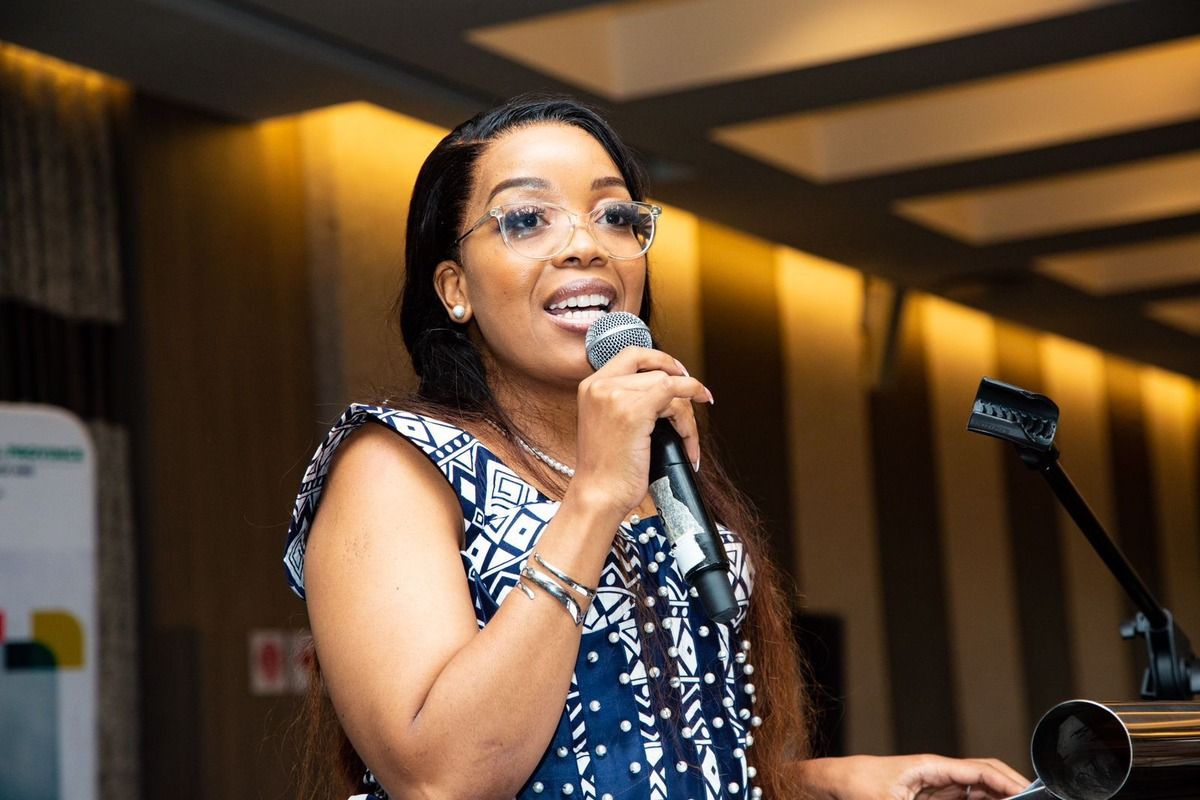

MAIN PHOTO: JACINTA NGOBESE-ZUMA
LEN KALANE
Inside the rise of Jacinta Ngobese-Zuma, the KwaMashu girl who turned a microphone and a movement into the loudest voice in South Africa
DURBAN — There is a particular kind of South African woman who does not ask for the room’s attention — she simply becomes impossible to look away from. Jacinta Ngobese-Zuma is that woman. In a little over two years she has gone from a familiar voice on Durban’s airwaves to arguably the most talked-about civic figure in the country: a name spoken with reverence in some homes and with fury in others, but rarely with indifference.
This Women’s Month, as the country pauses to celebrate women who have reshaped the spaces they walked into, Ngobese-Zuma’s name belongs firmly on that list — not because everyone agrees with her, but precisely because so many people, for so many different reasons, cannot stop talking about her. Whatever one makes of the cause she has chosen, the manner in which she built a national movement from a standing start is a case study in boldness, discipline and an unusually sharp read of the public mood.
“I’m a wife, mother, law student, activist and farmer,” she says quietly. It is not the introduction anyone expects.
The girl from KwaMashu
Born on 6 July 1986, Jacinta Ngobese grew up between Eshowe and KwaMashu, on Durban’s northern outskirts, raised largely by her grandparents. Her mother had her young; she never met her biological father, whose family had fled political violence before she was born. It was not an easy start, and by her own account, an early family rupture — her mother’s marriage, and the fraught process of untangling it at Home Affairs — left a mark on how she would later come to see the machinery of the state and the paperwork that decides who belongs where.
She studied supply chain management at the University of KwaZulu-Natal, and it was on campus, almost by accident, that broadcasting found her. An audition at the campus radio station opened a door; she walked through it and kept walking — through Vibe 94.7 FM, Inanda FM and Gagasi FM, building a reputation as a sharp, likeable on-air presence, before landing the mid-morning slot that would make her a household name in KwaZulu-Natal: “Cruise with Jacinta Ngobese” on Vuma FM, which she hosted from 2019 until 2025. Along the way she picked up a Best Female Radio Presenter award at the 2020 KZN Entertainment Awards and a nod for a prestigious US exchange programme for media professionals — the résumé, notably, of a working broadcaster who had already spent a decade earning her stripes long before the rest of the country learned her name.
From studio mic to the front of the march
In 2024, while still on air, Ngobese-Zuma founded March and March — a civic movement built around a single, blunt demand: that undocumented foreign nationals leave South Africa, and that government tighten border enforcement and prioritise citizens for jobs and public services. When Vuma FM did not renew her contract in 2025, rather than retreat from public life she doubled down, launching her own YouTube interview show and pouring her energy into the movement full time.
What followed was a remarkably fast climb. By 2026, March and March had gone from a Durban-based grievance group to a genuine national phenomenon, organising marches in Durban, Johannesburg, Cape Town and Pietermaritzburg, and pulling Ngobese-Zuma into rooms — television panels, radio debates, international press coverage — that few civic organisers, and fewer still without a party behind them, ever reach. In August 2026 she announced the movement’s next chapter: rather than becoming a political party, it would formalise into two structures — the SA First Forum, a legal advocacy and litigation body she has explicitly modelled on AfriForum, and the March and March Foundation, a humanitarian non-profit. It is, whatever one thinks of the politics, a textbook piece of institution-building — the move of someone thinking several years past the next march.
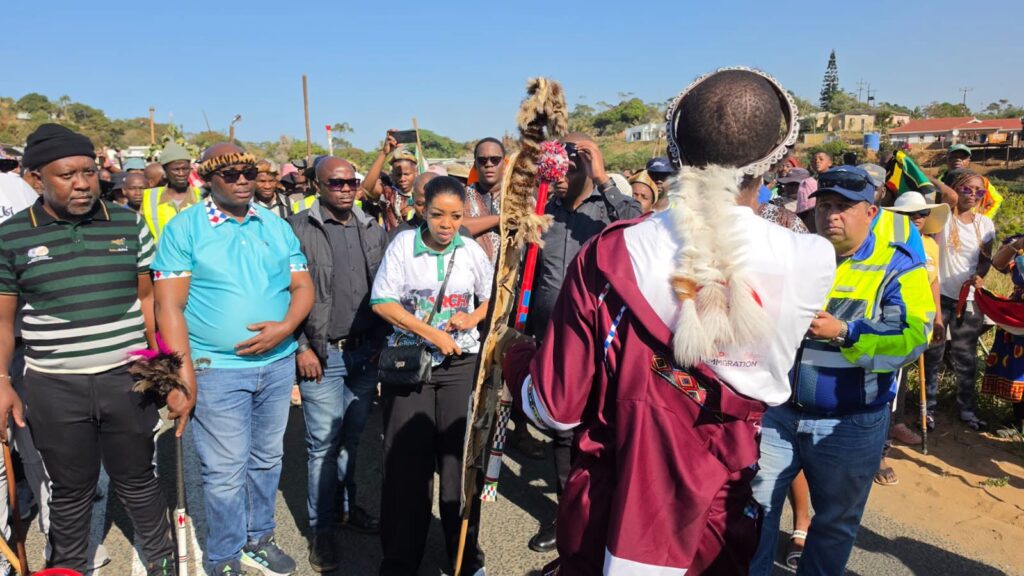
CAPTION: JACINTA WITH MARCH ON MARCH
The organiser’s gift
Talk to people who have covered her closely and one word recurs: discipline. Ngobese-Zuma runs March and March less like a protest and more like a campaign — briefings, structured messaging, a consistent slogan (“Put South Africans First”), and an evident understanding of how to keep a movement in the news cycle without a party machine, a corporate sponsor or an established political brand behind her. Journalists who expected “loud and brash” — the caricature that precedes her into most rooms — describe instead meeting someone petite, composed and, in interviews, disarmingly reflective about her own contradictions.
“I’m originally from Eshowe, grew up in KwaMashu before moving to Johannesburg, where I attended high school and university. I come from a radio background. I’m a wife, mother, law student, activist and farmer,” she told one interviewer earlier this year — a description that captures both the range of a genuinely unusual public figure and the case her supporters make for her: that she is one of them, not a career politician parachuted in to speak on their behalf.
That authenticity, real or performed, is central to her pull. Analysts covering the movement’s rise point to something structural underneath the noise: deep public frustration over unemployment, strained public services and a sense that the state has lost its grip on the border, all of which Ngobese-Zuma has channelled with unusual fluency across radio, podcasts, TV panels and viral video in a way few civic leaders — male or female — have managed in recent South African memory.
The AfriForum question
Nothing has tested that reputation quite like her newest, and most divisive, move. In August 2026, Ngobese-Zuma led a March and March delegation to meet AfriForum chief executive Kallie Kriel, announcing a “collaborative working group” between her movement and the Afrikaner rights lobby group — one of the most polarising organisations in South African civil society. The two bodies agreed to cooperate on community organisation, capacity-building, mother-tongue education, the rule of law and, notably, the fight against illegal immigration, with AfriForum offering to mentor the SA First Forum using lessons from its own three-decade, roughly 300,000-member playbook.
The reaction was immediate and split cleanly along old fault lines. Supporters framed it as pragmatism: two organisations with a track record of getting things done, working together on crime, schooling and border enforcement rather than waiting on government. Ngobese-Zuma herself was unapologetic, saying she would “meet with everyone who has a vision for this country,” irrespective of colour, and that March and March’s founding values rested on universal human rights and accountability, not racial politics.
Her critics saw it very differently. The Land Party’s Gcobani Ndzongana published an open letter warning that leaning on AfriForum for guidance on land and community development risked dragging the country back toward apartheid-era division, urging Ngobese-Zuma to interrogate AfriForum’s own record rather than seek its counsel. Black Forum SA was blunter still, calling the tie-up “a serious insult to blackness” and accusing her of a “black inferiority complex” for what it framed as selling out to “white masters.” Political analysts were split too — Professor Metji Makgoba of the University of Limpopo called the alliance simply “bizarre” given how far apart the two organisations sit on race, immigration and broader political outlook, even as commentators elsewhere noted AfriForum’s Kriel had just weeks earlier held a similar meeting with MK Party leader Jacob Zuma, suggesting the group is deliberately courting a wider, blacker constituency than it has historically reached.
Whatever the motive, the episode is instructive about who Ngobese-Zuma has become: a leader now significant enough that a 20-year-old Afrikaner lobby group actively wants her partnership, and controversial enough that agreeing to it detonates a national argument on its own. It is, again, a moment that will not be resolved on the page — but it belongs in any honest account of how far, and how fast, her influence has travelled.
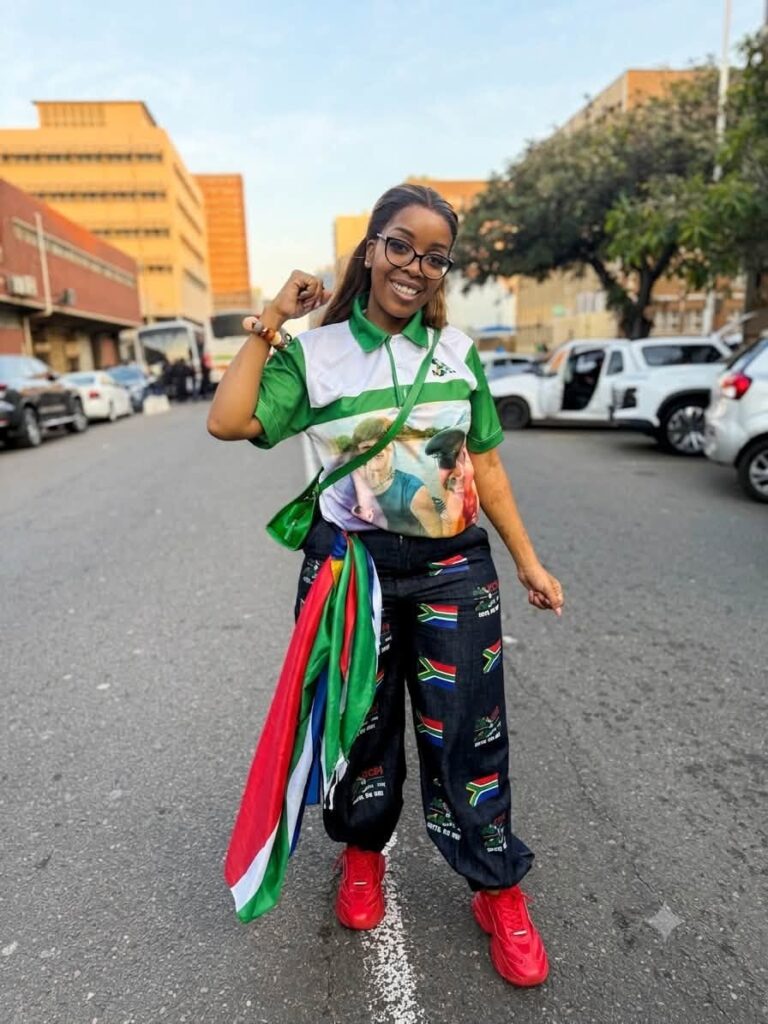
CAPTION: JACINTA NGOBESE-ZUMA
The ethnic-university remark — and the retraction
Barely had the AfriForum meeting’s dust settled when Ngobese-Zuma opened a second, more damaging front. Addressing a march through central Durban timed to coincide with a regional summit, she argued that South Africa’s ethnic and language groups — Zulu, Xhosa, Pedi, Tswana and Tsonga among them — should each have their own dedicated, home-language university, pointing to AfriForum’s own ties to an Afrikaans-medium institution as her template. Communities, she said, should be free to build “our own stuff” rather than wait on government or borrow only from white institutions.
The response cut deeper than the AfriForum meeting had, and this time it came from a direction she could less easily dismiss as old political rivalry. General Secretary of the SA Federation of Trade Unions (SAFTU) Zwelinzima Vavi accused her of pursuing a dangerous attempt to fracture the country along ethnic and linguistic lines, invoking apartheid-era Bantustan policy and warning that ethnically defined campuses risked turning South Africa’s diversity into separate territorial enclaves. Commentary across the political spectrum piled in, with several observers reading the remark as confirmation that her overtures to AfriForum had pulled her rhetoric further toward racial and ethnic thinking than her movement’s original, immigration-focused mandate ever required.
Within days, Ngobese-Zuma walked the comments back, saying she had been misunderstood and stressing that neither March and March nor AfriForum is a political party seeking to dictate national policy on education, or anything else. She has cast the retraction as good-faith experimentation rather than defeat — someone willing to test an idea publicly and step back if it does not land, instead of defending it to the end regardless of the cost.
The episode has also breathed fresh life into a question that has trailed the movement since its earliest marches: who, if anyone, stands behind it financially. Critics point to the speed and polish of March and March’s growth, and now its links to a well-resourced AfriForum, as grounds to suspect hidden backers shaping its direction. Ngobese-Zuma’s defenders reject that framing outright, arguing in one recent op-ed that insinuating a woman leader must be secretly funded or manipulated says more about discomfort with female leadership than about the movement’s books. Neither claim has been substantiated on the public record, and March and March’s finances remain, like much else about its founder this week, contested rather than settled.
The other side of the ledger
None of that boldness has come without serious cost, and a fair profile cannot look away from it. March and March’s campaign has drawn sustained criticism from human rights organisations, opposition and government figures, and international observers, who argue that the movement’s rhetoric and tactics have tipped, in practice, from lawful advocacy into harassment and intimidation of foreign nationals — including widely circulated footage of undocumented immigrants being confronted and removed from hospitals and schools. The South African Human Rights Commission has taken legal action against Ngobese-Zuma and her movement, a case she has fought publicly and defiantly, at one point calling on supporters to fill the Durban High Court in a show of force. The United Nations has voiced concern about rising threats and violence against migrants in South Africa during this period, and the diplomatic fallout has been real: Ghana’s government evacuated citizens who wanted to leave the country, and South Africa — long associated with the ethic of ubuntu — has found itself internationally labelled xenophobic, with Ngobese-Zuma named as the face of that shift.
She rejects the label outright. “We are not xenophobic,” she has insisted. “What we want is for undocumented immigrants to return to their countries so that limited resources benefit South Africans, especially the poor who suffer the most.” She frames the movement’s mission as law enforcement and government accountability rather than hostility toward foreigners, points to what she says are roughly four million undocumented South Africans failed by the same system, and has been openly critical of President Cyril Ramaphosa’s handling of the immigration debate, saying she would only meet him if it produced practical solutions. Her critics — including human rights groups, sections of the South African Police Service, and political leaders across the spectrum — do not accept that framing, and argue that a movement organising mass, deadline-driven demands for people to leave the country carries real risk of vigilante violence regardless of the stated intention behind it. It is a genuine, unresolved argument, playing out in courtrooms and on front pages, and this profile does not attempt to settle it.
Impossible to ignore
What is not in dispute is the scale of what she has built in such a short time, nor the fact that a young woman from KwaMashu, with no party machinery and no inherited platform beyond a decade of hard-won radio credibility, has forced her way into the centre of the national conversation on her own terms — a conversation now expansive enough to include an Afrikaner rights group on one flank and accusations of betrayal from black political formations on the other. Supporters see a fearless woman finally saying aloud what government would not, and building the coalitions needed to act on it; critics see a dangerous populist normalising hostility toward the vulnerable while making troubling new friends along the way. Both camps, notably, agree on one thing: she knows how to get the numbers, and she is not going anywhere quietly.
That, in the end, is the marker of the kind of outsized, boundary-testing leadership this Women’s Month series exists to examine — not comfortable consensus, but the undeniable fact of impact. Whether history remembers Jacinta Ngobese-Zuma as a champion of the overlooked or a cautionary tale about grievance politics will likely take years, and several more court dates, to settle. What is already certain is that she changed the shape of the conversation, and that in South Africa in 2026, whether you love her or loathe her, you cannot look away.
Sources: IOL/The Post, The Africa Report, The Citizen, YEN.com.gh, Bona Magazine, The Vibes, Pindula, TimesLIVE, Sowetan — reporting current as of 23 August 2026.