
By Lucky Nyathi | PiE People | 17 October 2026
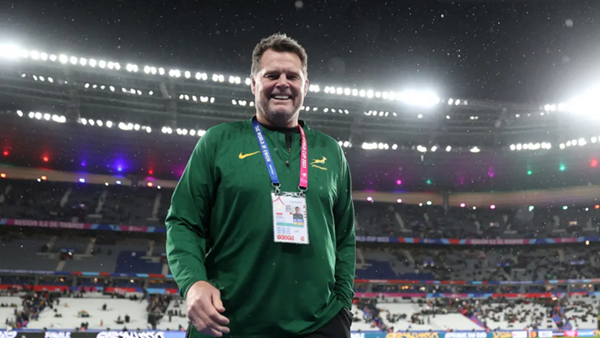
From a struggling Springbok side to back-to-back Rugby World Cup champions, Rassie Erasmus has reshaped South African rugby through bold leadership, tactical innovation, transformation and an uncompromising pursuit of victory. As the road to Australia 2027 gathers momentum, his next chapter could cement an already extraordinary legacy.
There are coaches who win trophies, coaches who change teams, and then there are those who change the way an entire nation sees its sport.
Rassie Erasmus belongs in the third category.
When Johan “Rassie” Erasmus took charge of the Springboks in 2018, South African rugby was searching for direction. A team once feared across the world had fallen from its traditional heights, struggling for consistency and confidence. The Springboks were ranked sixth in the world, and questions surrounded their identity, their leadership and their ability to compete with the best.
Eight years later, Erasmus has become one of the most influential figures in international rugby. Under his leadership, South Africa won the 2019 Rugby World Cup in Japan and defended the title in France in 2023, becoming the first men’s team to win four Rugby World Cups. The Springboks have also claimed multiple Rugby Championship titles and a British & Irish Lions series victory.
His achievement goes beyond the silverware. Erasmus has reimagined how the Springboks select, prepare, lead and play. He has challenged traditional ideas about team composition, turned the bench into a strategic weapon and helped build a team in which South Africa’s diversity is central to its identity.
Who Is Rassie Erasmus?
Born on 5 November 1972, Johan “Rassie” Erasmus grew up in Despatch in the Eastern Cape. Before becoming one of rugby’s most celebrated coaches, he made his name as a tough, intelligent loose forward who represented South Africa at Test level.
His playing career gave him an intimate understanding of the demands of international rugby: the physical punishment, the pressure of representing a nation and the importance of trust between teammates. But it was his analytical mind and interest in the finer details of the game that would eventually distinguish him as a coach.
Erasmus moved into coaching after his playing career, working with the Free State Cheetahs, Western Province, the Stormers and Irish province Munster. Those experiences helped him develop a reputation for unconventional thinking, close attention to performance data and a willingness to challenge established methods.
He returned to South African Rugby Union in a leadership role in 2017 and became Springbok head coach in 2018. The appointment gave him a daunting assignment: rebuild a national team under intense public scrutiny, with the next World Cup less than two years away.
He responded by questioning almost everything about the team’s existing approach.
Rebuilding the Boks: A New Identity, Not Just a New Team
Erasmus understood that restoring the Springboks would require more than changing the names on the team sheet. The side needed a clear playing identity, renewed confidence and a system that made the best use of the players available.
He expanded opportunities for new players, challenged established hierarchies and placed greater emphasis on squad depth, tactical adaptability and the specific roles individuals could perform. In his first Test as head coach, against Wales in Washington, DC, he handed 13 players their Springbok debuts.
The early results offered a glimpse of what was possible. South Africa recovered from a difficult start to beat England 42–39 in Johannesburg in June 2018, a dramatic victory that helped restore belief in the team.
Erasmus did not simply discard the old guard and assemble an entirely unfamiliar side. Instead, he combined experienced campaigners with emerging talent, retained the strengths of South African rugby and redesigned how those strengths would be deployed.
Powerful forwards, a dominant set piece, territorial kicking, relentless defence and clinical finishing remained central. What changed was how these elements were connected, how players were selected to execute them and how the team adapted to different opponents.
The rebuild culminated in a remarkable 2019 season. South Africa won the Rugby Championship before defeating England 32–12 in the Rugby World Cup final in Yokohama.
The Springboks had gone from uncertainty to world champions in less than two years.
Siya Kolisi and the Power of Representation
One of Erasmus’s most consequential decisions was appointing Siya Kolisi as Springbok captain in 2018, making Kolisi the first black player to captain South Africa’s senior men’s national rugby team.
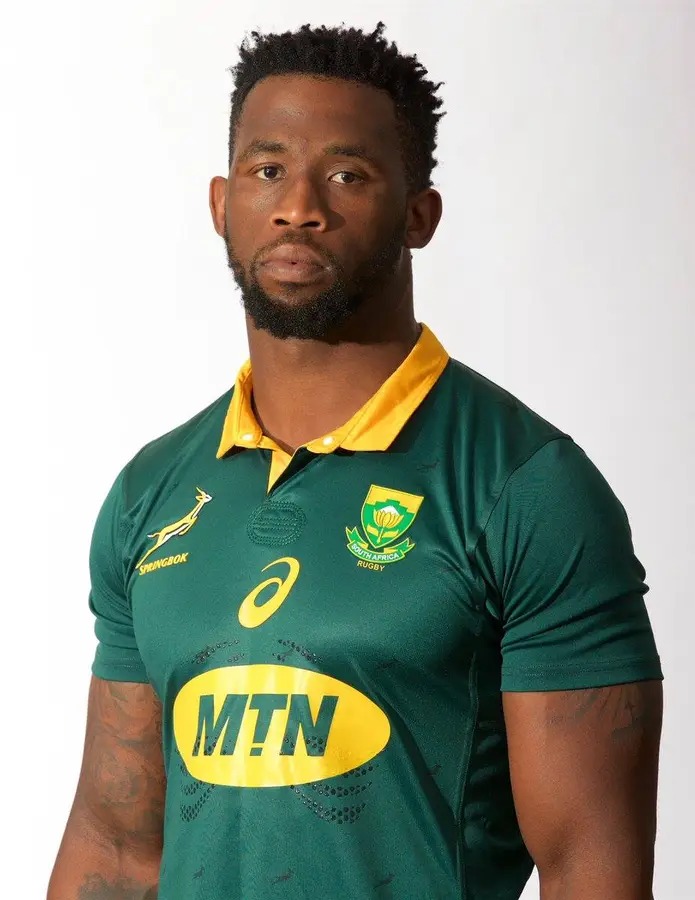
The appointment carried enormous significance in a country where rugby’s history is inseparable from apartheid, exclusion and the long struggle to make the sport representative of the nation.
For some observers, the decision provoked criticism and debate about transformation, merit and the future direction of Springbok rugby. Erasmus nevertheless backed Kolisi’s leadership and insisted that the team should reflect the country it represented while competing to win at the highest level.
The significance of the appointment was not limited to symbolism. Kolisi became a central figure in the team’s culture, helping unite players from different backgrounds around a shared purpose.
When he lifted the Rugby World Cup in 2019, the image resonated far beyond the stadium. South Africa had won its third men’s Rugby World Cup, but it had also presented a powerful image of a changing national team led by a black captain.
Kolisi would lead the Springboks to another World Cup triumph in 2023, reinforcing the significance of the leadership decision made five years earlier.
Erasmus’s approach to transformation has emphasised more than the number of players selected. Opportunity, meaningful participation, development and the ability to contribute at the highest level have all been important parts of the broader conversation.
His legacy here remains one of the most consequential aspects of his tenure: helping demonstrate that representation and elite performance need not compete with each other.
The Bomb Squad: Turning the Bench Into a Weapon
Few tactical ideas associated with modern rugby have attracted as much attention as the Springboks’ so-called “Bomb Squad”.
The term describes South Africa’s use of a powerful replacement bench, often including six forwards and two backs, designed to bring fresh physicality and tactical options into a match. Erasmus and his long-time coaching collaborator Jacques Nienaber helped make this approach a defining feature of the Springboks’ game.
Rather than treating replacements as players who simply cover for tired starters or injuries, the system made them part of the match-winning plan from the outset.
Fresh forwards could intensify pressure at the scrum, carry hard into defensive lines, compete at the breakdown and sustain the physical contest late into the game. The strategy also required careful management of substitutions, player workloads and the timing of tactical changes.
The idea was not that South Africa had invented replacements or forward-heavy benches. Its impact came from the clarity with which the Springboks built a game plan around them and the effectiveness with which they executed it.
The 2019 World Cup final offered a striking example. South Africa overwhelmed England in the second half, using forward power and set-piece dominance to turn a tight contest into a convincing victory.
Opponents and coaches around the world took notice. The Bomb Squad became a reference point in discussions about bench composition, squad depth and how international teams could influence the final quarter of a match.
It was a distinctly Erasmus approach: identify a competitive advantage, build a system around it and make opponents prepare for a problem that does not disappear when the starting team begins to tire.
Winning Again: The 2023 World Cup and a Growing Dynasty
Winning one World Cup is an extraordinary achievement. Defending it requires a different level of resilience.
At the 2023 Rugby World Cup in France, the Springboks faced a difficult route through the knockout stages, defeating France by one point in the quarter-finals, England by one point in the semi-finals and New Zealand 12–11 in the final.
These were not comfortable victories. They were demonstrations of composure, tactical discipline and an ability to survive the smallest margins under the greatest pressure.
South Africa became the first men’s team to win four Rugby World Cup titles and the second to defend the trophy successfully, following New Zealand in 2015.
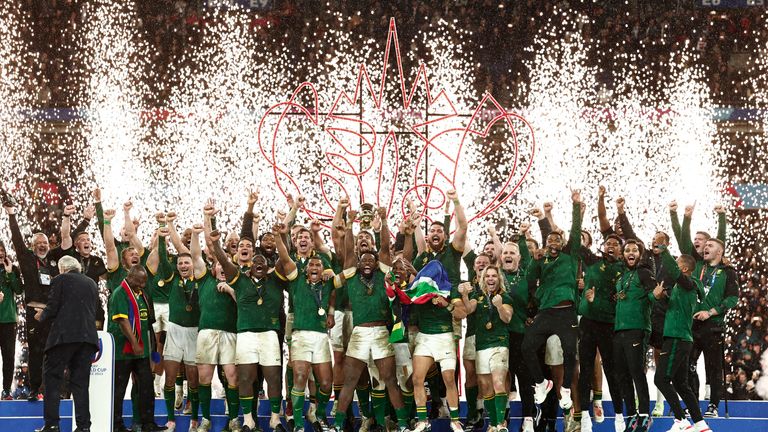
The 2023 campaign also underlined the value of a deep squad. Injuries, suspensions and the demands of tournament rugby tested the team’s resources, yet Erasmus’s broader system gave the coaching staff options and the players confidence in their roles.
The Springboks were no longer simply a team that could win through brute force. They could adapt their kicking strategy, change their bench configuration, target specific weaknesses and manage the closing stages of major matches with exceptional discipline.
That versatility has become one of the defining characteristics of Erasmus’s rugby philosophy.
The Science Behind the Success
Erasmus is often associated with bold decisions and strong public communication, but his work is underpinned by detailed preparation.
His coaching approach draws on performance analysis, opposition research, player-specific roles and careful tactical planning. The Springboks have used innovative communication methods, including colour-coded signals, to convey information to players during matches.
Erasmus’s willingness to experiment extends to selection, substitutions and the balance between attack and defence. He has shown that a successful team does not necessarily need to follow conventional thinking if another approach better suits its players and objectives.
His partnership with Jacques Nienaber was central to the first World Cup triumph. Nienaber’s defensive expertise complemented Erasmus’s broader leadership and tactical vision, demonstrating that the Springbok success story was also the product of a highly coordinated coaching team.
Erasmus has continued to evolve the team since returning as head coach in 2024. Rather than relying exclusively on the methods that delivered the 2019 and 2023 trophies, he has worked to develop new combinations, maintain competition for places and prepare emerging players for the demands of Test rugby.
The challenge is to keep winning while ensuring that the next generation can carry the system forward.
A Coach Admired Around the World
Erasmus’s influence extends well beyond South Africa. Coaches and analysts have studied the Springboks’ bench strategy, tactical flexibility and approach to high-pressure matches.
He has also become a prominent and sometimes polarising figure. His public challenges to officiating decisions and his direct communication style have attracted criticism, while his tactical ingenuity and ability to galvanise his squad have earned widespread admiration.
That combination is part of what makes him such a compelling figure in modern sport. He is not a conventional, detached coach. He is deeply invested in his team, outspoken about the issues he believes matter and prepared to take risks that other coaches might avoid.
His influence was recognised at the highest level in South Africa when he was awarded the Order of Ikhamanga in Gold in 2026, honouring his contribution to sport, national pride and social cohesion. The recognition placed his work within a wider national story about the ability of sport to unite people across social and cultural divisions.
In July 2026, Erasmus also surpassed Jake White’s record for the most Tests as Springbok head coach, marking another milestone in a career that has reshaped the national side.
His record is formidable, but the deeper measure of his influence may be that South Africa now enters major tournaments expecting to compete for the title rather than hoping to rediscover past glory.
Australia 2027: Can Rassie Make History Again?
The next great test is already on the horizon.
The 2027 Rugby World Cup in Australia presents Erasmus with an opportunity to achieve something no men’s team has accomplished: winning three consecutive Rugby World Cup titles.
South Africa will enter the tournament among the leading contenders, but a third successive championship is far from guaranteed. New Zealand, Ireland, France, England and other challengers will arrive with ambitions of their own, while the demands of international rugby continue to evolve.
Erasmus has another challenge to manage: renewing the squad without losing the qualities that made it successful. Senior players will need to be managed carefully, younger talent must develop into reliable Test performers, and tactical plans must continue to evolve as opponents study the Springboks more closely.
The encouraging sign for South Africa is that Erasmus has built a system rather than a team dependent on a handful of individuals. Competition for places, a deep pool of experienced players and a clearly defined identity provide a foundation for the next campaign.
His contract extension through 2031 also gives him the opportunity to oversee the 2027 tournament in Australia and the 2031 World Cup in the United States.
The ambition is clear. Whether the Springboks can make history again will depend on preparation, fitness, execution and the ability to perform when the pressure is greatest.
More Than a Rugby Coach
Rassie Erasmus’s story is ultimately about the power of leadership to change what a team believes is possible.
He inherited a Springbok side in decline and helped restore its confidence. He challenged conventional thinking, embraced tactical innovation and backed a leadership model that reflected a changing South Africa. He helped turn the bench into a competitive weapon and developed a team capable of winning in different ways.
Most importantly, he helped make Springbok success feel sustainable rather than exceptional.
The trophies are historic. The tactical innovations have influenced the game. The image of Siya Kolisi lifting the Webb Ellis Cup has become part of South Africa’s sporting heritage.
But Erasmus’s greatest test may be the one still ahead: whether he can keep evolving the Springboks while maintaining the hunger, unity and competitive edge that brought them to the top.
Australia 2027 offers the next chapter.
And if history has taught us anything about Rassie Erasmus, it is that counting the Springboks out before the final whistle would be a mistake.
PiE | People — celebrating the people whose ideas, leadership and achievements shape our world.