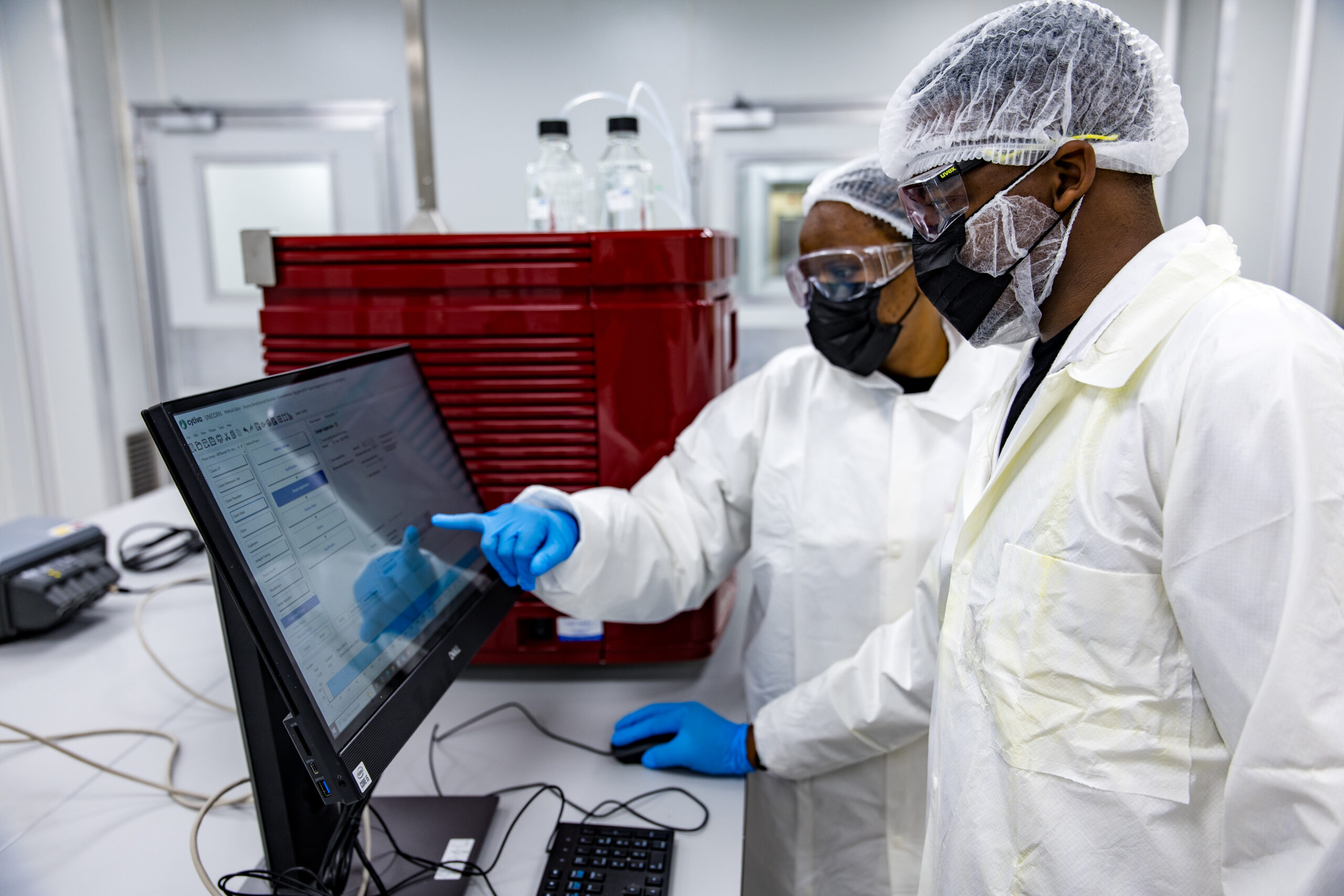

MAIN PHOTO: Inside FuturePHARMA’s state-of-the-art clean facility, researchers work in sterile conditions to ensure that biological molecules grown in living organisms like plants, mammalian cells, yeast or bacteria are free from contaminants and therefore safe to begin human clinical trials
South Africa imports almost every active ingredient that goes into its medicines. This week, President Cyril Ramaphosa opened the CSIR’s FuturePHARMA facility: a shared, open-access plant built to close the gap between a promising laboratory result and a medicine a patient can actually get. Here is what is inside, who it is for, what was said at the launch, and what has to go right.
PiE TECH TEAM
PRETORIA – On Wednesday morning, on the CSIR campus in Waterkloof, President Cyril Ramaphosa cut the ribbon on a facility that its builders hope will change a stubborn fact of South African health: the country can discover things, but it struggles to make them. After the unveiling he walked the floor, met the scientists, engineers and technical specialists behind it, and watched demonstrations of the pharmaceutical development platforms, including small-molecule pilot products.
The facility is called FuturePHARMA. It is not a factory in the usual sense, and the President was careful to say so. It is something rarer and, its backers argue, more important: infrastructure for the awkward middle stretch of a medicine’s life, after the lab bench and before the production line.
| 98% of APIs used in local medicines are imported | R15bn estimated annual API import bill | ~R150m invested in the facility to date | 2 capability areas: small molecules and biologics |
Figures: CSIR (via Business Day) and launch remarks as reported by SAnews. The R150m is the amount invested to date, per CSIR’s Tsepo Tsekoa.
The 98% problem
Every tablet, capsule or injection has two parts: the active pharmaceutical ingredient, or API, which does the therapeutic work, and everything that turns it into a dose a patient can take. South Africa has a capable industry for the second part. For the first, it leans almost entirely on imports. According to the CSIR, local manufacturers import 98% of the APIs they need, at a cost of about R15 billion a year.
That dependence, said the CSIR’s Group Executive for Advanced Chemistry and Life Sciences, Dr Rachel Chikwamba, leaves local production exposed to external shocks, rising input costs and currency swings. Her sharper point was about where the system breaks. South Africa is strong at early-stage research, she said, but that strength fades at the moment an invention must be turned into a product that can be made safely and at scale.
Anyone who has followed African science will recognise the pattern: a good paper, a promising compound, a clever process, and then no affordable place to prove that it works at a size that matters. Building such a place privately is expensive, and for a university lab or a start-up it is usually impossible. FuturePHARMA is the state’s attempt to build it once, and share it.
“Scientific excellence alone is not enough.”
PRESIDENT CYRIL RAMAPHOSA, ON WHY THE FACILITY EXISTS
The President framed the problem in the same terms. Too many promising innovations, he said, struggle to move from the laboratory into further development, commercial production and wider social use, and that is the challenge FuturePHARMA was set up to address.
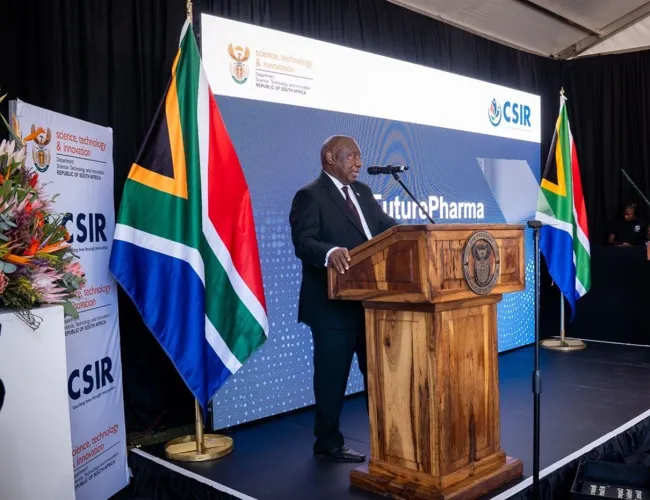
PHOTO: PRESIDENT RAMAPHOSA OPENING THE FACILITY
What it is, and what it is not
FuturePHARMA is an open-access facility. The CSIR describes it as a national capability rather than a private preserve: researchers at universities, scientists at other research councils and companies of all sizes can use its equipment and expertise to take a concept toward the clinic. The services on offer span process development, product development, analytics, quality systems and regulatory development.
Ramaphosa was explicit that this is not a standard drug plant. Reporting on the speech quoted him as saying it should not be seen as a “conventional commercial pharmaceutical manufacturing facility”. Its value lies in shared infrastructure and know-how that would be too specialised or too costly for individual researchers, universities and emerging companies to establish alone. Anything developed there must still travel the usual clinical, regulatory and commercial route before it becomes a product.
The project is being built in two phases. The first, now being launched, concentrated on the translational capability to take research through product development and into clinical testing, and laid the base for more local manufacturing. A second phase will scale that capability and develop strategic capacity for the health system, covering day-to-day needs as well as readiness for the next pandemic.
The money so far is largely public. The CSIR’s Tsepo Tsekoa told Business Day that about R150 million has been invested to date, mostly by government and with support from Germany’s KfW Development Bank. The CSIR’s own material says the small-molecule facility is funded by National Treasury through the Department of Science, Technology and Innovation.
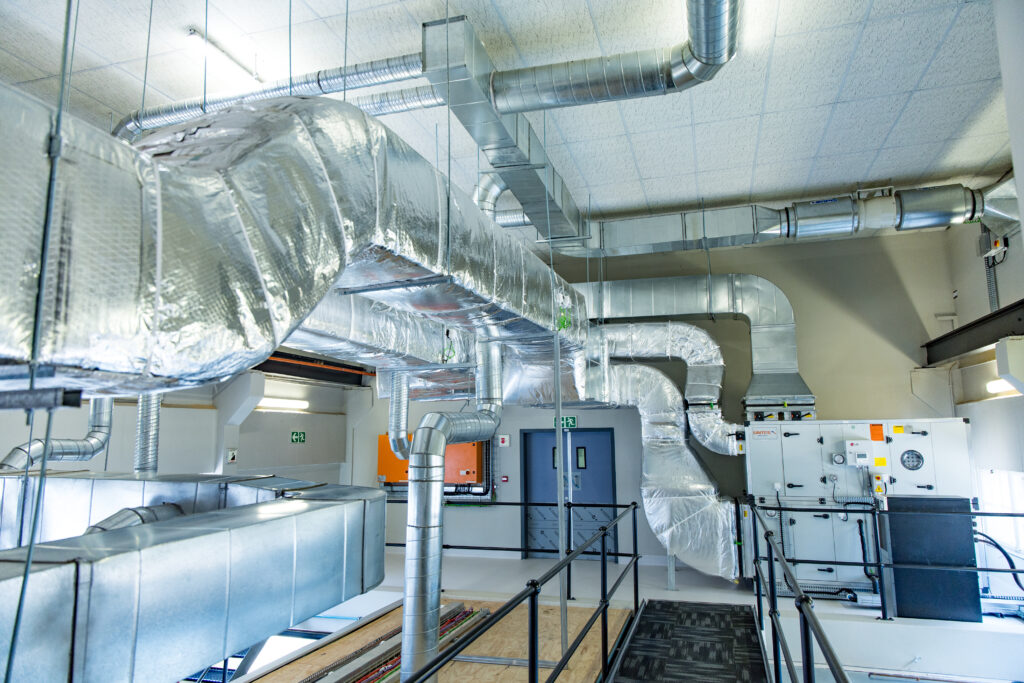
PHOTO: The biological research facility is equipped with a sophisticated and modern air filtration system to ensure compliance with international safety standards.
Inside the facility
SMALL MOLECULES: CHEMISTRY REINVENTED
The first of two capability areas covers small-molecule medicines, the family that includes common painkillers and anti-inflammatories. Teams here can work with conventional batch chemistry, with continuous flow chemistry and with biocatalysis, all backed by digital tools.
Continuous flow is the headline technology. In a traditional batch plant, ingredients are mixed in large vessels, one lot at a time. In a flow system, reagents are pumped through a network of reactors in a steady stream, with sensors and automated controls watching conditions in real time. The CSIR says this approach is faster, safer and more resource-efficient than batch processing, and that its production-scale pilot system shows how waste and energy use can fall. The CSIR also says it has built Africa’s first open-access API manufacturing hub using continuous flow, and describes the pilot plant as the continent’s first large-scale one.
The workflow is deliberately stepwise. Benchtop flow reactors and integrated analytical equipment support early proof-of-concept work. Once a process is established, it can be scaled on the CSIR’s larger flow facility. The aim, as the CSIR describes it, is to develop a process to kilogramme scale with a company, after which that company sets up its own flow plant and begins manufacturing. FuturePHARMA, in other words, is designed to be left behind.
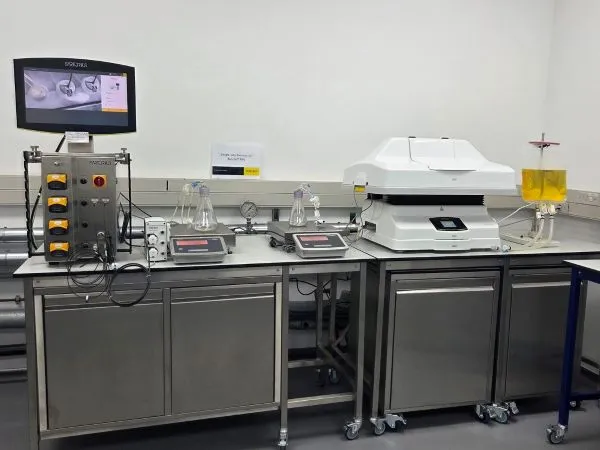
PHOTO: In the mammalian cell culture laboratory at the CSIR, a bioreactor is used for biomanufacturing research, process development and workforce training. This rocking motion bioreactor gently tilts a sterile, disposable bag to mix liquid and help oxygen reach fragile mammalian cells. Because the cells stay inside a sealed single-use bag, there is less cleaning and sterilising between batches, making it useful for vaccine and cell therapy production.In the mammalian cell culture laboratory at the CSIR, a bioreactor is used for biomanufacturing research, process development and workforce training. This rocking motion bioreactor gently tilts a sterile, disposable bag to mix liquid and help oxygen reach fragile mammalian cells. Because the cells stay inside a sealed single-use bag, there is less cleaning and sterilising between batches, making it useful for vaccine and cell therapy production.
BIOPHARMACEUTICALS: VACCINES AND PROTEINS
The second capability area targets biological medicines: protein-based therapies, vaccines and related products made in plant systems, yeast expression systems and mammalian cell culture. The CSIR’s planning material describes the aim as producing investigational, clinical-grade material at pilot scale, for clinical testing and for emergency use, in cGMP-ready space.
This builds on experience. Chikwamba pointed to more than two decades of CSIR investment in research and manufacturing infrastructure, including its Biomanufacturing Industry Development Centre, which has been used to train a skilled workforce and grow the biotechnology sector. The Africa Centres for Disease Control and Prevention has recognised the CSIR as a regional manufacturing capability and capacity development hub, and the World Health Organisation has designated it an African biomanufacturing training hub.
THE WIDER CLUSTER
FuturePHARMA does not stand alone. It works with the API Innovation Cluster, set up by the DSTI and the Technology Innovation Agency in 2020, whose second phase the CSIR now hosts. The cluster also supports translational projects at an API+ Laboratory at CPT Pharma. Separately, the CSIR has invested in a supercritical carbon dioxide encapsulation facility focused on precision dosage-form manufacturing.
A test case: the celecoxib pilot
The clearest proof of concept so far is celecoxib, a prescription anti-inflammatory used to treat pain and inflammation. According to CSIR material, a team funded by the DSTI patented a continuous flow process at laboratory scale and then partnered with the CSIR to establish an industrial-scale version. Business Day reports that FuturePHARMA has already piloted a process to make the celecoxib API.
It is a modest drug, and that is the point. If a locally developed process can make an everyday medicine’s key ingredient at pilot scale, the same route may be repeated for other essential medicines. SAHPRA’s CEO made the link directly at the launch: widening the range of locally made APIs would let the country produce more essential medicines and reduce the risk of critical shortages.
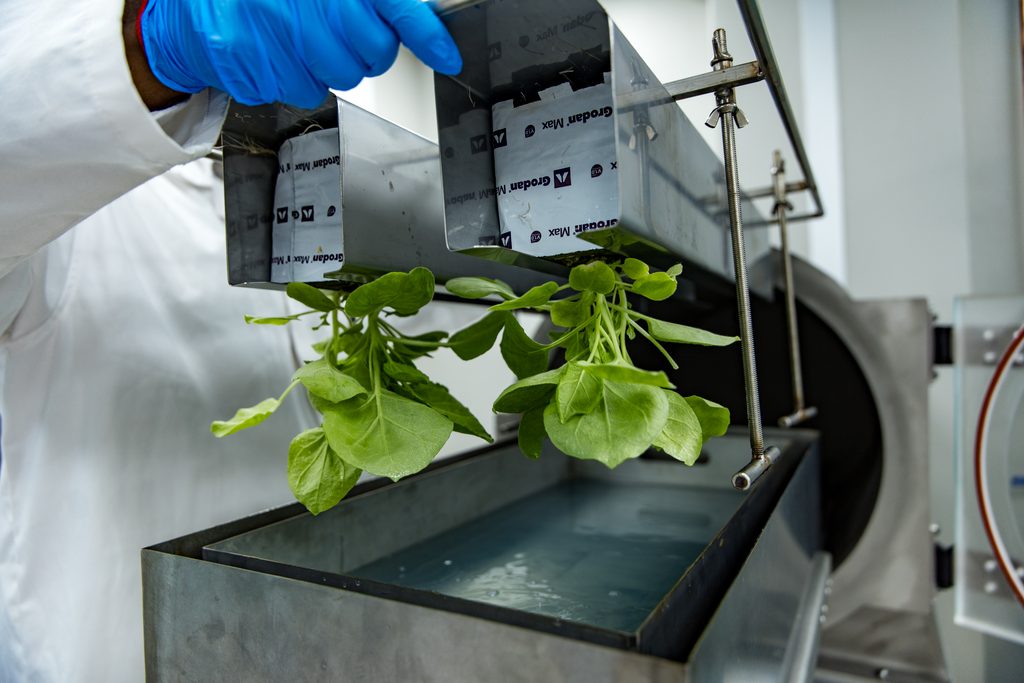
PHOTO: A vacuum infiltration system and genetic engineering tools are used to introduce genetic sequences into the leaves
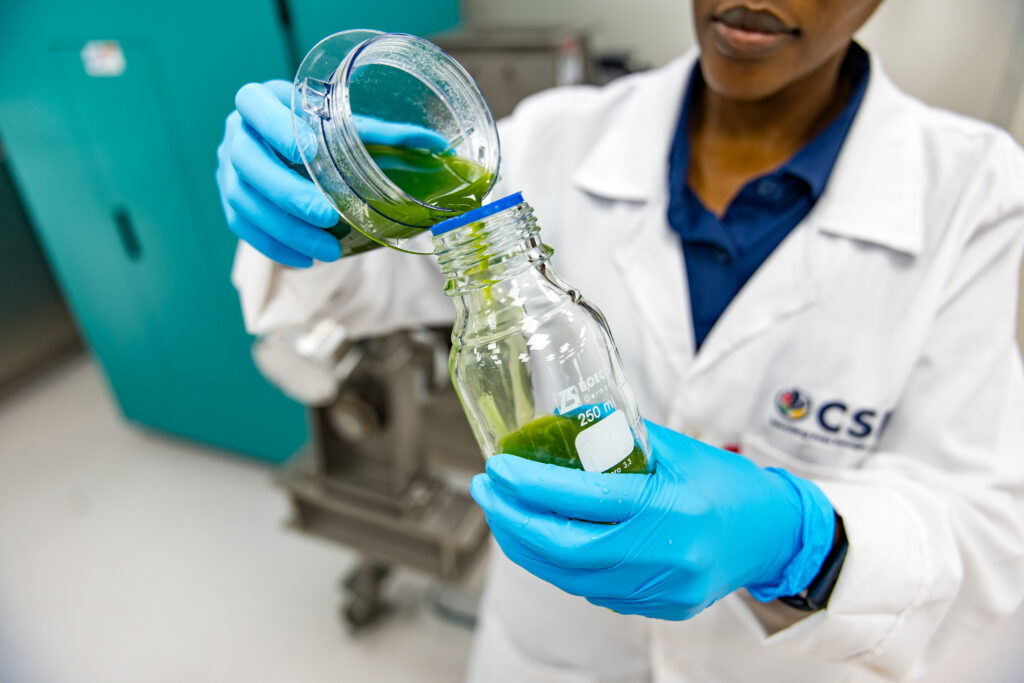
PHOTO: Cellular machinery inside the plants then produces a target molecule, which can be extracted (right) and purified for testing in clinical trials.
Who gets to use it
The intended users are not only big pharmaceutical houses. The CSIR says the facility will support entrepreneurs and emerging businesses by giving them access to infrastructure, technical expertise, regulatory support, skilled people and manufacturing capability, without forcing them to build their own at the riskiest stage.
A founder with an idea will be able to test it, find out whether the product is viable, build a technology package and produce initial runs for market testing, while being connected to businesses, funders and others in the industry. Chikwamba’s hope is that this creates a pipeline of new pharmaceutical companies and the skilled workforce that Africa’s growing manufacturing sector needs.
Voices from the launch
THE PRESIDENT: CONNECT THE SYSTEM
Ramaphosa began with the lesson of COVID-19. The pandemic showed that developing economies must strengthen local scientific, technological and manufacturing capability to protect their people’s health, and it was a reminder, he said, that “health security, economic resilience and national development are interconnected”.
Much of his address was about institutions rather than equipment. The pharmaceutical value chain, he noted, cuts across several mandates: the DSTI for research, technology and skills; the Department of Health for medicines and vaccines; the Department of Trade, Industry and Competition for industrial development, localisation and investment; National Treasury for public financing; and regulators such as SAHPRA for the pathways products must pass through. His message was that strategies, investments and programmes must reinforce one another, and that emerging instruments, among them a Pharmaceutical Roadmap and the Vaccine Innovation and Manufacturing Strategy, should tie research capability to national health priorities, industrial opportunity and market demand.
He also placed FuturePHARMA beside established players, naming Biovac as an example of a manufacturer contributing different capabilities to the same value chain. He closed with a hope that the facility becomes a place where South African knowledge becomes technology, technology becomes product, and products create lasting social, industrial and economic value for the country and the continent.
THE CSIR: A SANDBOX FOR THE NEXT EMERGENCY
Chikwamba described FuturePHARMA as a “sandbox”: a controlled environment in which South Africa can test not only whether it can make safe products, but also the logistics, supply chains and technical systems that a health emergency demands. Business Day reported her saying the facility can be rapidly reconfigured to make clinical-grade products in a crisis.
The design logic is that capability is kept warm. The facility will keep producing what the innovation ecosystem needs and keep training its people, so that a response does not have to be built from scratch after a threat appears. The goal, she said, is a faster response and a country that “will not be waiting in line” for products from elsewhere.
THE REGULATOR: PARTNER FIRST, REFEREE SECOND
SAHPRA CEO Dr Boitumelo Semete-Makokotlela argued that local manufacturing is not merely an industrial objective but is tied to access to medicines and health security. She said the regulator has adopted a policy position, published in 2025, that supports local manufacture through shorter evaluation timeframes and reduced assessment fees while holding the line on quality, safety and efficacy.
She told the CSIR that SAHPRA will work with it as FuturePHARMA seeks the regulatory authorisation it needs, citing the regulator’s support for the mRNA vaccine manufacturing platform as precedent. With a note of humour she added that there would come a moment when the regulator must act as the enforcer. SAHPRA already works with the CSIR and other national regulators on the continent through the regional biomanufacturing hub, and that collaboration will extend to training regulators in small-molecule manufacturing. Enabling local production, she stressed, cannot be done by the regulator alone: science, industry, financing, procurement, trade, health policy and regulation must line up. She also pointed to patients who sometimes cannot get medicines because global supply chains are disrupted.
THE WHO: THE PATIENT’S VIEW
The WHO’s representative to South Africa, Dr Shenaaz El-Halabi, brought the discussion back to the person waiting for treatment. For that patient, she said, progress means a medicine that is available when needed, safe, effective and affordable. She warned that reliance on external supply leaves countries vulnerable when global production is disrupted or demand surges, as happened during COVID-19.
She tied the facility to the WHO’s framework for strengthening local production of medicines, vaccines and other health technologies in the African Region for 2025 to 2035. It calls for a holistic approach covering research and development, innovation hubs, technology transfer and partnerships, with governments aligning industrial policy to public health needs, research institutions supplying discoveries and skills, industry bringing manufacturing expertise and regulators protecting quality. She also highlighted the CSIR’s growing role in building Africa’s biomanufacturing workforce.
Why it matters beyond South Africa’s borders
Ramaphosa is the African Union’s Champion on Pandemic Prevention, Preparedness and Response, and he has pressed African countries to build their own capacity to make vaccines, medicines and diagnostics. At the launch he noted the emphasis the AU and Africa CDC place on local manufacturing as part of the continent’s health security and sovereignty agenda, and said South Africa is well placed to contribute to regional value chains through its research institutions, universities, regulators and manufacturing base. FuturePHARMA, he said, creates openings for collaboration with African researchers, institutions and companies.
The numbers behind that ambition are steep. Africa CDC’s framework aims for 60% of the vaccines used in Africa to be made on the continent by 2040. When the target was set in 2021, the continent produced only about 1% of the vaccines it used. At the 2025 public health conference in Durban, Science, Technology and Innovation Minister Blade Nzimande welcomed an Africa CDC-led pharmaceutical manufacturing plan backed by the AU, Afreximbank and Gavi with US$3.2 billion in investment, centred on regional hubs, WHO-quality standards and better regulation through the African Medicines Agency. More recently, African leaders have been reported to have adopted a declaration to produce at least 60% of health products locally by 2040.
Hubs of this sort are what such targets are made of. A facility that lets African start-ups and universities prove a product, trains regulators and manufacturers from across the continent, and can be repurposed when an outbreak hits, is a piece of shared infrastructure that no single small market could easily afford. That is the continental case for FuturePHARMA: it is less a South African plant than a South African contribution to a common supply chain.
The hard questions
A launch is a beginning, and enthusiasm should not be mistaken for results. These are the questions that will decide whether FuturePHARMA delivers; they are open questions, not findings.
- Who picks up the baton? The facility develops and de-risks processes, but it is not meant to manufacture at commercial scale. Its impact depends on companies adopting what it proves, which is why Ramaphosa stressed investment, procurement and market demand alongside science.
- Will demand follow supply? Africa has seen what happens when capacity outruns orders. In 2022 the Africa CDC warned that production of the Johnson & Johnson vaccine in South Africa could stop because countries were not ordering it. Local manufacture needs buyers, and public procurement is the biggest lever.
- Can phase 2 be funded and delivered? About R150 million has been spent so far. Scaling to strategic capacity, as the second phase intends, will need sustained funding and the skills to run it.
- Will regulation keep pace? SAHPRA’s faster, cheaper pathway for locally made products is a promising start. Across the continent, analysts argue that reaching the 2040 target will require harmonised regulation between African markets.
- Can locally made ingredients compete? The CSIR argues flow chemistry cuts waste and energy use. Whether that translates into prices that can stand against established import sources is a question only production data will answer.
What to watch next
- The first commercial technology transfers: a company taking a FuturePHARMA-developed process into its own plant.
- SAHPRA’s authorisation for FuturePHARMA’s own operations, and the first regulators trained in small-molecule manufacturing.
- Funding and scope for phase 2, and how it connects to the Pharmaceutical Roadmap and the Vaccine Innovation and Manufacturing Strategy.
- New APIs entering the pipeline beyond celecoxib, and any African partners signing on as users.
Fact file
| What | CSIR FuturePHARMA: an open-access pharmaceutical innovation and manufacturing facility |
| Launched | Wednesday 7 October 2026, by President Cyril Ramaphosa |
| Where | CSIR Campus, Waterkloof, Tshwane (Pretoria) |
| Funding | National Treasury through the Department of Science, Technology and Innovation (DSTI); German KfW Development Bank support. About R150m invested to date |
| Capability 1 | Small-molecule product and process development: batch chemistry, continuous flow chemistry, biocatalysis, digital integration |
| Capability 2 | Biopharmaceutical development: vaccines and protein-based medicines using plant, yeast and mammalian cell systems |
| First pilot | Active ingredient for celecoxib, an anti-inflammatory and pain medicine |
| Regulatory partner | South African Health Products Regulatory Authority (SAHPRA) |
| Phases | Phase 1: translational capability. Phase 2: scale and strategic capacity for health-system needs and pandemic readiness |
SOURCES
- SAnews: “President launches FuturePHARMA facility to strengthen SA’s health sovereignty”, 7 October 2026 (sanews.gov.za)
- SAnews: “FuturePHARMA to bridge scientific discoveries gap”, 7 October 2026 (sanews.gov.za)
- Business Day: “CSIR launches facility to reduce reliance on imported drug ingredients”, Tamar Kahn, 7 October 2026
- BeninWebTV: “South Africa: FuturePHARMA aims to support local medicine production”, 7 October 2026
- Presidency and CSIR pre-launch notices, 6 October 2026 (csir.co.za; sanews.gov.za)
- CSIR: Pharmaceutical technologies; API Innovation Cluster; “We can make pain relief drugs more affordable”; “CSIR invests in agile infrastructure for local production of critical medicines”; FuturePHARMA brochure (csir.co.za)
- Eastern Cape Industrial Business News: API Innovation Cluster phase 2 hosting
- SciDev.Net / AllAfrica: Africa CDC-led pharmaceutical manufacturing plan, CPHIA 2025; Africa CDC and AU 60% targets (The EastAfrican, Chatham House, Gazette NGR); The Lancet via PMC on COVID-19 vaccine demand