
Why Rassie Erasmus and Siya Kolisi keep turning rugby wins into something bigger — and why, this time, it matters more than usual, THE PIE TEAM EXAMINES…...
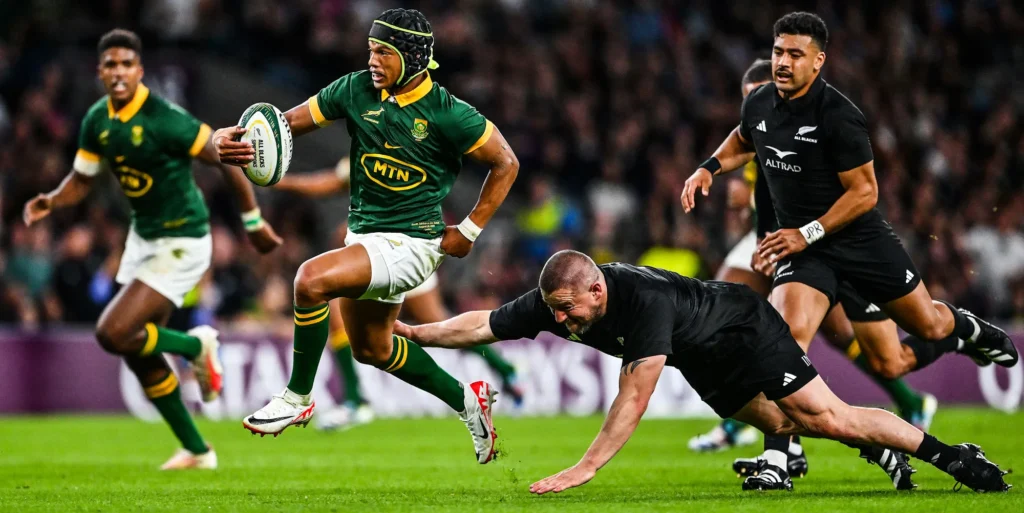
The scoreline read 43-28. The series read 3-1. On paper, it was the Springboks closing out the inaugural Rugby’s Greatest Rivalry series against the All Blacks in Baltimore, a fourth and decisive Test that also marked Rassie Erasmus’s 100th match in charge of South African rugby. But anyone who has followed this Springbok side over the past few years knows the paperwork was never really the point.
More than 68,000 people packed M&T Bank Stadium, a US rugby attendance record, and by most accounts a large share of that crowd was South African — expatriates and tourists who had found their way to Maryland for the occasion. Erasmus admitted afterwards he wasn’t entirely sure how so many of them had made the trip. But what struck him more, he said, was who they were standing in for: the people who couldn’t be there. Farmers. Township residents. Families doing their shopping at the local mall on a Saturday afternoon back home. Ordinary South Africans, watching on television, in taverns, in living rooms, across every corner of the country.
This has become something of a signature for Erasmus and his captain. Kolisi, reflecting on the coach’s influence since 2018, described how Erasmus arrived with a team that was, in his words, not in a good headspace, and set about changing that by reminding the players what the jersey has meant to the country and insisting the collective always comes before any individual. It is a message Kolisi has carried further than most — as the first Black captain in Springbok history, leading a squad drawn from eleven language groups and every corner of South African society, he has become as much a symbol of transformation as a rugby player.

CAPTION: COACH RASSIE ERASMUS

CAPTION: CAPTAIN SIYA KOLISI
Rugby as a language for nationhood
None of this is accidental, and it isn’t new. Since he first took charge, Erasmus has spoken about wanting the Springboks to reach beyond elite schools and into townships and small rural towns, so the team actually looks like the country it represents. Commentators have credited him with redefining what leadership can look like off the field as much as on it, and organisations from university chancellors to the FW de Klerk Foundation have praised him for using the sport as a vehicle for social cohesion. He has, more than once, been described as a nation-builder in the same breath as a rugby coach.
That framing matters because of the moment South Africa finds itself in. Over the past eighteen months, US President Donald Trump has repeatedly claimed that white South Africans, and white farmers in particular, are being systematically targeted and persecuted — language he has used to justify granting refugee status to a group of Afrikaners and to escalate diplomatic tension with Pretoria. Independent fact-checkers, South African crime researchers and the country’s own government have all pushed back hard on the claim, pointing out that violent crime in South Africa cuts across racial lines and that no credible evidence supports the idea of a coordinated campaign against white farmers.
It is against that backdrop that a Springbok coach standing in an American stadium, thanking farmers, township residents and mall-goers back home in the same sentence, takes on extra weight. It is a small, human counter-image to the narrative playing out in Washington: not a country cleaved along racial lines, but one a rugby team is trying, imperfectly and deliberately, to hold together.
A team that mirrors the country
None of this erases South Africa’s real fractures, or the hard statistics on inequality and crime that no rugby result can paper over. Erasmus and Kolisi are not claiming otherwise. What they are offering, week after week, is something closer to Nelson Mandela’s original instinct in 1995 — that a shared jersey, however briefly, can let a divided country recognise itself in the same story. Kolisi has said as much himself, describing the current era as a chance to show the world, once again, who South Africans are and what they stand for.
Whether that sentiment survives the next election cycle, the next crime statistics release, or the next undiplomatic exchange in the Oval Office is an open question. But for one Saturday night in Baltimore, with a green-and-gold sea of supporters singing along and a coach searching for the words to describe what it meant, rugby did what it has periodically done for South Africa for three decades now: it gave people something to feel proud of together, however briefly, whatever else was happening beyond the touchline.
Result: South Africa 43-28 New Zealand (Baltimore) — Springboks win series 3-1