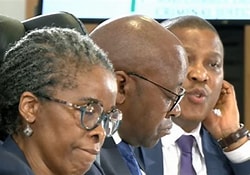

PiE NEWS ANALYSIS – The NCC leader and MP made a brief appearance on 11 August before commissioners postponed his testimony to 19 August, after he blamed a malfunctioning laptop for submitting his statement only hours before he was due to testify.
Johannesburg | 11 August 2026
Fadiel Adams, the Member of Parliament and leader of the National Coloured Congress (NCC), made a brief appearance before the Madlanga Commission of Inquiry on Tuesday, 11 August 2026 at the Brigitte Mabandla Justice College in Pretoria — but his testimony was postponed to 19 August after evidence leaders said they had not had time to prepare, following his late submission of a sworn statement.
When it goes ahead, his testimony is expected to be one of the most closely watched sessions the commission has held, tying together a police-corruption whistleblower complaint, the office of suspended Police Minister Senzo Mchunu, and Adams’s own pending criminal case.
Adams has been a fixture in South African headlines for months, but for reasons that pull in several directions at once. Understanding what he will eventually face under oath requires separating three distinct — though now tangled — threads: who he is and how he built a political career; the criminal case he is currently out on bail over; and the whistleblower complaint that helped trigger one of the biggest crises to hit South African policing in years.
Who is Fadiel Adams?
Adams was born on 14 June 1976 in Retreat, Cape Town, the third of six children of a builder and a seamstress. By his own public account, he dropped out of school in Grade 11, became involved with gangs and drugs, and was homeless and addicted by the time he was 30 — a personal history he has spoken about openly rather than concealed.
His entry into politics grew out of community activism in Lavender Hill, a working-class area on the Cape Flats. He founded the Gatvol Capetonian Movement, a pressure group focused on the grievances of Cape Flats communities, before establishing the Cape Coloured Congress in August 2020. He was elected to the City of Cape Town council in the 2021 municipal elections. In 2023 the party rebranded as the National Coloured Congress (NCC) ahead of national elections.
At the 2024 general election, the NCC won just over 37,000 votes — enough for two seats in the National Assembly, one of which Adams took up himself. The party campaigns on what it frames as the neglect and marginalisation of coloured South Africans, and Adams has built a national profile as an outspoken, often deliberately provocative, voice on the subject, clashing regularly with both the ANC and the DA in the House.
“There was no façade; I didn’t need to say one thing and do another. Everything was done right in front of the people.” — Fadiel Adams, on his political style
The criminal case: arrest over the Magaqa murder probe
Separate from his commission appearance, Adams is currently out on R10,000 bail on charges of fraud and defeating the ends of justice. He was arrested in May 2026 following allegations that he interfered with the long-running investigation into the 2017 murder of former ANC Youth League secretary-general Sindiso Magaqa, reportedly by having contact with a convicted hitman connected to that case at a sensitive stage of the investigation.
The arrest itself has since become a subplot inside the Madlanga Commission: evidence presented to the inquiry showed that IDAC formally requested SAPS travel and authorisation records for the Political Killings Task Team (PKTT) officers who carried out the operation to arrest Adams in the Western Cape — a detail that has fed suspicion, still untested, about the extent to which Adams’s legal troubles and his whistleblowing role may be connected.
The IDAC complaint and the Mchunu connection
The reason Adams has become central to the Madlanga Commission’s work traces back to a Section 27 affidavit he submitted to the Investigating Directorate Against Corruption (IDAC) in November 2024. In it, Adams named senior Crime Intelligence officials — including then-divisional head Lieutenant-General Dumisani Khumalo — alleging fraud, corruption, nepotism and abuse of state resources, and claiming that criminal dockets he had personally opened in Cape Town and Soweto had been intercepted within SAPS.
Adams has said the complaint was based on classified crime intelligence documents he says were slipped under the door of his parliamentary office — an account that KwaZulu-Natal Police Commissioner Lieutenant-General Nhlanhla Mkhwanazi has directly challenged. Testifying earlier at the commission, Mkhwanazi accused Adams of handling sensitive, classified material recklessly despite not sitting on Parliament’s Joint Standing Committee on Intelligence, the only body cleared to receive such documents.
The commission has since heard that Adams’s complaint did not travel a simple, direct route to IDAC. Evidence presented showed that the office of Police Minister Senzo Mchunu — now suspended pending the outcome of the same inquiry — wrote to then-IDAC head Advocate Andrea Johnson in November 2024 forwarding Adams’s complaint and effectively directing that it be investigated. That letter, signed by Mchunu’s chief of staff Cedric Nkabinde, is what set in motion the investigation that led to Khumalo’s arrest.
Johnson herself later told the commission — contradicting earlier evidence she gave to Parliament’s ad hoc committee — that IDAC had in fact solicited the affidavit from Adams, rather than simply receiving it unprompted. A separate IDAC prosecutor, Drushanta Ramsamy, testified that Johnson referred repeatedly to meetings with Mchunu while directing the Crime Intelligence investigation, including one held at the minister’s home, and that a key witness in a related forklift-tender probe — itself stemming from a December 2024 Adams complaint — was flown in from the Eastern Cape at the minister’s arrangement.
Taken together, this evidence has raised a question the commission is expected to press Adams on directly: was he an independent whistleblower acting on documents that came to him unsolicited, or was his complaint effectively channelled — and possibly encouraged — from within the police minister’s own office as part of a wider campaign against senior Crime Intelligence figures? Both Mchunu and Johnson’s conduct are themselves under separate scrutiny at the commission, and none of these allegations, including those concerning Adams, have been tested or resulted in findings by the commission at this stage.
Suspended from Parliament
Compounding the picture, Adams was suspended from Parliament for 20 sitting days and had his salary and allowances reduced after the Joint Committee on Ethics and Members’ Interests found he had improperly published a Democratic Alliance staffer’s personal contact details and an internal email on social media. The National Assembly adopted the committee’s sanctions in early August. Adams has publicly acknowledged the conduct — telling reporters, “I made a really stupid mistake” — while pushing back on any suggestion that the timing was connected to his upcoming Madlanga appearance.
What happened on 11 August — and what’s next
Commission spokesperson Jeremy Michaels confirmed on 31 July that Adams would testify on the 11th, following months of back-and-forth between Adams and the commission’s legal team after he was first issued a Rule 3 notice in October 2025. Adams has said publicly that he wants the chance to “tell my side of the story” after being named repeatedly in Mkhwanazi’s earlier testimony.
That schedule did not hold. Evidence leader Advocate Matthew Chaskalson told the commission on Tuesday that Adams’s sworn statement — first requested on 25 October 2025 — had only been received after 9pm the previous night, leaving the legal team without enough time to prepare for questioning. Chaskalson applied for a postponement, and the commission agreed to push Adams’s testimony to Wednesday, 19 August.
Adams attributed the delay to a malfunctioning parliamentary laptop, telling the commission it had been “either in for repairs or frozen” for around 18 months and that he had only become aware of the commission’s request roughly three to four months earlier. Commission chair Justice Mbuyiseli Madlanga was openly sceptical, telling Adams he found the explanation “hard to believe” given the request dated back to October 2025, questioning how Adams could function as a parliamentarian if he could not use a laptop, and warning him that “you are not taking this commission seriously” and should not continue to treat it that way going forward.
When Adams returns to the stand on 19 August, political analysts who follow the commission expect the questioning to focus on a narrow set of core issues:
- How Adams actually obtained the classified Crime Intelligence documents underlying his Section 27 complaint, and whether his account of them being slipped under his office door holds up.
- The extent of his association with Major-General Feroz Khan and, through him, any direct links into Crime Intelligence structures.
- Whether his complaint was genuinely self-initiated or was solicited — and to what degree Mchunu’s office shaped or accelerated the resulting IDAC investigations.
- Whether he was, in the words of crime analyst Chris de Kock, a witting participant in what looked like “orchestrated attacks” on Crime Intelligence officers, or simply a person whose complaints were used by others for their own ends.
Political analyst Professor Dirk Kotze has suggested the commission will want to pin down the circumstances under which Adams received the documents and his relationship with Khan in detail, while De Kock has framed the central question more bluntly: whether Adams was being used, or was himself a player.
The bigger picture
Adams’s appearance lands at a pivotal point for the Madlanga Commission, which was established to investigate explosive allegations first made by Mkhwanazi in July 2025 about political interference in policing, the disbandment of the Political Killings Task Team, and organised-crime infiltration of law enforcement. The inquiry has already forced the resignation of IDAC’s own head, Andrea Johnson, amid findings that some of the resulting investigations were conducted unlawfully, and it continues to examine Mchunu’s suspension as police minister.
For Adams personally, the stakes cut in two directions. If his account of an unsolicited whistleblower complaint holds up, it strengthens his position as a minor political figure who stumbled into a major corruption story. If the commission instead finds his complaint was solicited or coordinated from within the police minister’s office, it raises harder questions about his independence — questions that will sit alongside, but are legally separate from, the fraud and obstruction case he still faces over the Magaqa murder investigation.
The commission has stressed repeatedly that none of the allegations traversed in its hearings — against Adams, Mchunu, Johnson or the Crime Intelligence officials named — amount to findings of guilt. Its mandate is fact-finding, and a final report, with any recommendations, is still to come. Tuesday’s brief appearance, and Madlanga’s visible impatience with Adams over the delay, has only sharpened anticipation for 19 August, when Adams’s own account is finally due to go on record, under oath, for the first time since his name became central to one of South Africa’s most consequential corruption inquiries in years.
This article draws on public reporting and evidence led before the Madlanga Commission of Inquiry as at 11 August 2026. Allegations referenced remain untested and no adverse findings have been made against any individual named.