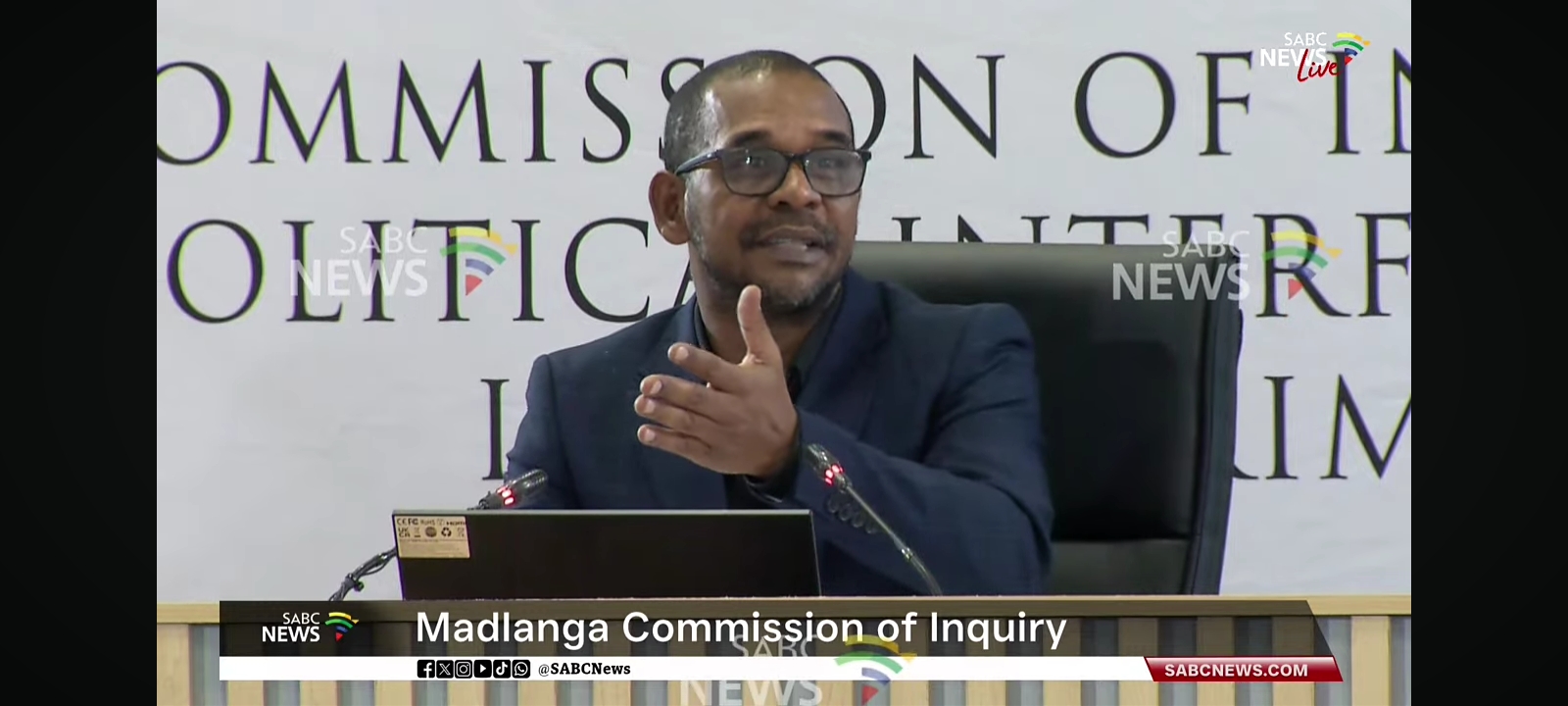

MAIN PHOTO: FADIEL ADAMS WRAPPING UP AT THE MADLANGA COMMISSION
A witness G who turned out to know everybody, a bakkie-owning associate arrested at the venue, and a Friday dash for Jumu’ah that left as many questions hanging as it answered — the NCC leader’s week on the stand, in one sitting.
By the PiE NewsDesk · 21 August 2026
Fadiel Adams told the Madlanga Commission this week that it “looks like” he had been used. On the evidence he himself supplied over three days at the Brigitte Mabandla Justice College, it is difficult to argue the point — though, in fairness to Adams, he was adamant throughout that being used and being willing are two very different things, and he intends to keep saying so for as long as anyone will let him.
The National Coloured Congress leader and suspended MP arrived at the commission as the author of the Section 27 referral that ultimately triggered the arrest of Crime Intelligence head Lt-Gen Dumisani Khumalo and several colleagues. He left it, three testy sittings later, as something closer to Exhibit A in a inquiry into who was really pulling the strings behind his own complaint — with a laptop excuse, a dead general, a man called Elvis and an associate’s arrest all competing for the title of most memorable subplot.
The Dead Man’s Alibi
Adams’s explanation for why he fired off a fraud complaint to then-police minister Senzo Mchunu within a day of opening dockets in Orlando rested heavily on the late Maj-Gen André Lincoln, the respected former anti-gang unit officer who had, Adams said, warned him that corrupt officers were intercepting his case files. There was just one structural problem with building a defence on a source who cannot be cross-examined: evidence leader Lee Segeels-Ncube pointed out, with the patience of someone who has had this conversation before, that you cannot rely on a dead man every time it’s convenient. Commission chairperson Justice Mbuyiseli Madlanga went further, noting that Lincoln was in Cape Town and incapacitated at the relevant time and could not plausibly have been intercepting anything happening a province away.
“You cannot rely on a dead man every time. It is unacceptable.”
— Adv Lee Segeels-Ncube, Madlanga Commission evidence leader, to Fadiel Adams
Commissioner Sandile Khumalo supplied the tidier version of events: the dockets ended up in Pretoria because Adams’s complaint to the minister’s office triggered that outcome directly, not because of any interception plot. It is the kind of correction that turns a conspiracy into a paper trail — considerably less cinematic, but considerably easier to check.
Meet Elvis, Who Knows Everyone
If the Lincoln defence supplied the week’s forensic drama, the emergence of “Witness G” supplied its soap opera. Adams told the commission he was assisted in opening the Orlando cases by a contact he knew only as Elvis — a name that turned out to belong to a Crime Intelligence informant who is, among other things, a self-proclaimed handler of political fixer Brown Mogotsi and a longstanding friend of suspended Crime Intelligence deputy Maj-Gen Feroz Khan. Khan, readers will recall, is the same officer whose relationship with former IDAC head Andrea Johnson produced the commission’s most-quoted WhatsApp exchange to date, in which he addressed her as “gorgeous.” Mogotsi is the same self-described fixer whom the commission’s own interim report has already recommended for further investigation, alongside Witness G.
Segeels-Ncube laid the resulting geometry out for Adams in a single sentence: the person who helped him open the dockets in Orlando was also a Crime Intelligence figure, a friend of General Khan, the handler of Brown Mogotsi, and connected — by that same chain — to the minister Adams approached about the dockets the very next day. Adams’s response amounted to a shrug: he was, he said, surprised by the connections himself, and denied knowing Khan at all. He also spent Friday morning correcting his own account of how he met Elvis, softening a version he had given a day earlier about travelling to the police station together.
None of this establishes that suspended Minister Mchunu was part of any such arrangement — the commission has not put that allegation to him in this leg of proceedings, and Adams himself said he could not draw a direct line to the minister. What it does establish, on the commission’s own account, is that a remarkable number of the people who shepherded Adams’s complaint into being happened to already know each other rather well.
Throwing Andrea Under the Bus
For a man widely accused of being a pawn, Adams spent a fair amount of stage time trying to relocate the blame. He told the commission he has laid charges against IDAC over what he says are discrepancies in how his Section 27 referral was handled, and he pushed back hard against former IDAC head Andrea Johnson’s own evidence — pointing out that his referral did, contrary to Johnson’s earlier testimony, include material about the KwaZulu-Natal political killings task team. If Adams is right, it would mean Johnson misled the commission about the contents of a document that has already ended a career and reshaped a national investigation. It is, at minimum, a striking way to spend a week insisting you were manipulated: by publicly accusing one of your alleged manipulators of manipulating the record too.
“I do believe I was used.”
— Fadiel Adams, to the Madlanga Commission
The Scharnick Interlude
No self-respecting week at Madlanga passes without a subplot violent enough to make the main plot look tame, and this one arrived via Stuart James Scharnick — a Richards Bay businessman, described in the commission’s own evidence as the man who lets suspended deputy national police commissioner Lt-Gen Shadrack Sibiya drive his bakkie, and who has separately been characterised in testimony as having dozens of prior cases to his name. Scharnick had been a visible presence at Adams’s hearings for two days running, at one point seen interacting with Adams himself during a tea adjournment. That adjournment ended with Sowetan journalist Herman Moloi filming Scharnick, Scharnick allegedly confronting and threatening Moloi over it, and police arresting Scharnick at the venue roughly an hour after Moloi opened an intimidation case.
The commission’s spokesperson did not mince words about the optics: intimidating journalists covering a judicial inquiry into political interference in policing is not, it turns out, a good way to reassure anyone that the interference has stopped. Scharnick’s arrest adds his name to a growing list of people orbiting the Sibiya camp who have found themselves in handcuffs somewhere near the commission’s front doors — which is either extraordinary bad luck or a fairly efficient advertisement for what the commission has been trying to establish all along.
Friday’s Parting Shot
Adams used his final hours on the stand to retract elements of his Thursday evidence — apologising for arriving under-prepared and correcting his account of the Orlando meeting with Elvis — before turning, in the time-honoured tradition of witnesses who have promised bombshells all week, to one more thread for commissioners to chase after he had gone. He urged the commission to examine a separate matter involving a Brigadier Johnson, whom he said was related to former IDAC head Andrea Johnson, and suggested it warranted a look at Maj-Gen Khan’s own alleged involvement. It was less a bombshell than a hand grenade lobbed on the way out the door, with the pin left for the commissioners to remove at their leisure — Adams was not there to be asked a single follow-up question about it, having already asked to be excused so he could get to Friday prayers.
That, in the end, is as tidy a closing image as this saga has produced: three days of testimony that started with a dead man who couldn’t confirm anything and ended with the witness himself out the door before anyone could confirm his final claim either. Evidence leader Segeels-Ncube has indicated her questioning of Adams is done for now. Whether Friday’s parting allegation goes anywhere will depend on people who, unlike General Lincoln, are still around to answer for it.
This piece uses a light, satirical tone typical of political sketch-writing. All factual claims are drawn from public reporting and sworn testimony before the Madlanga Commission of Inquiry; allegations attributed to Mr Adams or other witnesses are their own evidence, not findings of fact, and named individuals implicated in testimony have denied wrongdoing where stated. Readers should consult the original sources for full context.
Sources: SABC News · The Citizen · TimesLIVE · Sunday Times · EWN · Sowetan · Business Day · IOL · Mail & Guardian · Daily Maverick · News24 · Scrolla.Africa · MDNtv · Wikipedia (Madlanga Commission, Brown Mogotsi)