

MAIN PHOTO: CHOIRMASTER RALF SCHMITT AND SOME OF THE YOUTH CHOIR MEMBERS
LEN KALANE
There is a moment, a few bars into almost any Ndlovu Youth Choir performance, when an audience stops watching and starts feeling. The harmonies lock in, the drums find their pocket, thirty pairs of feet hit the stage in the same instant — and something that started as an after-school activity for vulnerable children in rural Limpopo becomes, again, undeniable proof that talent does not check a postal code before it arrives.
This is the story about how a group of children from a rural Limpopo care programme grew into one of the most loved choirs on Earth — and why, seventeen years on, the Ndlovu Youth Choir is only just getting started.
A Musical Extravaganza, By Their Own Definition
The choir describes itself, without a trace of false modesty, as a musical extravaganza — unique arrangements, powerhouse vocals and mesmerising choreography rolled into one irresistible package. It is not marketing spin. It is, at this point, simply an accurate job description.
Since forming in 2009, the Ndlovu Youth Choir has gone from a village amphitheatre in the Moutse Valley to Carnegie Hall in New York, from local fundraising concerts to the final of America’s Got Talent, and from singing for their own community to performing for royalty, tech billionaires and tennis legends. Along the way they have carried a message that never changes even as the stages get bigger: hope, unity and the boundless potential of young South Africans.
How It All Started
The choir’s origin story has nothing to do with talent scouts or record labels. It began inside the Ndlovu Care Group’s Orphan and Vulnerable Children’s Programme, an NGO initiative in the Moutse Valley, Limpopo, set up in the shadow of South Africa’s HIV/AIDS crisis to give children from an under-resourced rural community the same access to care, education and opportunity as their more privileged peers. Music was originally just one strand of that support — a way to keep children engaged, disciplined and connected to one another.
What changed everything was a simple, uncomfortable question the choir’s co-founder began asking every young person who turned up to audition: are you still at school? Too many answered that they were “just chilling” — teenage shorthand for having dropped out, failed to make the marks for university, or simply run out of options in a community with punishing youth unemployment. That answer became, in the founder’s own words, the thing that haunted him most — and the reason the choir evolved from a feel-good extracurricular programme into something far more purposeful: a genuine pathway to a career, a wage and a future for young people who had very few of those on offer.
Word of the choir’s quality spread quickly and locally long before any international breakthrough. Within its first eighteen months the group had grown from seventeen singers to seventy, and had already shared a stage with visiting international ensembles from Canada and the United States. The foundations of a world-class outfit were being laid in a rural amphitheatre years before the rest of the world had any idea it existed.
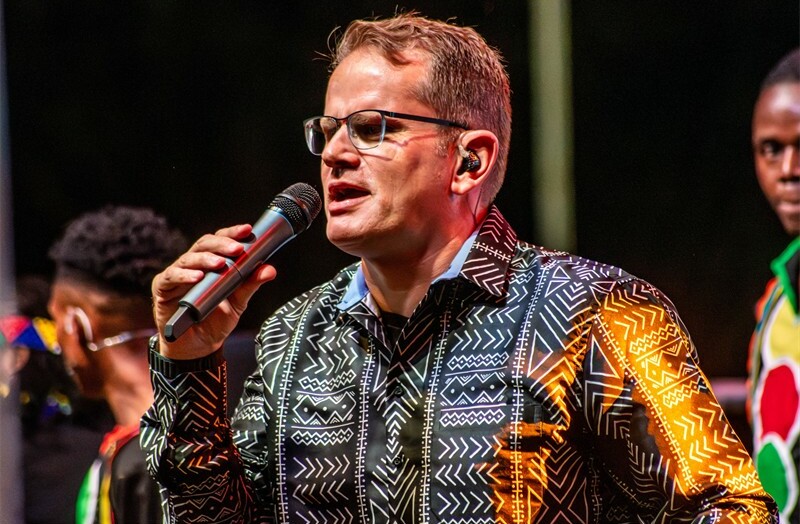
PHOTO: RALF SCHMITT
Meet the Man Behind the Music: Ralf Schmitt
Contrary to a persistent popular assumption, the choir’s conductor and co-founder is not an import — he is thoroughly South African. Ralf Schmitt was born in Johannesburg and got his own start in music as a boy chorister with the famed Drakensberg Boys’ Choir, before completing his schooling at Kearsney College in KwaZulu-Natal and going on to study music at the University of Pretoria. He remains close to his own choral roots to this day and still serves on the board of the Drakensberg Boys’ Choir School.
Schmitt is a composer and producer as much as a conductor, and his musical fingerprints extend well beyond Ndlovu. He has worked with Josh Groban, Andrea Bocelli and Celine Dion, contributed arrangements to a FIFA World Cup final production, and worked alongside Shakira on the vocal arrangement of “Waka Waka,“ the official anthem of the 2010 FIFA World Cup held on South African soil. A committed custodian of the country’s indigenous music, his fieldwork transcribing traditional songs has been published in two songbooks, and he has run workshops on South African choral music everywhere from Buenos Aires to Singapore.
“Just because you’re born in poverty doesn’t mean you are poverty.” — Ralf Schmitt
It is this same conviction that shaped the choir’s philosophy from day one: that talent is universal even when opportunity is not, and that the job of an institution like Ndlovu is simply to close that gap. Schmitt has described the choir’s breakthrough single, “Believe,” as being inspired directly by the group’s own early trials — a song about persistence written for singers who were still, at the time, entirely unknown.
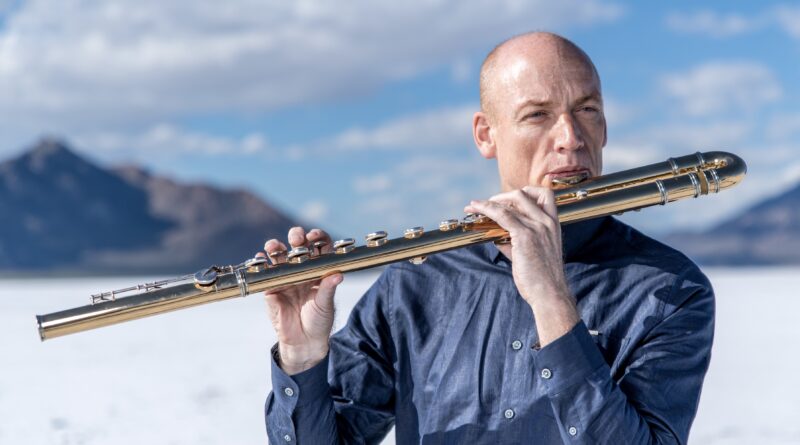
PHOTO WOUTER KELLERMAN
From Viral Clip to the World Stage
The moment the wider world properly discovered Ndlovu came in October 2018, when the choir released an isiZulu reimagining of Ed Sheeran’s “Shape of You,“ recorded with South African flautist and Grammy winner Wouter Kellerman. The video went viral, picked up international press, and won Best Independent Music Video at the Hollywood Music and Media Awards. It also caught the eye of America’s Got Talent producers, who came calling the following year.
Season 14 of AGT turned out to be a watershed. The Ndlovu Youth Choir became the first choir in the history of either America’s Got Talent or Britain’s Got Talent to reach the final of the competition. Judge Simon Cowell, never a man of faint praise, called their final performance the best final he had ever sat through, and went on to sign the group to his own label, SYCO, in partnership with Sony Music. Their debut studio album, Africa, followed in 2019 and went straight to number one on the South African iTunes chart — an emphatic answer, if one were needed, to any doubt about whether reality-TV exposure could translate into a lasting recording career.
A Passport Full of Stamps
What has followed reads like a highlight reel most established touring acts would envy. The choir has performed to more than 115,000 people in a single outing in Cape Town; taken part in “The Match In Africa,“ an exhibition tennis event that shared a stage with Rafael Nadal, Roger Federer, Bill Gates and Trevor Noah; held a celebrated residency at the AFAS Theatre in the Netherlands; headlined Germany’s long-running Africa Festival in Würzburg; and sung at the hallowed Carnegie Hall in New York. They have performed for Britain’s King Charles III, and undertaken multiple sold-out tours of Europe and the United States.
Even a global crisis could not silence them. During the hardest months of the Covid-19 pandemic, the choir produced upbeat public-service messages encouraging safety and hope, which were shared by both the World Health Organization and the United Nations, and they joined the world’s biggest names for Global Citizen’s “One World: Together At Home“ broadcast. Three more albums, Rise (2020), Grateful (2022) and Celebrate (2023), cemented a recording career that keeps pace with their relentless touring schedule.
Their repertoire is itself a kind of statement: traditional South African genres — gospel, ghoema, isicathamiya, amapiano — sitting comfortably alongside radical reworkings of global hits by Toto, U2, Kygo and Ed Sheeran. It is a sound built specifically to travel, without ever losing its accent.
Heirs to a Great South African Tradition
It is not unreasonable to place Ndlovu in the lineage of South African musical exports that set international stages alight long before them. Ipi Tombi, the exuberant township-and-tribal revue that conquered London’s West End and international touring circuits in the 1970s, proved decades ago that South African rhythm, colour and vocal power could fill Western theatres night after night. Sarafina!, Mbongeni Ngema’s Soweto-set musical, carried a very different story — one of township uprising and youthful defiance — all the way to Broadway and, later, the big screen, showing the world that South African stagecraft could carry real political and emotional weight, not just spectacle.
Ndlovu Youth Choir belongs unmistakably in that company: another distinctly South African sound conquering international audiences on its own terms. But where Ipi Tombi and Sarafina! were scripted theatrical productions built around a cast of characters and a plotline, Ndlovu’s story is the plot. These are not actors playing children from disadvantaged communities overcoming hardship through music — they are exactly that, performing as themselves, in real time, with the stakes still real. That authenticity, more than any single vocal run or dance break, may be what has made them so instantly beloved from Johannesburg to Los Angeles.
Home Ground: The 2026 South African Tour
For all their globe-trotting, the choir has never lost its connection to South African audiences, and their annual homecoming tour has become a fixture on the country’s live entertainment calendar, selling out every year since 2021. The 2026 edition opened at Cape Town’s Artscape Opera House in early February before making its way to Johannesburg, where the choir closed out a run of six shows at Teatro at Montecasino this past weekend, concluding on Sunday, 2 August.
True to founder Ralf Schmitt’s promise of a “stronger South African sound“ for this year’s programme, audiences at Montecasino were treated to a set list leaning hard into home-grown genres — gospel, ghoema and an amapiano medley alongside tributes to South African greats Miriam Makeba, Hugh Masekela, Johnny Clegg and Mango Groove — interwoven with the choir’s now-signature reworkings of international staples like “Circle of Life,“ “Waka Waka,“ “Bohemian Rhapsody“ and a stirring “Nessun Dorma.”
Next Stop: Edinburgh
The Montecasino run was not a full stop but a launch pad. Fresh off their Johannesburg shows, the choir is packing for Scotland, where they will make their debut at the world-famous Edinburgh Festival Fringe with a brand-new production, A Celebration of Africa — another first for a group that seems to collect them the way other artists collect awards. It is a fitting next chapter: the Fringe is one of the last major international stages still to host them, and after Cape Town, Johannesburg, New York, Würzburg and beyond, Edinburgh audiences are about to discover exactly what the rest of the world already knows.
Why They Matter
Strip away the awards, the viral clips and the celebrity duets, and the Ndlovu Youth Choir’s real achievement is quietly radical: they have built a sustainable, dignified career pathway for young South Africans who, in Ralf Schmitt’s own telling, might otherwise have been “just chilling“ — out of school, out of options, and out of the story the rest of the world tells about success. Instead, seventeen years after a handful of children gathered in a rural amphitheatre in Limpopo, this ensemble is packing theatres on five continents, carrying with them, wherever they go, the unmistakable, irresistible sound of home.
Ndlovu Youth Choir’s In Concert 2026 South African tour ran from 5–8 February at Artscape, Cape Town, and 30 July–2 August at Teatro, Montecasino, Johannesburg. The choir departs shortly for its debut season at the Edinburgh Festival Fringe.


