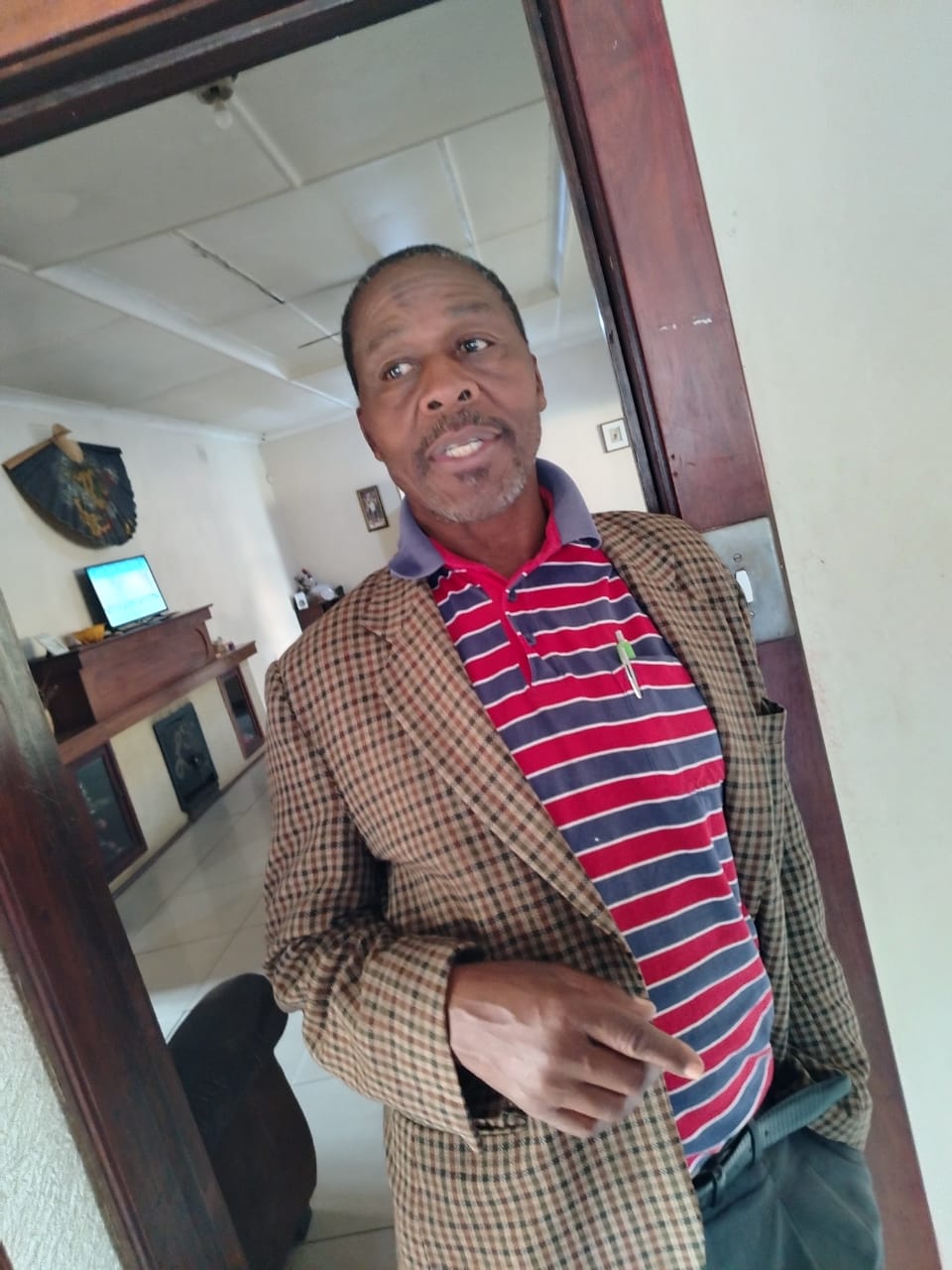

CAPTION: MUDINI MAIVHA
He chased stories for the Sunday Times, City Press and The Star, fled the security police into exile, and came home to a 3.4-hectare plot in Walkerville. When disease and thieves wiped out his piggery, he started again. Now he calls farming the last chapter of a life that has had many.
LEN KALANE
One Saturday in Zimbabwe, exiled journalist Mudini Maivha took the road from Harare to Chivu, a semi-rural town just before Masvingo. It is the same road that carries on to Beit Bridge and across the Limpopo into South Africa.
“No, I wasn’t going back there to my persecutors!” he says.
He was paying a visit to a fellow member of the Fourth Estate: Justin Nyoka, once the Drum magazine correspondent for Rhodesia, whose articles Maivha used to read. There was brunch and there were drinks and talk of Nyoka’s years at the magazine and of his colleague on the other side of the river, the late Drum editor Stan Motjuwadi.
The two men, it turned out, shared more than a trade. Nyoka had escaped into Mozambique to avoid arrest while writing for Drum as its Rhodesia correspondent during the Zimbabwe Bush War. Maivha had slipped into Lesotho to escape apartheid arrest before a 13-vehicle entourage of security branch police raided his backroom in Tshiawelo III, Soweto.
Maivha’s own newspaper career had run through the Sunday Times and City Press, two years each, and The Star for 18 months, all in the mid-to-late 1980s. He covered general news, crime, politics and soccer. At The Star he went out on an assignment one day and never came back to the office. It later emerged that he had gone into exile.
What he saw on the tour
Then came the tour of the farm.
There was a very large herd of cattle, and an even larger herd of goats. “When I thought I had not seen these animals in such large numbers under a black man,” Maivha recalls, “I was yet to see the largest piggery of my life.”
Nyoka, by then Zimbabwe’s Permanent Secretary of Information, a post equivalent to a Director-General in South Africa, was one of the biggest black farmers supplying pigs to the Cold Storage Commission, if not the biggest. The last stop was the maize field. The grain was grown mostly to feed the animals and bring down feed costs, and the stovers were milled for the cattle and goats, though not for the pigs.
“I was awed!”
A promise made in Harare
That night, Maivha regaled his wife, Maria, his companion through five years in exile, with the day’s experience. They agreed that if they were lucky enough to return to South Africa alive, they would strive to buy a farm, however small.
They returned in 1992. Four years later, they took out a mortgage on a 3.4-hectare plot in Walkerville towards the Vaal area, further south of Johannesburg.
The dream was to grow to the scale he had seen at Nyoka’s farm.
They started with 13 sows and grew the herd to 70, aiming for a 100-sow unit that would sell 25 pigs a week to abattoirs. Before they began, Maivha went to Hekpoort and Magaliesburg to learn from people already in the industry.
The man who helped him most, giving up half a day of his time, was Arthur Hollers, founder of Hiperformance Feeds. Piggery was Hollers’ first business before he moved into animal feed.
“We may not talk for a year or two or more,” Maivha says, “but he recognises me at sight or my voice on the phone.”
The pigs begin to die
Then one morning, three pigs were dead. There was no sign of what had killed them, and no snake bites.
More followed, at night and during the day. A call to the Gauteng Department of Agriculture’s veterinary section would eat up R60 of airtime while the person on the other end said they were looking for someone relevant.
“Stupid of me!” he says now. “Had I taken one dead pig to a local vet, the problem in my piggery would have been solved!” By his own sums, a pig that cost R400 multiplied by 70 comes to R28,000. The herd died until only three sows were left.
The help came from an unlikely place: a minibus taxi. One evening, sitting beside a Zimbabwean expatriate as they counted fare money for the driver, Maivha struck up a conversation in Shona. She mentioned that her sister was a vet. That sister saved his last three sows. The diagnosis was mange, a skin disease caused by mites living in and under the skin, which causes emaciation and, left untreated, death.
Along the way there were also thefts. “Who said a pig is not stealable because it squeals?” he asks. The expert thieves, he explains, simply do not touch the animal. They herd it out of the pig house and shepherd it along a path, and the pig walks in a straight line without making any alerting sound, no squeaking, oinking and grunting, a swift silent walk into the night marshalled by the thieves. The next morning you wake up to an empty hog house.
The deaths and the thefts spelt the end of the venture.
“This is probably my 13th life… This is the last chapter in my life, and I want to make it a success.”
Starting again from the soil
But Maivha was by now already a farmer, no turning back and so he carried on. He diverted and began growing vegetables, then diversified into sugar beans and maize. It was a journey of meeting the players in the game: agricultural extension officers, fresh produce market agents and grain commodity buyers.
He did not find it hard to abandon the piggery, “perhaps because of the pain of the losses.”
Today his markets are established. Maize goes to Hiperformance, and sugar beans to packagers in Walkerville and Randfontein. His vegetables alternate between the Joburg Fresh Produce Market and Pick n Pay and Boxer. He does his marketing in person.
Government support, he says, is real, though how far it goes is debatable.
“That help definitely needs to be reviewed so that it can be more focused, streamlined and consistent.”
The Gauteng Department of Agriculture has recognised his efforts and issued him a new JXK90 Farmall tractor, on top of a tractor and implements it gave years ago to a cooperative he established for other farmers.
His biggest challenge has always been capital: for a truck, for fertiliser, for more implements. With his colleague Azwi Tshitangano, he has just bought a used John Deere planter, and they plan to add a ripper and a disc harrow after the next harvest.
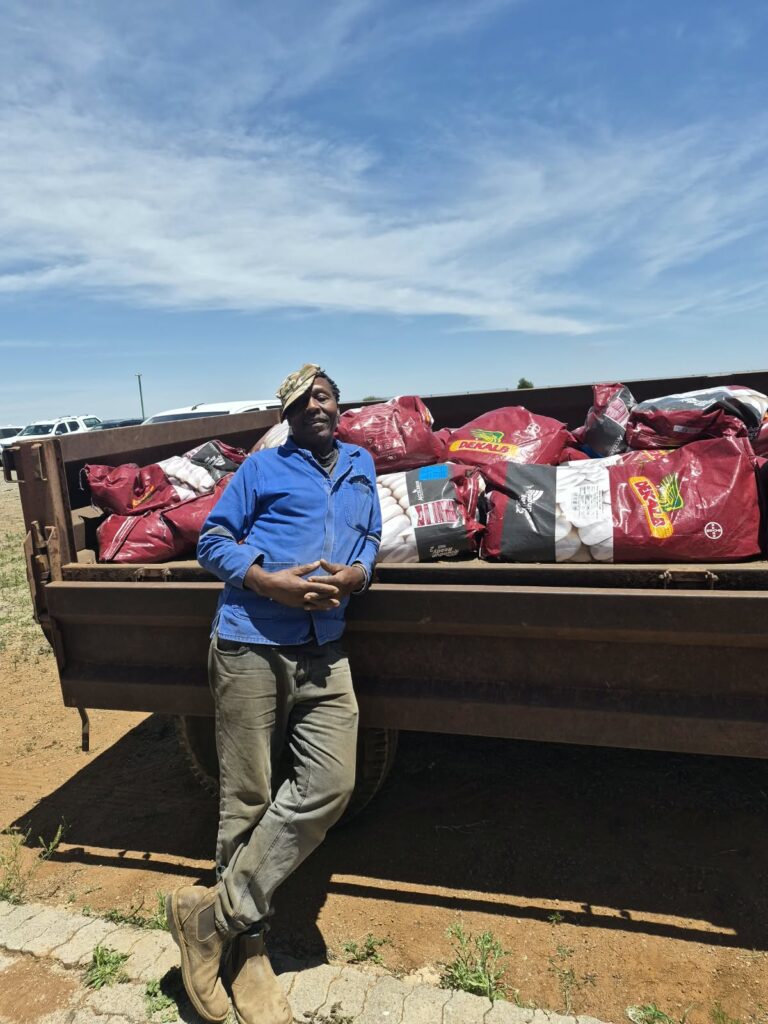
CAPTION: MUDINI THE FARMER
One farmer among many
Maivha’s story is one small piece of a much larger one. Since 1994, thousands of black South Africans have taken up commercial farming, some on land they bought, some on state-leased farms and many on plots as modest as his, and most have learned the trade the hard way. Nobody knows exactly how many. Government has said the country has about 35 000 commercial farmers, but Statistics South Africa’s census counts only VAT-registered operations. It has been estimated that more than 200 000 households of all races farm commercially outside that count, and estimates of small-scale black farmers range from 50 000 to 200 000. Black farmers are thought to produce between 5% and 10% of commercial output.
The timing of Maivha’s purchase was not kind. Deregulation in the early 1990s opened export markets to established farmers just as state support for emerging black farmers was being withdrawn. Government programmes have tried to close that gap since, with mixed results.
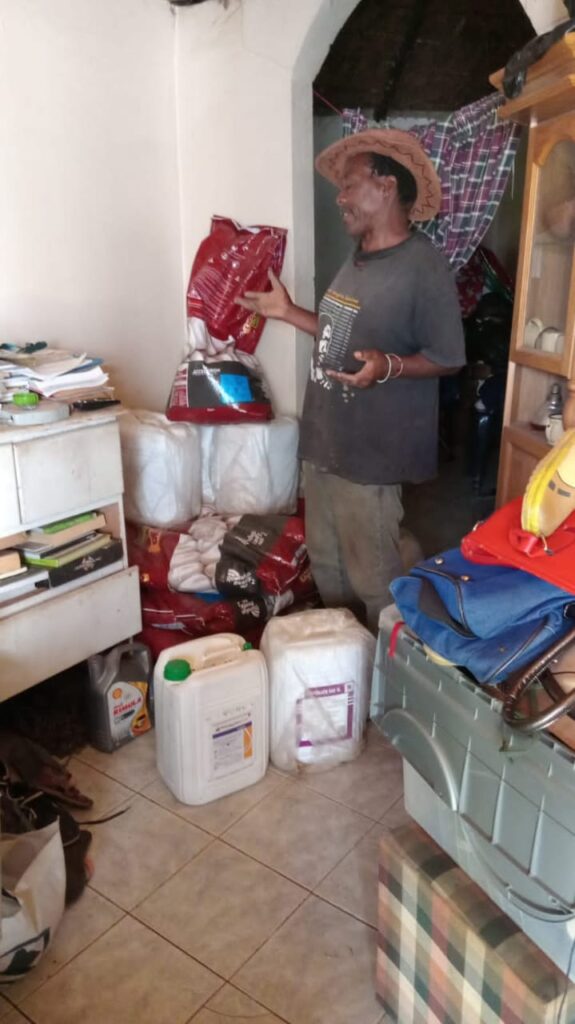
CAPTION: MUDINI IN ROOM OF FARM CHEMICALS
In 2006 the state began buying farms under the Proactive Land Acquisition Strategy and leasing them to black farmers. The leases are short and cannot be traded, and farmers say the insecurity discourages them from investing in the land. This year President Cyril Ramaphosa said about 2.5 million hectares of state-owned land would be released to black farmers, with title deeds intended to give them formal ownership.
On finance, the Land Bank’s Blended Finance Scheme, launched in 2022, pairs government grants with loans. Treasury says 610 clients had been funded by the end of March this year, and the Finance Minister says 76 small-scale farmers moved into commercial production over three financial years. Parliament’s agriculture committee is still asking whether the scheme delivers lasting results, and an earlier version left many farmers exposed. The commodity bodies run their own programmes. Grain SA’s Phahama Grain Phakama supports 6 783 developing grain farmers with training and mentorship, much like the study groups Maivha urges newcomers to join.
Some have broken through in unexpected places. Gift Mafuleka left McCain Foods to lease a state farm in Bronkhorstspruit, also in Gauteng, and was featured on CNN as an example of young black commercial farmers. In KwaZulu-Natal’s Ugu District, Ms Lubanyane became the first black woman farmer to supply macadamias to the export market. In Limpopo, Gene Likhanya started with 2.5 hectares of macadamia trees and built Madimbo Macadamia. Redlands, a black- and youth-owned dairy, has expanded with Land Bank blended finance. Black citrus growers have set a target of half of South Africa’s citrus exports by 2032, and Botlhale Tshabalala, who farms on communal land, was Grain SA’s New Era Commercial Farmer of the Year in 2025.
Against that backdrop Maivha is not an exception. The capital shortages, the thin and inconsistent support and the slow, self-taught climb are the everyday version of what these programmes are meant to fix.
The 13th life
There was never a moment, Maivha says, when he thought of giving up, despite a myriad of challenges. Before the farm and journalism, he was a till packer at Checkers, a mine clerk, a journalist, a trade unionist, a military veteran and a black economic empowerment activist, among other things.
“Farming is my 13th life,” he says, “and it was not a wrong option.” That belief keeps him going on the hard days.
He is not content to stay a primary producer. In three to five years, he says, the business will be packaging its own produce. That secondary level pays better than farm-gate prices, even though farmers carry the heavy costs of production.
ADVICE FOR ANYONE WHO WANTS TO START
Don’t climb the tree using the branches. “Unlike me,” Maivha says, it is costly. Be patient, and first learn through the study groups and training sessions the department provides. “It will save you money and heartaches.”
Start small. If you lose, you lose small, and you still have the energy and the funds to get up and go on.
■