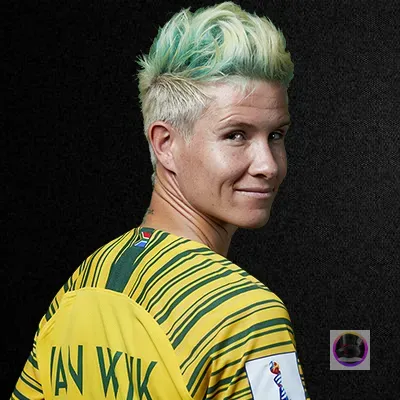

Legendary Banyana defender Janine Van Wyk
LEN KALANE
No mattresses on the beds. No lightbulbs in the lamps. Not a drop of water in the taps.
That was the welcome waiting for a 19-year-old Janine van Wyk when Banyana Banyana checked into a half-finished hotel in Nigeria in 2006, at her first continental tournament. After a sweltering training session, some of her teammates spotted a river outside, wrapped themselves in the hotel’s pristine white towels, and walked out to wash. Van Wyk had never bathed in a river in her life. She was young, self-conscious, and filthy. She followed them in.
It is the kind of story that makes you laugh now. It is also the best possible place to start, because it tells you what the Banyana career of the 1990s, 2000s and early 2010s actually looked like: small buses, empty rooms, hostile hosts, and a stubborn refusal to go home.
Twenty years on, that same national team is in Morocco, with a new generation, a proper programme and a World Cup place on the line. And the woman who rinsed off in that Nigerian river has since told the whole journey in a book, titled with the only number that matters: 185.
| JANINE VAN WYK | AT A GLANCE |
| Born | 17 April 1987, Alberton, Gauteng |
| Position / shirt | Defender, Number 5 |
| Banyana debut | 2005, against Nigeria |
| Caps | 185 (12 goals), a record for any African player, male or female |
| Captain | From 2013; first captain at a Women’s World Cup (2019) |
| Honours | Olympics 2012 and 2016; WAFCON champion 2022; 2019 World Cup |
| Last cap | 4 December 2023, 2-0 v Burkina Faso, Lucas Moripe Stadium |
The stakes in Rabat
Banyana did not want to be here. A poor WAFCON in Morocco this winter, which brought a 2-1 loss to Tanzania, a 2-2 draw with Ivory Coast, a 1-0 win over Burkina Faso and a 2-1 quarter-final defeat to the hosts, closed the direct route to Brazil 2027. What remained was the back door: a ‘play-in’ against Nigeria in Casablanca on 13 August, which Banyana won 2-1 through Thembi Kgatlana and captain Refiloe Jane. Nigeria, ten-time African champions, will miss a World Cup for the first time in their history.
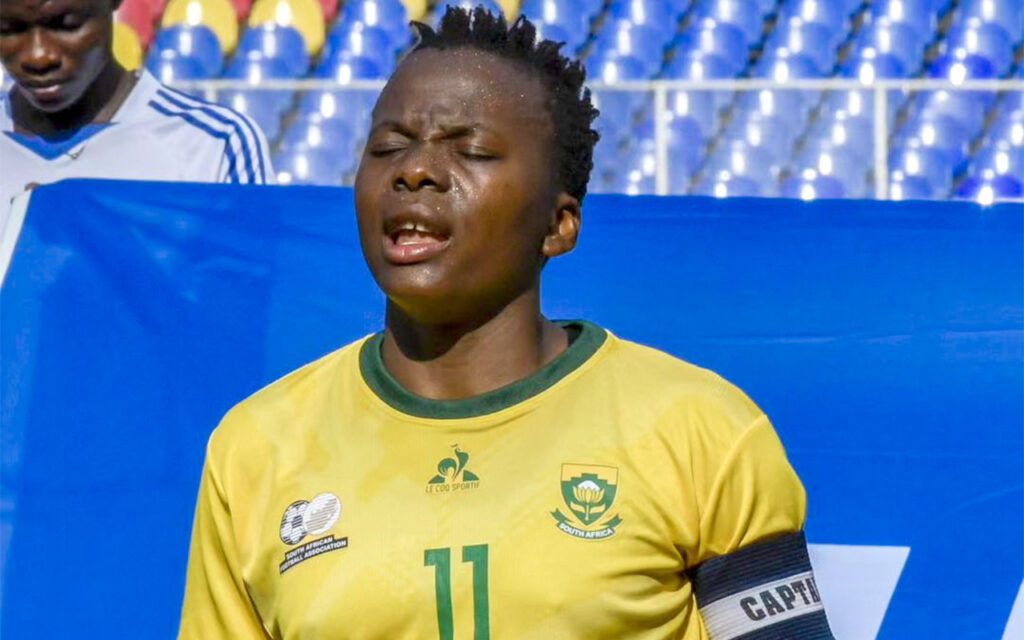
CAPTION: Thembi Kgatlane scored against Nigeria to qualify for the World Cup playoffs
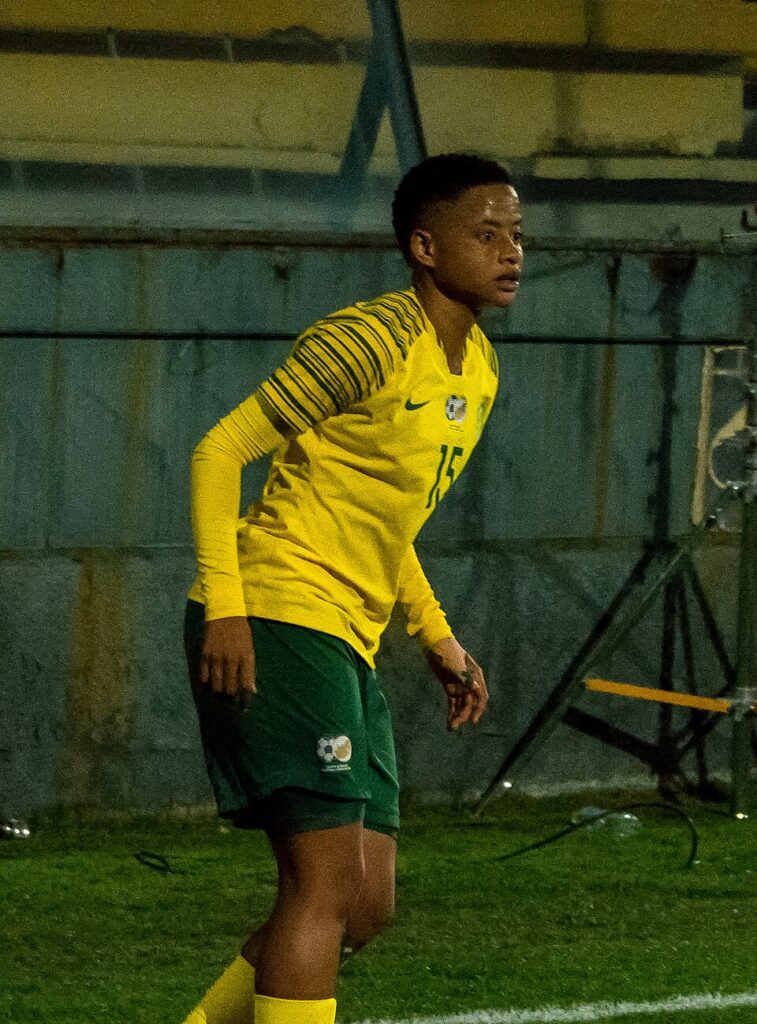
Captain Refiloe Jane scored against Nigeria but was later penalised for handling a goal-bound ball on the goal-line owing to sustained pressure by Nigeria towards the dying minutes, taking one for the team, so to speak – Nigeria scored from the penalty spot to make it 2-1 after Banyana had a comfortable 2-0 cushion while Jane got a red card (send-off) and will as a result miss the first game against Chinese Taipei.
So now it is the play-offs. From 28 November to 5 December, six nations from different confederations meet at the Mohammed VI Football Complex in Rabat: South Africa, Chinese Taipei, Ecuador, Uzbekistan, Ghana and Papua New Guinea. Each side plays three matches. The top two advance to a final phase in February 2027, a single-knockout round of six teams fighting for three World Cup places. The three winners go to Brazil.
| BANYANA’S FIXTURES (SA TIME) | DATE | OPPONENT |
| Matchday 1 | Sat 28 November, 16h00 | Chinese Taipei (ranked 38th) |
| Matchday 2 | Tue 1 December, 21h00 | Ecuador (ranked 60th) |
| Matchday 3 | Sat 5 December, 19h00 | Uzbekistan (ranked 51st) |
Rankings as quoted by coach Desiree Ellis at the squad announcement. All matches in Rabat.
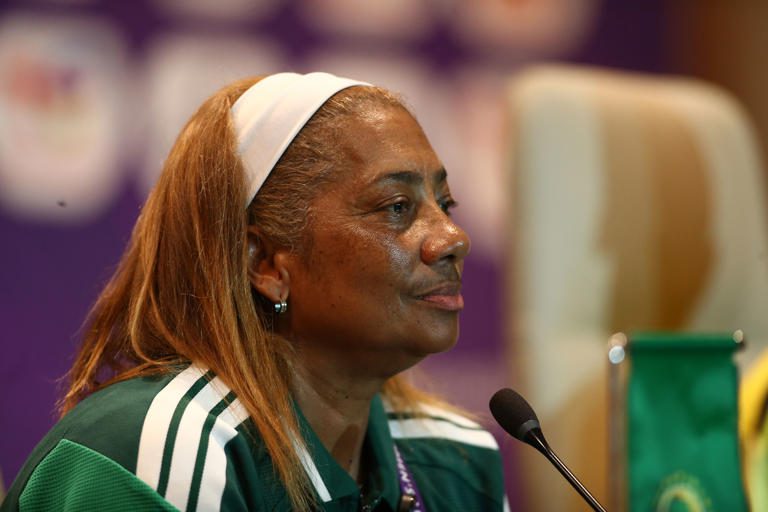
Banyana long serving coach Desiree Ellis
Ellis has warned against reading the rankings too literally. Banyana lose ranking points beating minnows like Madagascar, she argues, while the opponents in Rabat get theirs from playing stronger teams. Chinese Taipei have just come off the Asian Games; Uzbekistan lost 6-3 to one side and drew with Chinese Taipei; Ecuador held Chile to a 1-1 draw in South America’s play-offs before losing to Argentina. “We have never gone into any tournament and underestimated anyone,” she said.
The girl who played with the boys
To understand how Van Wyk got to 185, you have to start somewhere unfashionable: a school with no football. She was born in Alberton, grew up in Germiston, and attended Hoërskool Alberton, an Afrikaans-medium school that did not play the game. Her first team was the Springs Home Sweepers in KwaThema. There were no girls’ teams around her, so she played with boys, which she has described as a blessing in disguise.
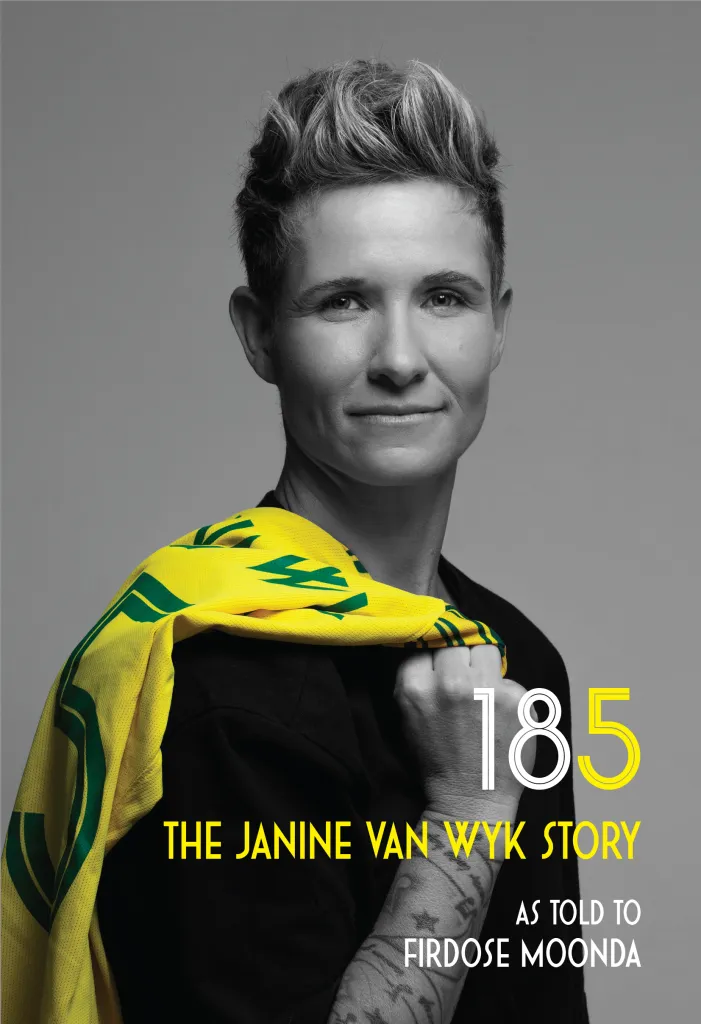
Her co-author, Firdose Moonda, has pointed to exactly this as what makes the story unusual: an Afrikaans-speaking schoolgirl making her way in a sport dominated by the Black majority, in townships and communities whose cultures were unfamiliar to her. It is, Moonda argues, the inverse of the stories usually told about South African sport, and a distinctive way into understanding the country as well as the game.
By 2005 she was in the green and gold. Her debut came against Nigeria, the opponent who would define her career. A year later, at that 2006 African Women’s Championship in Nigeria, the squad beat Algeria 4-0 and Equatorial Guinea 2-0, then travelled to Delta State to face the hosts. They lost 2-0 and finished third. By her own account, it was a match lost before kick-off, in an empty hotel, to a team that played mind games as an art form.
Nigeria: the rivalry that bookends everything
Even in defeat, 2006 left Van Wyk with something. Nigeria’s centre-back Onome Ebi, who would go on to become the first African to play at six World Cups, swapped shirts with her. Both wore Number 5. It was the first time an international opponent had given Van Wyk her jersey, and for a player who treated the Banyana shirt as sacred, she writes that she understood the symbolism immediately.
Banyana’s first-ever win over Nigeria came off her boot. 7 November 2012, Bata
Six years after the river, she delivered the sweetest answer. At the 2012 African Women’s Championship in Equatorial Guinea, a Van Wyk free kick was the only goal against Nigeria, the first time South Africa had beaten the Super Falcons since the national team was formed in 1993. It knocked the perennial champions out and sent Banyana into the final. (They lost it 4-0 to the hosts, a story we will come back to.)
There is a final symmetry. This August, Banyana beat Nigeria again, this time to keep the World Cup dream alive. A Van Wyk-era wound, finally and permanently closed by the players she left behind.
Finals, heartbreak and a Number 5 shirt
The Van Wyk years are an education in how close Banyana came before they got there. Three continental finals fell inside her career, and all three were lost: 2008 and 2012 to Equatorial Guinea on their own soil, and 2018 to Nigeria in Ghana, a 0-0 draw decided 4-3 on penalties. Banyana had lost five finals in all by the time the sixth finally went their way.
Around those heartaches, the achievements piled up. She was named captain in 2013. She played at both Olympic Games Banyana have ever qualified for, London 2012 and Rio 2016, featuring in all six matches, and Rio was her first major tournament as skipper. She was named in the 2016 Women’s AFCON Best XI. Then, in 2017, she became the first South African woman to sign for an American club, joining the Houston Dash in the NWSL, where she made 41 appearances over two seasons and was later joined by Kgatlana and Linda Motlhalo.
And always, in parallel, there was the club she founded in the early 2010s and named after herself: JVW FC. More on that in a moment.
France 2019: the first flag
On Saturday 8 June 2019, at the Stade Océane in Le Havre, Janine van Wyk led out a South African women’s team at a World Cup for the first time. Desiree Ellis, the first coach to take Banyana there, had a squad built around Jane, Matlou, Nothando Vilakazi, Kgatlana and goalkeeper Andile Dlamini. Van Wyk entered the tournament with 166 caps.
Kgatlana scored in the first half to put Banyana 1-0 up against Spain. It did not last. Spain won 3-1. Four days later, at the Parc des Princes in Paris, China edged it 1-0, and Van Wyk spent the night putting her body in front of Chinese shots and, as the book’s extract has it, eating a piece of the famous turf. On 17 June in Montpellier, Germany won 4-0. Three matches, three defeats, one goal.
Ellis’s verdict, in Van Wyk’s telling, was the one that mattered: Banyana had shown they had not come to France to make up the numbers.
That Germany match, Monday 17 June 2019 in Montpellier, turned out to be Van Wyk’s final appearance at a World Cup. Many assume it was Australia and New Zealand in 2023. It was not.
The World Cup that got away
By 2023, Banyana were African champions, and Van Wyk, then 36, had lifted the WAFCON trophy as captain the previous July after a 2-1 win over hosts Morocco, though she began that final on the bench. A second World Cup was within reach. In June 2023, Ellis confirmed Van Wyk would not be going. She had an injury, she told the coach she would not be at her best, and she stepped aside from a squad that was about to make history without her.
It did. Banyana lost 2-1 to Sweden after leading, drew 2-2 with Argentina after leading 2-0, beat Italy 3-2, and advanced to the Round of 16 for the first time ever, falling 2-0 to the Netherlands in Sydney. The tournament belonged to Kgatlana, Motlhalo, Jane and company. Van Wyk watched on, two caps short of the continent’s all-time record.
Pretoria, 4 December 2023: eight minutes
She had already announced her retirement. “This has been by far one of the hardest decisions of my life,” she said in October, adding that she wanted to leave on her own terms. But one thing remained. The all-time African record, the male and female record, belonged to Egypt’s goalkeeper Ahmed Hassan on 184 caps. Van Wyk had 183.
SAFA gave her the chance to finish it. Banyana needed to see off Burkina Faso over two legs to qualify for the 2024 WAFCON, and the second leg, at the Lucas Moripe Stadium in Atteridgeville, would carry a triple significance: Van Wyk’s record 185th cap, Ellis’s 100th match in charge, and a ticket to Morocco.
She led the team out. Then, barely eight minutes in, Lebohang Ramalepe came on for her, and a small crowd rose to give her a standing ovation as she hugged her teammates on the way off. Ten minutes into the second half, Linda Motlhalo, the woman who would later lead the midfield in Rabat, converted a penalty. Banyana won 2-0, and 3-1 on aggregate. The record was hers. Hassan’s 184 had been passed.
She has given her all every time she has stepped onto the field. Desiree Ellis on Van Wyk
Two of the names from that afternoon are in the squad that has gone to Rabat: Ramalepe, the substitute who took Van Wyk’s place, and Motlhalo, the penalty scorer.
The podium: who sits behind 185?
Van Wyk’s record has stood for almost three years, but behind her the leaderboard has been reshuffled by retirements and one active captain on the rise. Here is where South Africa’s most-capped players stand.
| # | PLAYER | CAPS | GOALS | STATUS |
| 1 | Janine van Wyk | 185 | 12 | Retired 2023 |
| 2 | Noko Matlou | 174 | 66 | Retired April 2025 |
| 3 | Refiloe Jane | 155+ | 17 | Active, Banyana captain |
| 4 | Nompumelelo Nyandeni | 150 | 39 | Retired April 2025 |
| 5 | Nothando Vilakazi | 137 | 7 | As of mid-2026 |
Jane’s total differs slightly by source: TimesLive had her on 155 on 13 August; Wikipedia’s squad table lists 153. An updated tally past 150 is not confirmed in current sources.
No. 2: Noko Matlou, 174 caps
A debutant in December 2006, Matlou is the second most-capped African player ever, and the goalscorer of the pair: 66 goals for her country. In 2008 she became the first South African to win a CAF award, as African Women’s Player of the Year. She captained Banyana in her 174th and final cap, a 3-0 win over Malawi at UJ Soweto on 5 April 2025, at the age of 39. Ellis later used her as the reference point for why age should not rule players out.
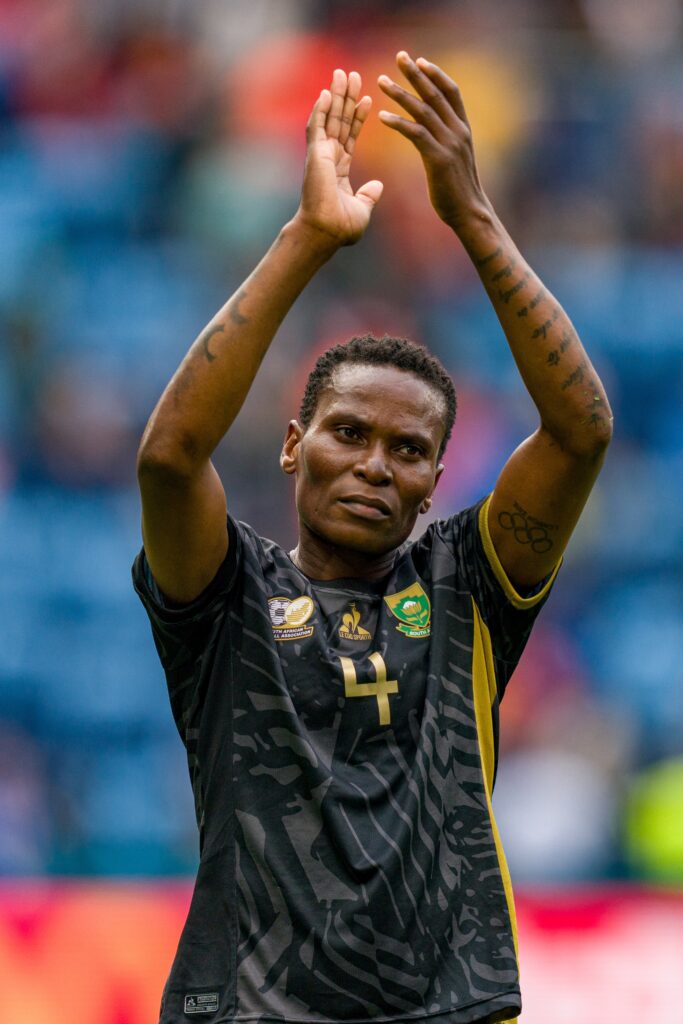
Noko Matlou, Banyana second most capped player
No. 3: Refiloe Jane, 155 and counting
Soweto-born, a debutant in 2012, “Fifi” Jane hit 150 caps on 9 June 2026 in a 1-0 win over Japan, Banyana’s first-ever victory against them, and became the third most-capped Banyana player of all time. Two months later she scored the winner against Nigeria, and was sent off after a handball ruled by VAR, which is why she will miss the opener against Chinese Taipei. In 2019 she was Van Wyk’s vice-captain on 104 caps. She is now the captain, 34, and still some 30 caps shy of the record.
The one who just missed: Nompumelelo Nyandeni, 150 caps
Nyandeni, known as “Mbuzi”, debuted at 15 in 2002, three years before Van Wyk. She played at both Olympics and scored 39 goals. Six years after her last call-up, she was recalled in April 2025 for a farewell, and captained Banyana in her 150th and final cap, a 2-1 win over Malawi. Now back at JVW, she wants to be remembered, she says, for helping Banyana reach their first Olympics in 2012 and playing with a smile.
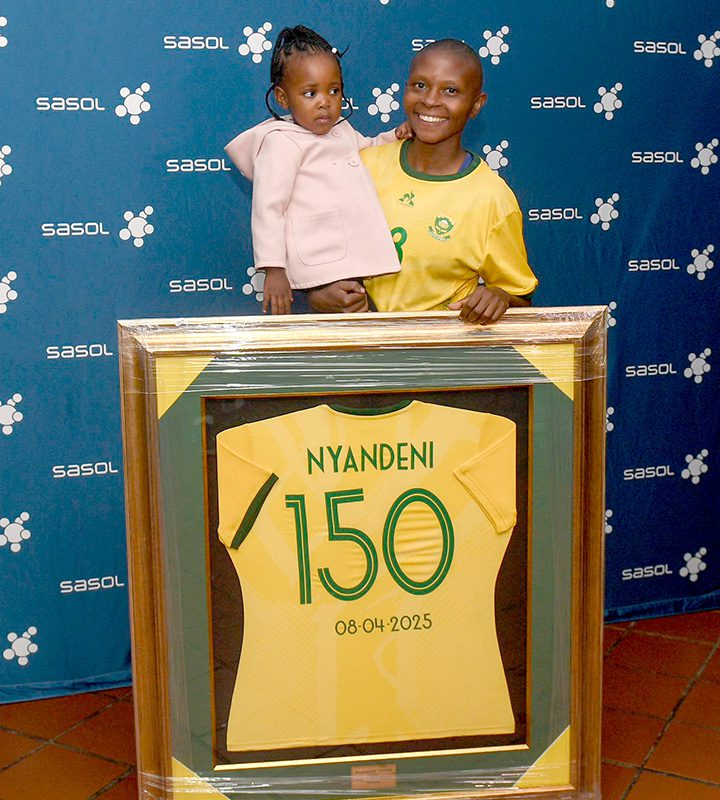
CAPTION: Holding baby in celebration, Nompumelelo Nyandeni
Portia Modise (124 caps and a national-record 101 goals), Mamello Makhabane, Lebohang Ramalepe, Jermaine Seoposenwe and Amanda Dlamini are among the others in the 100-cap club. Van Wyk’s era produced the cast of South African women’s football.
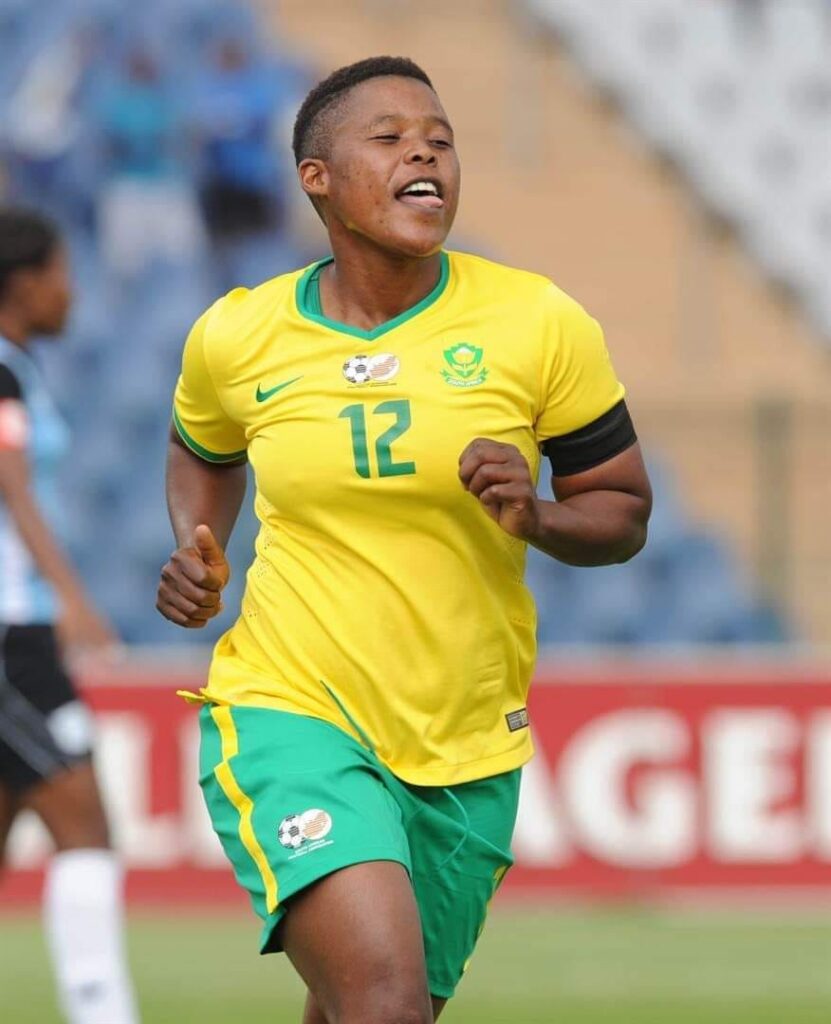
Banyana top goal scorer Portia Modise
More than a number: building the road
The record, Van Wyk says in the book, could change the narrative about who football is for. But the quieter story is the one she was building while still playing. With Lauren Duncan, she co-founded an academy after noticing how few development opportunities existed for girls, starting with Saturday camps. Duncan suggested naming it JVW, so Van Wyk’s international name could lend credibility to a vision that was not yet proven.
By 2016, 1,800 girls were taking part in the JVW schools league. By 2025, more than 350 schools were affiliated. And the pipeline is not abstract: two members of this Rabat squad, goalkeeper Kaylin Swart and forward Gabriela Moodaly-Salgado, play their club football for JVW FC. Nyandeni is back at the club too.
Her mantra, as the book relays it, is simple: “Nothing worth having comes easy.” Reading the empty-room chapter of 2006, you can believe it.
The Class of Rabat: Ellis’s 23
Ellis named her squad on 10 November at the SABC Sport Studios in Auckland Park. FIFA allows only 23 players, against the 26 she could take to WAFCON, so she wanted multi-functional players. She had to omit others because of exams, injuries and invalid passports. Denmark-based midfielder Sibulele Holweni returns, and Wendy Shongwe, a 2023 World Cup player and the only one who did not feature at WAFCON, is recalled.
| POSITION | PLAYERS (CLUB) |
| Goalkeepers | Andile Dlamini, Katlego Moletsane (both Mamelodi Sundowns); Kaylin Swart (JVW FC) – Dlamini has been replaced with Thandeka Ngcobo (See below). |
| Defenders | Karabo Dhlamini, Lebohang Ramalepe, Khutso Pila, Bambanani Mbane (all Mamelodi Sundowns); Antonia Maponya, Lonathemba Mhlongo, Fikile Magama (all UWC) |
| Midfielders | Bongeka Gamede, Sibulele Holweni (both FC Nordsjælland, Denmark); Linda Motlhalo (Glasgow City, Scotland); Refiloe Jane (TS Galaxy Queens); Amogelang Motau (Club Tijuana, Mexico); Noxolo Cesane, Nonhlanhla Mthandi (both Mamelodi Sundowns) |
| Forwards | Thembi Kgatlana (Tigres UANL, Mexico); Wendy Shongwe, Nthabiseng Majiya, Ronnel Donnelly (all Mamelodi Sundowns); Gabriela Moodaly-Salgado (JVW FC); Hildah Magaia (Al-Ittihad, Saudi Arabia) |
NB: Goalkeeper Andile Dlamini has been withdrawn due to injury suffered during the November 15, 2026, final of the CAF Women’s Champions League in Egypt (Mamelodi Sundowns Ladies vs Morocco’s AS FAR) and her place taken by University of the Western (UWC) goalkeeper Thandeka Ngcobo who will work alongside Kaylin Swart and Kebotseng Moletsane in the goalkeeping department.
Look at it through a Van Wyk lens. Jane, Mbane, Dhlamini, Ramalepe, Motlhalo and Kgatlana were all part of her last Banyana chapters, with Mbane and Dhlamini part of the gold-winning squad of 2022 and the 2019 and 2023 World Cup squads. Magaia, “the Breadwinner”, scored both goals in that 2022 final against Morocco, the first player to score twice in a final since Equatorial Guinea’s Gloria Chinasa did it against Banyana in 2012. These are Van Wyk’s teammates and the women she captained. Now they are the elders.
Ellis has also asked her veterans to prove their worth beyond reputation: she says Jane is still valuable, particularly on set pieces, and that experience is just a word if a player cannot add value. It is a test Van Wyk passed for 18 years.
Where the line runs
On Saturday at 4pm, in Rabat, the national anthem will play again. Jane, suspended, will be unavailable, and Banyana will face the opponent ranked 38th in the world with a point to prove about every one of those mattress-less hotels, every empty carousel, every final lost on someone else’s soil.
The road from that Delta State river to Brazil 2027 is longer than any single match. It runs through Chinese Taipei, Ecuador and Uzbekistan, and, if all goes well, through a February knockout. But it is a road that Janine van Wyk helped to pave, one tackle, one captain’s armband and 185 caps at a time.
Whatever happens in Rabat, remember where the story started: with no water, no lightbulbs, and a teenager who got up the next morning and played anyway.
ABOUT THE BOOK
185: The Janine van Wyk Story, co-written with Firdose Moonda, is published by Karavan Press. The 2006 Nigeria hotel story draws on an extract published by The Guardian on 17 November 2026. Further reporting from SAFA, SABC, TimesLive, ESPN, CAF, Olympics.com, SuperSport and AfricaSoccer.com.