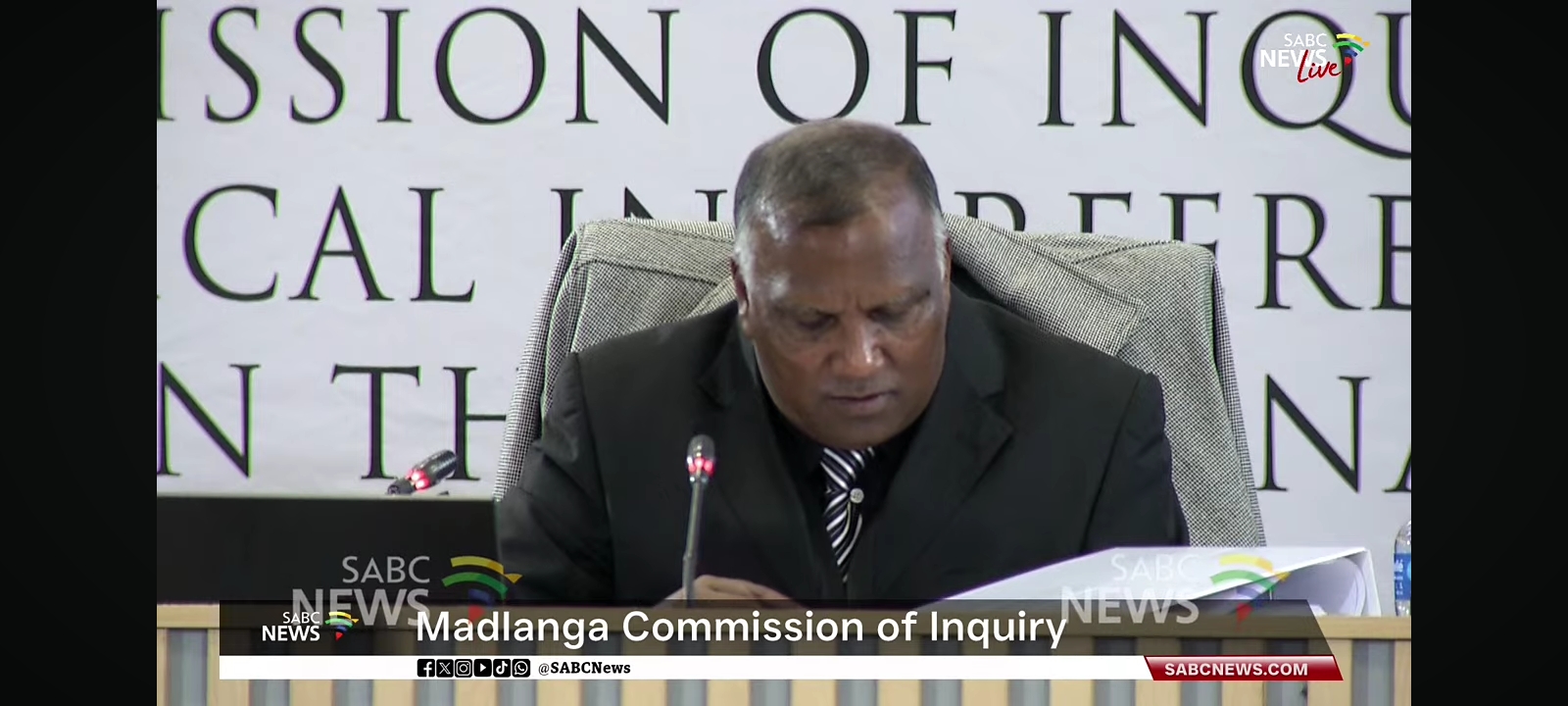

MAIN PHOTO: IPID’S LEN BARNABAS JOHN
PRETORIA — Wednesday, 12 August 2026
The Madlanga Commission of Inquiry turned its focus to KwaZulu-Natal on Wednesday, hearing evidence that specialised police task teams in the province may be using lethal force to eliminate suspects rather than arrest them, and that some officers are entangled with the tow-truck industry and drug syndicates.
Len Barnabas John, the Independent Police Investigative Directorate’s (IPID) deputy director for investigations in KZN, appeared before the commission at the Brigitte Mabandla Justice College in Pretoria to detail alleged extra-judicial killings linked to three specialised task teams operating in the province.
Three task teams under scrutiny
John’s evidence centred on three units he believes fall under the authority of KZN Police Commissioner Lieutenant-General Nhlanhla Mkhwanazi: a cash-in-transit (CIT) robbery task team headed by Hawks officer Lieutenant-Colonel Deena Govender, a drug syndicate unit led by Colonel Mbongeni Samuel Khalishwayo, and a taxi-industry unit headed by Captain Pedro Rodrigues.
He warned that the involvement of these units in organised-crime investigations creates an opening for criminal syndicates to manipulate police operations to eliminate rivals.
“There is clear evidence that this risk has materialised in KwaZulu-Natal,” John told the commission.
‘They go out to kill’: patterns in the shooting data
John gave the commission figures on the scale of the shootings his directorate has investigated: between 1 April 2023 and 31 May 2026, IPID probed more than 300 cases of alleged extra-judicial killings involving the three task teams, of which 77 cases resulted in 149 deaths.
He said police accounts typically describe suspects as having been killed after exchanging gunfire with officers, but that IPID’s own reconstructions have sometimes contradicted that version.
“You’ll get a case where there are nine people that are shot, and you find only three firearms,” John said.
He added that police have in some instances failed to identify the people they killed. “In some cases, they cannot even give you the names of the deceased that they shot. So we believe that the police are not doing proper investigations to arrest the suspects. We can look from the examples that we have that they go out to kill the person.”
Concerns over delayed access to crime scenes
John told the commission that IPID investigators are often delayed in reaching scenes where task-team members have shot suspects, which he said raises the possibility that scenes are altered before investigators arrive — including concerns that weapons or gunshot residue could be planted on victims to support claims that they had exchanged fire with police.
He also said journalists are frequently alerted to task-team shootings before IPID is, meaning the directorate sometimes learns of incidents through social media rather than official notification.
“At scenes where task teams are involved in the shooting, almost without exception, there are delays,” John said, adding that no convictions have yet been secured against officers in the outstanding cases.
Police officers, tow trucks and the drug trade
John also described what he called close links between the tow-truck industry, drug trafficking, and elements within SAPS. He said most tow trucks are being used to move drugs across the country, with some police officers allegedly complicit.
“So police are very much involved in the tow truck industry. They have their friends in the tow truck,” he said.
He pointed to the April 2023 shooting in which alleged drug lord and tow-truck operator Bevan Loftus and four others were killed by police, alleging that Govender had been instructed by suspected drug and tow-truck gang leader Clive Naicker to deploy the task team against Loftus, a business rival.
“It’s a known fact that certain police officers at station level are linked with certain tow truck businesses,” John said, describing an alleged arrangement in which officers steer towing jobs to favoured companies in exchange for payment.
“The reason they do that is because they have police friends that don’t ever stop and search them. Even at roadblocks, they have a free pass to go through,” he said of the tow operators allegedly moving narcotics.
Compiled from reporting by The Citizen, The Witness, eNCA and SABC News on the Madlanga Commission of Inquiry into Criminality, Political Interference, and Corruption in the Criminal Justice System.