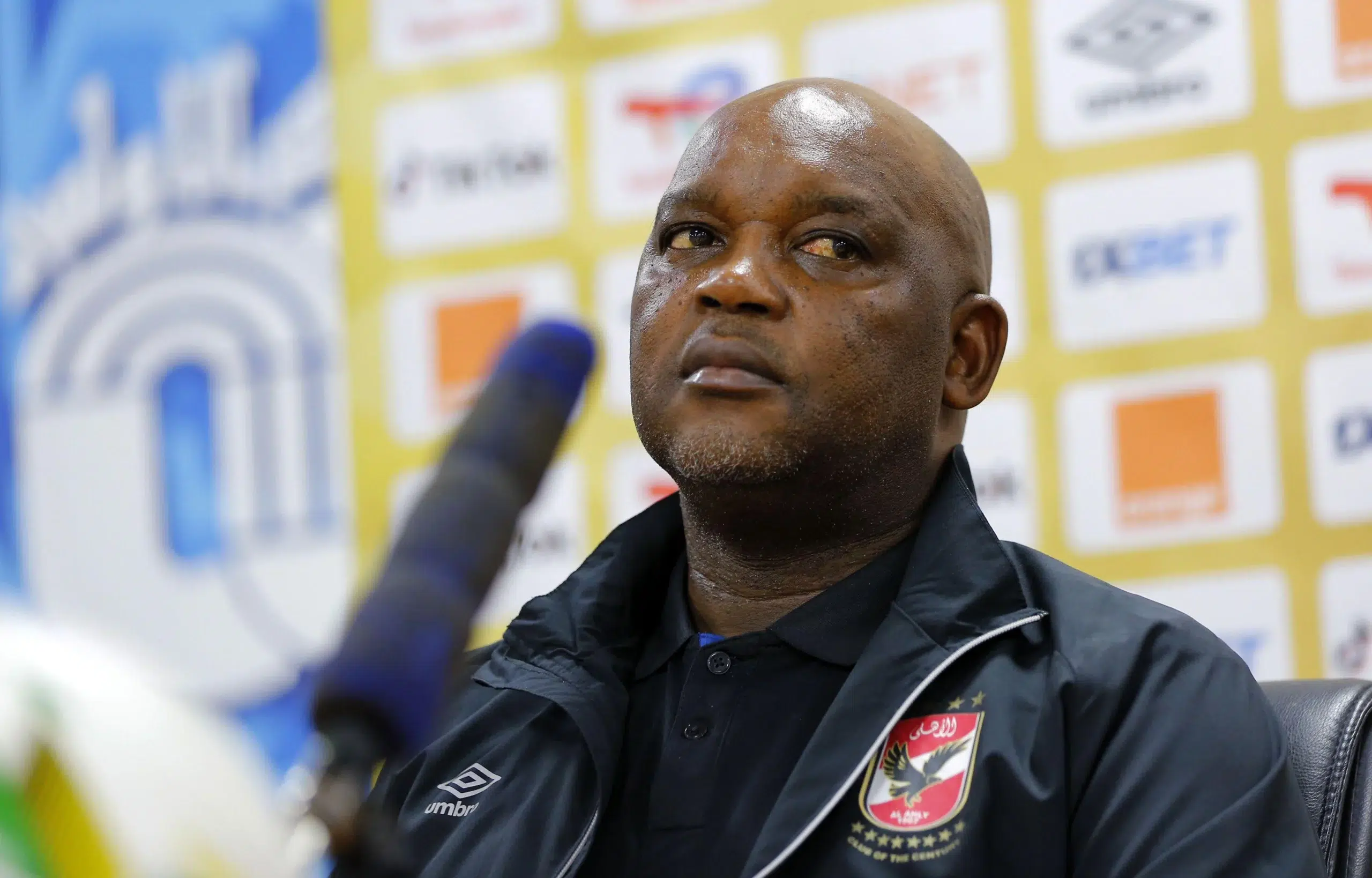

A closer look at the coaches, analysts and conditioning specialists Mosimane has trusted with 19 trophies — and the reshuffle forced on him before he’d even signed
LEN KALANE
By the time Pitso Mosimane sat down at SAFA House on Tuesday to be unveiled as Bafana Bafana’s new head coach, the headline had already written itself: South Africa’s most decorated coach was going home. But the more interesting story sits one layer beneath the appointment itself — in the small group of technical staff Mosimane has carried from Mamelodi Sundowns to Cairo, to Jeddah, to Abu Dhabi and Tehran, and who he has now managed to keep, lose, or deliberately leave behind as he rebuilds a national team set-up.
It is worth correcting the record before going further. The working assumption around Mosimane’s arrival was that he would import a settled five-man unit wholesale. That is not quite what happened. Of the four lieutenants he had hoped to bring — an assistant coach, an opposition analyst, a performance analyst and a conditioning coach — only two have actually made the trip to Bafana. The other two left for Saudi Arabia before Mosimane’s contract was even finalised, forcing a rebuild he did not choose and did not have time to plan.
The Confirmed Two: Continuity, Not Reinvention
At his unveiling, Mosimane confirmed that two long-serving lieutenants will join him at Bafana: performance and data analyst Musi Matlaba, and conditioning coach Kabelo Rangoaga. Both, he pointed out, have since completed their own coaching qualifications — they arrive not simply as support staff but as coaches in their own right, a subtle but deliberate distinction Mosimane made a point of drawing.
“We’ve been together, we’ve had our long journey. There has been obstacles, but more successful than obstacles. We’ve won 19 trophies together, among them four CAF Champions League finals, and three FIFA Club World Cups.” — Pitso Mosimane, SAFA House press conference, 1 September 2026
Musi Matlaba — the analyst who never left the room
| Role | Performance and data analyst |
| Background | Matriculated at Potchefstroom Boys High; began working under Mosimane at Mamelodi Sundowns |
| Journey with Mosimane | Sundowns → Al Ahly (Egypt) → Al Ahli Jeddah → Al Wahda → Abha → Esteghlal → Bafana Bafana |
| Trophies alongside Mosimane | Multiple PSL/domestic titles at Sundowns; CAF Champions League and FIFA Club World Cup runs with Al Ahly |
Matlaba is arguably the least visible but most durable member of the Mosimane operation. He has followed the coach through six clubs across three countries and two continents without a single break in the relationship, a run of loyalty that is unusual even by the standards of football’s tight-knit backroom culture. His value is technical rather than tactical in the public sense — he is the man who turns matches into numbers, builds the opposition data Mosimane uses to set his teams up, and, according to colleagues, is one of the few in the group entrusted to challenge the head coach’s read of a game before a matchday. Having gone through his own coaching qualification, he now arrives at Bafana with a dual identity: analyst and coach, which may in time open the door to an expanded role beyond pure data work.
Kabelo Rangoaga — from fitness trainer to trusted voice
| Role | Strength and conditioning coach |
| Journey with Mosimane | Sundowns → Al Ahly → Al Ahli Jeddah → Al Wahda → Abha → Esteghlal → Bafana Bafana |
| Reported earnings (Esteghlal, Iran) | Approx. USD144,000 — the highest-paid member of the technical team after Mosimane himself |
Rangoaga’s is the story of a conditioning coach who became indispensable enough to be the best-remunerated assistant in Mosimane’s travelling party, according to contract details that emerged from Mosimane’s spell in Iran. That detail is instructive: in an operation built around player fitness sustaining Mosimane’s famously high-tempo, high-pressing sides, the conditioning coach is not a peripheral hire but close to a co-pilot. Rangoaga has now followed Mosimane to six jobs in six years across South Africa, Egypt, Saudi Arabia, the UAE and Iran, giving him arguably the widest first-hand exposure to elite conditioning regimes of any South African fitness coach currently working.
The Two Who Got Away: Al Fateh’s Timing
The genuine twist in this story is not who Mosimane kept, but who he lost — and how close to the wire it happened. Mosimane’s full travelling unit had, for years, consisted of four names beneath him: Rangoaga, Matlaba, video/opposition analyst Kyle Solomon, and assistant coach Maahier Davids. SAFA’s National Executive Committee approved Mosimane’s appointment on 8 August. By then, Davids and Solomon had already agreed to join Saudi club Al Fateh — Davids as assistant coach, Solomon as video analyst — alongside former Bafana strength and conditioning coach Kopano Melesi, who also took up a post there.
The timing meant Mosimane’s preferred four-man technical team effectively became a two-man one before contract talks with SAFA were even concluded, a detail that has been reported but not widely unpacked. It is a reminder that even a coach of Mosimane’s stature does not fully control his own backroom once the market moves — Davids and Solomon had bills, careers and offers on the table, and SAFA’s protracted salary negotiations with Mosimane (his camp reportedly rejected an initial R5 million offer before SAFA doubled it to R10 million) gave Saudi Arabia the window it needed.
Maahier Davids — the ‘final piece’ who left before he arrived
| Role | Assistant coach |
| Family | Younger brother of former Maritzburg United and Bafana assistant coach Fadlu Davids |
| Career before Mosimane | Orlando Pirates, Maritzburg United, Cape Umoya United, Santos, Ajax Cape Town, Saint George (Ethiopia) |
| Joined Mosimane | November 2022, at Al Ahli Jeddah — described at the time as completing the coach’s ‘Dream Team’ |
| Now | Assistant coach, Al Fateh (Saudi Arabia) |
Davids was the last man recruited into Mosimane’s inner circle and, by several accounts, the one Mosimane was most keen to install as his Bafana assistant. His omission is the clearest illustration of how fragile a ‘settled’ technical team really is once the head coach’s own contract talks drag on. Davids holds a UEFA A Licence and, notably, is the younger brother of Fadlu Davids — himself a former Bafana Bafana assistant coach under Molefi Ntseki, which gives the Davids family an unusual double footprint in the national team’s recent coaching history, on opposite sides of two different regimes.
Kyle Solomon — the opposition analyst SAFA didn’t get
Solomon’s departure is less discussed than Davids’s but arguably just as costly for the new set-up. As Mosimane’s dedicated opposition and video analyst, Solomon’s job was distinct from Matlaba’s — where Matlaba builds performance and data profiles, Solomon specialised in breaking down upcoming opponents. Reports from Mosimane’s time in Iran put his earnings at roughly USD84,000, the lowest of the four lieutenants but still a specialist role SAFA now has to fill from scratch, likely from within existing structures or fresh recruitment, with Bafana’s next Afcon qualifiers against Guinea and Eritrea already on the calendar this month.
The Mkhalele Question
This is the angle with the most emotional weight for South African fans: what happens to Helman Mkhalele, the popular former Bafana winger who served as Hugo Broos’s assistant from 2021 through this year’s World Cup in Mexico, and who was reportedly Broos’s own preferred choice to succeed him.
In the immediate aftermath of Broos’s exit, with Davids and Solomon already gone to Saudi Arabia, several reports suggested Mosimane could retain Mkhalele almost by default — continuity between eras, and a pragmatic fix for two suddenly-vacant posts. That theory did not survive Mosimane’s own press conference. Asked directly about Mkhalele’s future, Mosimane was polite but unambiguous.
“And it’s the people who understand the way I work, the way we work. We work differently — from SA, on the continent, even beyond the borders of the continent. So, I have the people that I think can support me.” — Pitso Mosimane, on his preference for his own lieutenants over inherited staff
The subtext is hard to miss. Mkhalele built his coaching reputation entirely inside the Bafana bubble under Broos’s methods; Mosimane’s people have been battle-tested across four countries and three continents under his own methods. For a coach who has always been explicit that trust and shared footballing language matter more than local sentiment, Mkhalele’s five years of success under a different coach counted for less than Matlaba and Rangoaga’s decade of shared history under Mosimane himself. It is a quietly ruthless piece of squad-building logic dressed in diplomatic language — Mosimane never said Mkhalele was not good enough; he simply made clear that ‘understanding how I work’ was the only qualifying criterion that mattered.
It leaves Mkhalele, one of the most recognisable faces of Bafana’s World Cup qualification run and their run to the last four at Afcon, on the outside of the new set-up — collateral not of poor performance, but of a change in coaching philosophy that prizes continuity with Mosimane’s own career over continuity with the team’s recent past.
The Vacancy Nobody Has Filled Yet
With Davids gone, Mosimane confirmed he is still hunting for an assistant coach and admitted the search is proving difficult — potential candidates are already contracted elsewhere in South African football, and a domestic appointment brings its own complications given how tightly Mosimane’s other three roles are now Mosimane-loyalists rather than SAFA incumbents.
“We’re yet to fill the post of the assistant coach. But coaches are not easy to get. They’ve got contracts, so we are busy. We will finalise that a little bit later.” — Pitso Mosimane
The clock is not generous. Bafana’s 2027 Africa Cup of Nations qualifiers against Guinea and Eritrea fall later this month, meaning Mosimane may have to take charge of his first competitive matches back in the Bafana dugout with a three-person technical team rather than the four- or five-man unit he is used to — a live case study in how much of modern international coaching is logistics and staffing, not just tactics.
What This Reshuffle Actually Tells Us
- Loyalty has a shelf life set by the market, not by relationships. Davids and Solomon didn’t leave because the bond with Mosimane weakened — they left because Saudi Arabia moved faster than SAFA’s contract negotiations did.
- Mosimane is picking shared history over inherited success. Mkhalele’s exclusion isn’t a verdict on his competence; it’s a statement that Mosimane values people who have been tested inside his own system above people who succeeded inside someone else’s.
- The unit that remains is unusually specialised rather than broad. Matlaba and Rangoaga are not generalist assistants — one is data, one is conditioning — which suggests the vacant assistant coach post may need to be a genuine tactical/technical voice on the touchline to balance the group.
- The five-man ‘dream team’ framing was always slightly ahead of reality. Even at Al Ahli and Esteghlal, Mosimane’s core inner circle was really four lieutenants plus himself; what’s changed for Bafana is that it has been cut in half practically overnight.
- Money remains the quiet variable. SAFA’s slow-walked salary talks (R5 million to R10 million) look, in hindsight, to have cost Mosimane two of his own people before he’d even signed — a reminder that federation bureaucracy has real, material consequences for coaching continuity.
Sources
iDiskiTimes; Soccer Laduma; TimesLIVE; Sunday World; Goal.com; Pulse Sports; KickOff; Briefly.co.za; SportsBrief; News24; Bona; Wikipedia (Pitso Mosimane). Reporting current as of 1 September 2026.