
Critical insights from a study by researchers at the CSIR have found that refill water has evolved beyond a niche alternative water source and is now an established component of household drinking water supply for many consumers. Increasingly, small kiosks or shops with a hum of filtration equipment and a steady trickle of customers refilling bottles with “purified water” are the norm in retail centres, fuel filling stations and even townships in South Africa. And while many South Africans have made buying refilled water part of their weekly shopping routine, governance frameworks have not evolved at the same pace as the refill water market growth.
Water refill stations are becoming common sightings in South Africa’s communities and retail spaces. The CSIR’s Purified Refill Water Consumer Preferences Survey explored water purchasing choices and behaviours that influence not only the continued growth of the sector but also the effectiveness of future policy interventions.
“How much do we know about what we’re drinking, and why we’re choosing it over the water that already comes out of our taps at home?” are some of the questions CSIR senior researcher Dr Luyanda Ndlela considered in her study of factors influencing the regulation and water quality of South Africa’s refill water sector.
The initiative forms part of a Water Research Commission (WRC)-funded project, promoting understanding of how South African consumer behaviour and perceptions are influencing continued growth of the refill water sector and the effectiveness of future water policy interventions.
Between June and July 2026, the anonymous and voluntary online survey covered 23 questions on demographic characteristics, purchasing behaviour, motivations for purchasing refill water, perceptions of refill water quality, knowledge and awareness of regulatory requirements, water treatment technologies, household practices related to container hygiene, storage and use of refill water and general consumer knowledge.
“It’s not a nationally representative study, but it offers a candid look at the habits, beliefs and blind spots of everyday refill water users,” says CSIR senior researcher Dr Lorren Haywood.
It is not about access — it is about trust
Refill water differs from packaged bottled water in that maintaining water quality does not depend solely on the refill water operator. Approximately one-third of respondents (32%) indicated that they purchase refill water because it is more affordable than packaged bottled water, suggesting that refill water occupies a distinct position within the drinking water market by providing consumers with an option that is perceived to offer the quality benefits associated with purified water at a substantially lower cost than commercially bottled water.
Municipal water must meet national drinking water compliance standards (SANS 241), and therefore understanding why consumers choose refill water over municipal tap water provides important insights into the growing demand for alternative drinking water sources and the role that refill water is playing in improving perceived water security.
Perhaps the most striking finding is that 95% of survey respondents already have access to municipal water service provision at home, implying that they are not buying refill water because they have no other choice; they are buying it because they have lost confidence in the water coming out of the tap, believing it to be of poor drinking quality.
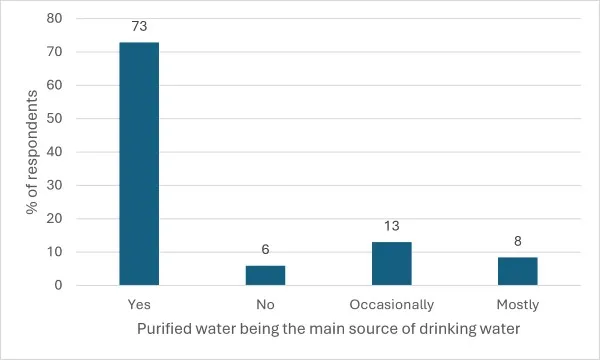
Nearly three-quarters of respondents said refill water is now their main source of drinking water, and most refill weekly or every two weeks, typically buying 10 to 20 litres at a time. In other words, this is not an occasional purchase; for many households, it has quietly replaced the kitchen tap altogether.
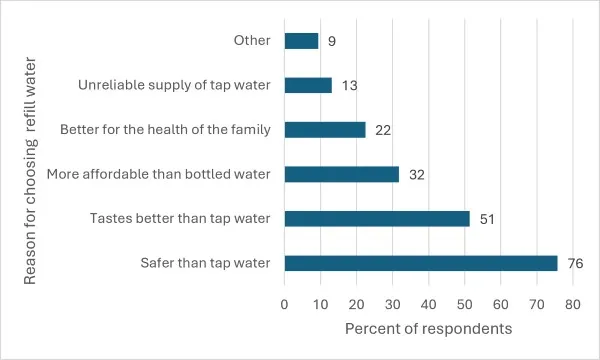
Why the switch? Overwhelmingly, respondents indicated they believe refill water is safer (76%) and tastes better (51%) than tap water. About a third also pointed to cost, as refill water is generally seen as a cheaper alternative to bottled water, with two-thirds of respondents rating it as “affordable” or “very affordable.”
Refill water is purified using processes like reverse osmosis, ozonation, and ultraviolet filtration, which strip out not just contaminants but also the residual chlorine that normally protects tap water from bacteria as it sits in a bottle or tank. That protective buffer is gone by the time the water reaches its container. From that point on, keeping the water safe becomes a personal responsibility.
The study found that numerous households are applying inconsistent container cleaning habits, as almost one in ten respondents admitted to never cleaning their reused container at all.
“The survey’s most important — and most overlooked — message is that your container is part of the water quality system, whether you realise it or not,” says CSIR senior researcher Dr Sam McCulloch-Jones.
While most respondents said they clean their containers before refilling, more than half only give them a plain water rinse. This is not enough to remove the invisible biofilm that builds up inside reused bottles.
Storage of refill water is often at room temperature, as seventy per cent of respondents store their refill water on the counter or in a cupboard rather than the fridge — a habit that, in South Africa’s summer heat, can allow susceptibility to stray bacteria. A noteworthy result is that 28% of respondents said they had never replaced their plastic water refill containers, which augurs favourably for reducing plastic waste.
“None of this means refill water is unsafe. It means the safety of what is in your glass depends on more than just what happens at the kiosk,” McCulloch-Jones adds.
Good taste is not the same as good testing
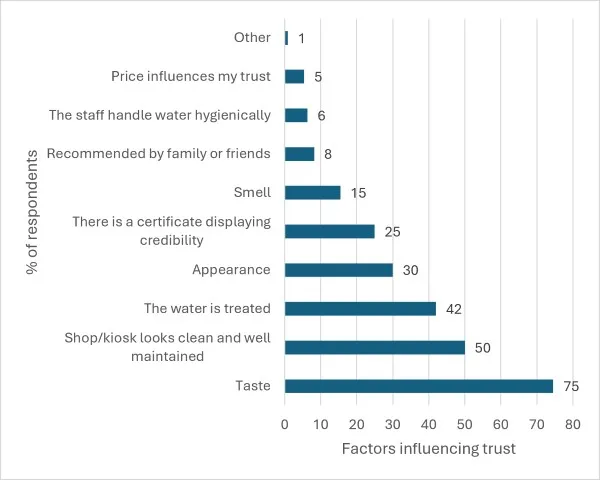
When asked what makes respondents trust the water they are buying, taste emerged as the top factor (75%), followed by shop cleanliness and appearance (50%) and the visibility of operational water treatment equipment (42%).
Only one in four respondents said they look for a water quality certificate or lab test result, and very few paid attention to how staff handled the dispensing equipment. This is significant because taste and appearance are not reliable indicators of whether water is safe. Water can look and taste perfectly fine while still falling short of South Africa’s national drinking water standard (SANS 241). Equally important, water that departs from the refill station safe can still become contaminated afterwards.
Most of us do not know who is checking
Perhaps the biggest surprise in the results: despite trusting refill water enough to make it a main drinking source, most respondents have limited knowledge of refill water regulations.
Fifty-eight per cent said they were not sure whether refill water is regulated the same way as bottled water, and 70% did not know whether any official standards apply to it at all. Several respondents assumed certification schemes used for bottled water automatically applied to their local refill shop — they generally do not.
If consumers have limited knowledge of how refill water is regulated, misunderstand risks of handling and storage, or make purchasing decisions based primarily on perception rather than objective information, these factors need to be considered when developing an appropriate governance framework.
What this means for the consumer
“The takeaway message isn’t ‘stop using refill water.’ For many households it remains a practical, more affordable alternative to bottled water, and the survey found overwhelming satisfaction with the taste and perceived quality on offer,” Haywood says.
Continued growth of the refill water sector will require governance systems that match consumer expectations, provide greater regulatory transparency, strengthen routine quality assurance and promote informed consumer practices. Addressing these issues will improve public confidence, protect consumer health and support the long-term sustainability of the refill water sector.
“This study is a signal to regulators and refill operators alike: South Africans have voted with their wallets for refill water, and they’re doing so based on trust,” says Ndlela. “Matching that trust with consistent testing, clear labelling and public information isn’t just good practice — it’s what the respondents already buying this water say they want.”