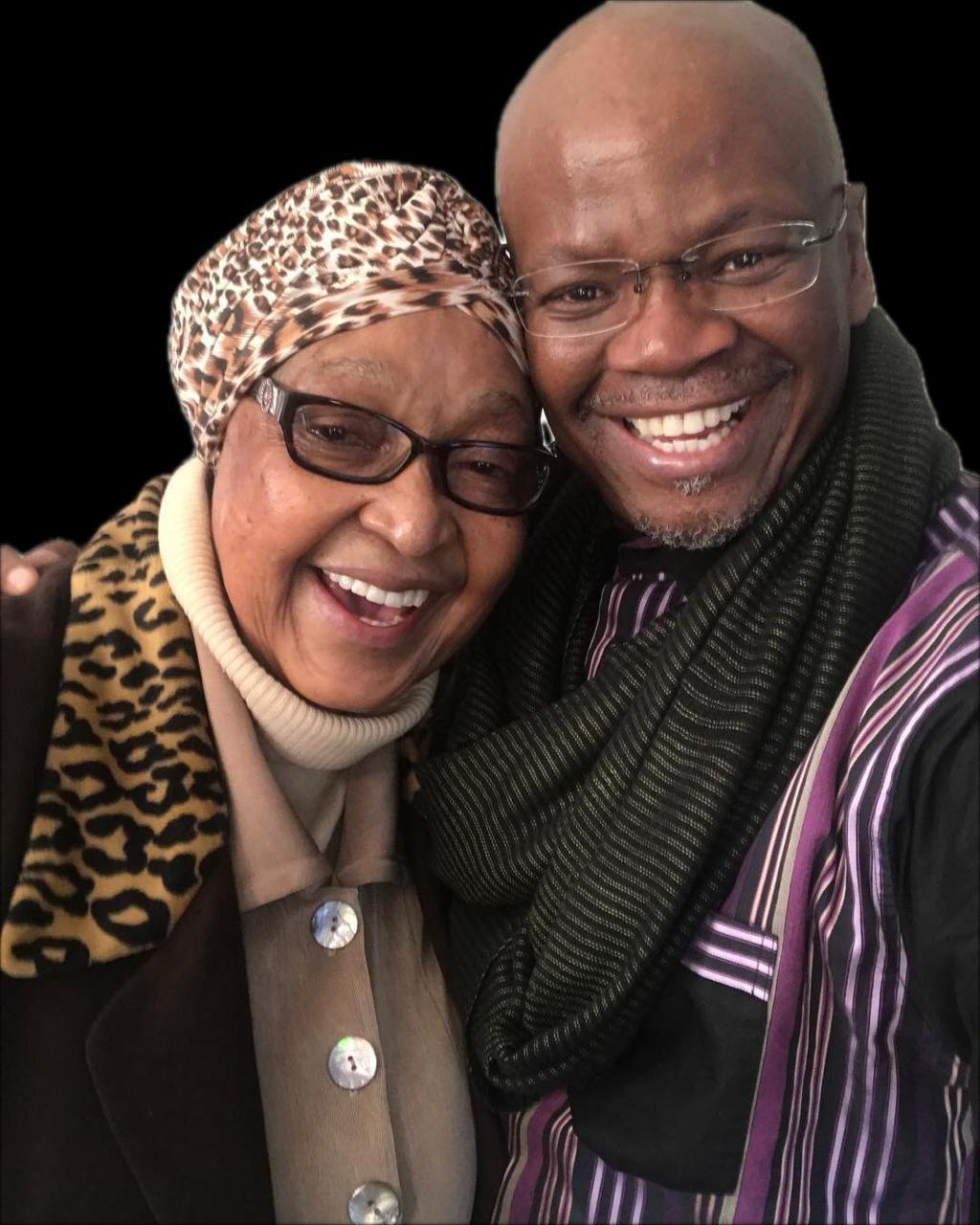

Sonwabile Ndamase, the Soweto-forged innovator behind the Madiba shirt, on identity, design and the fashion diplomacy of Threads of Unity 2026
On 26 September 2026, Vilakazi Street in Soweto — the only street in the world to have been home to two Nobel Peace laureates — will once again become a runway for African excellence. Five designers from South Africa and five from Nigeria will share one stage for Threads of Unity 2026, a fashion-and-diplomacy event bringing together heritage, creativity and cross-border unity. At the centre of that gathering stands a man whose own story began on that same street more than three decades ago: Sonwabile Ndamase, the designer who gave Nelson Mandela his shirt — and, in doing so, gave South Africa a new language of leadership.
This Heritage Month, we trace his journey from a rural Eastern Cape childhood to global recognition, revisit his own words on what the Madiba shirt really carries, and look ahead to the celebration that awaits him on Vilakazi Street.
Video: Conversation w/ uMama uWinnie — Credit: Sonwabile Junior Ndamase / YouTube
PART 1
The Man Who Refused to Wear Somebody Else’s History
A Boy from Mthombe Village
Sonwabile Ndamase was born in Mthombe village, near Libode in the Eastern Cape, and raised by his mother, Buyiswa Ndamase, a single parent who worked as a dressmaker and waitress while raising five children. She taught her children to be self-sufficient all-rounders at home, and it was at her sewing machine that Ndamase first learned to knit and stitch — a hobby he never expected would define his life. In later years he would be recognised as a royal son of the Mpondo Kingdom, a heritage that runs through much of his design philosophy.
The Curriculum He Refused to Accept
In 1985, Ndamase enrolled at a fashion college in downtown Johannesburg. He did not stay comfortable there for long. The syllabus, he has said, was built almost entirely around European fashion history and technique, with little room for the study of African design traditions. Rather than complete a course that asked him to look everywhere but home for inspiration, he walked away and started his own label instead.
That label was Vukani — Xhosa for “wake up” — founded in the early 1980s out of a modest backyard operation, at a time when black South Africans, and especially black men, had almost no access to the formal fashion industry. It was a defiant act before it was a design house: proof that African fashion did not need to wait for permission from a Western curriculum to exist. As the business grew, Ndamase relocated it to central Johannesburg to tap into the networks and markets the city hub offered, and later travelled to Sweden and the United States to study the commercial and retail side of the clothing trade — grounding his creative instinct in a hard-won understanding of how fashion actually moves through the world.
Soweto, Vilakazi Street, and an Opportunity Asked For
It was on Vilakazi Street, Soweto, that Ndamase’s career changed course. He has often told the story of approaching Winnie Madikizela-Mandela directly and asking for the opportunity to become her designer. Mama Winnie became one of his earliest and most influential supporters — and when Nelson Mandela walked free from prison in 1990 after 27 years, it was her call that brought Ndamase into Mandela’s Soweto home.
Mandela needed a wardrobe that could do two things at once: carry enough weight to sit across the table from captains of industry, yet remain approachable enough to greet ordinary South Africans without changing who he was — and without a tie. It was, in effect, a design brief for a new kind of power.
The Innovation: Engineering a New Grammar of Leadership
This is where Ndamase’s real innovation lies — not simply in making a shirt, but in re-engineering what a leader’s clothing could mean. Every structural decision was deliberate: the shirt had to be long enough to stay tucked or untucked without losing its shape on Mandela’s tall frame, generous enough in the sleeve that it never needed a jacket, and finished with a concealed, buttoned-up collar that could read as formal in a boardroom and relaxed on a factory floor. It was cut from silk, worked in bold, nature-inspired or oriental-influenced patterns, in rich tones of burgundy, charcoal grey and royal blue — never loud, always unmistakable.
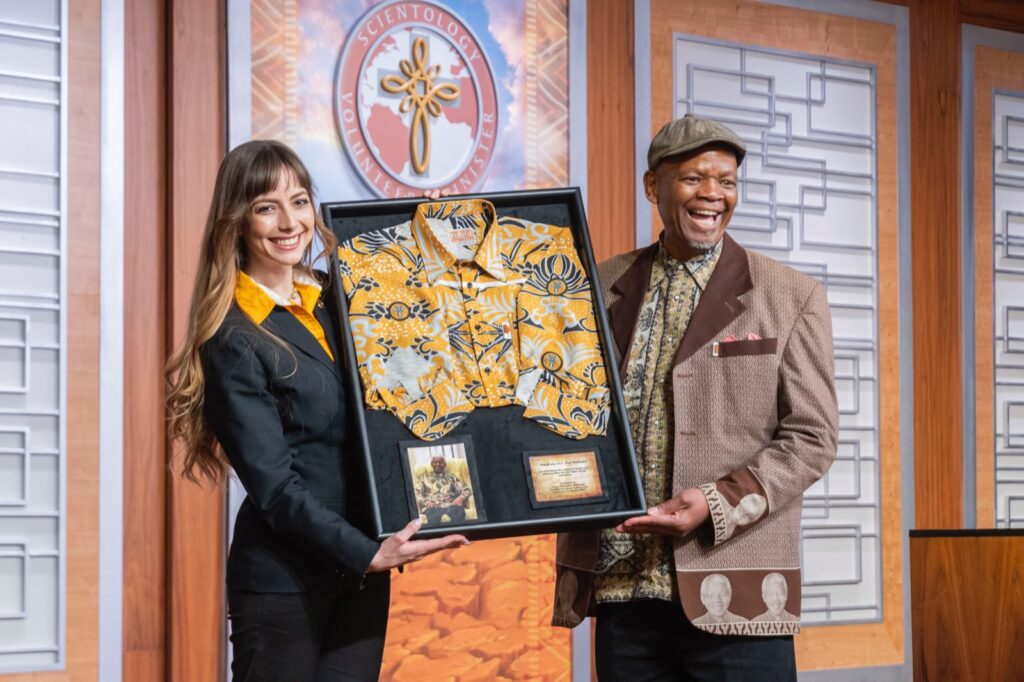
According to Wikipedia’s account of the garment’s history, Ndamase maintains he was the first to introduce this style in 1990, ahead of other claims to the design. Whichever account one favours, what is not in dispute is that Ndamase’s version became the template the world came to recognise — the one now known simply as the Madiba shirt.
The innovation was as political as it was aesthetic. For decades, the necktie and the tailored suit had been the uniform of institutional power in South Africa — a language borrowed wholesale from elsewhere. Ndamase’s shirt broke that uniform without ever raising its voice. It let a president meet global leaders on equal footing while still looking like the man from Soweto who wore it. That combination — authority without imitation, presence without a tie — is what turned a garment into a symbol, and a tailor into an innovator.
Building an Industry, Not Just a Brand
Ndamase’s second act of innovation was institutional. In 1988 he founded the South African Fashion Designers’ Agency (SAFDA), and in the early 1990s he launched the annual Vukani! Fashion Awards — a platform he has described as part of the broader political evolution of fashion in a democratising South Africa. Through SAFDA and Vukani!, designers who had been kept on the margins of a historically white-dominated industry found a formal route into the mainstream, with mentorship, national fashion-week exposure and skills accreditation built in.
His influence reached beyond South Africa’s borders: the city of Atlanta, Georgia, proclaimed 13 March as “Vukani Day” in recognition of his global impact, and his client list grew to include Bill Clinton, Jacob Zuma and generations of cabinet ministers and dignitaries, alongside Nelson Mandela. Closer to home, he has taken his mentorship into some of the country’s poorest districts, training fashion cooperatives in Ntabankulu in the Eastern Cape with the explicit goal of producing the country’s next great design talent from a community that rarely gets the chance.
In March 2024, Ndamase suffered a mild stroke. He continues to design from his workshop, still surrounded by fabric and the hum of sewing machines, and is now focused on passing his techniques on to a new generation of garment-makers — ensuring that the innovation does not end with him.
“Anybody who wants to live a Mandela legacy, guess what they are doing? They will go and pick up Madiba shirts.” — Sonwabile Ndamase
PART 2
On the Madiba Shirt: In His Own Words
Ndamase rarely speaks about the Madiba shirt as merely a garment. In his opening address to the Ink & Identity Colloquium, he set out, in his own words, why he believes clothing carries memory, dignity and nationhood — and why the shirt he designed continues to matter today. Excerpts from that address:
“When we speak of the Madiba shirt, we are not speaking only of fabric… We are speaking of a symbol. A symbol of freedom, of resilience, and of pride.”
He described the shirt as something still alive — not a relic frozen in the 1990s, but a design that continues to be reinterpreted and carried forward.
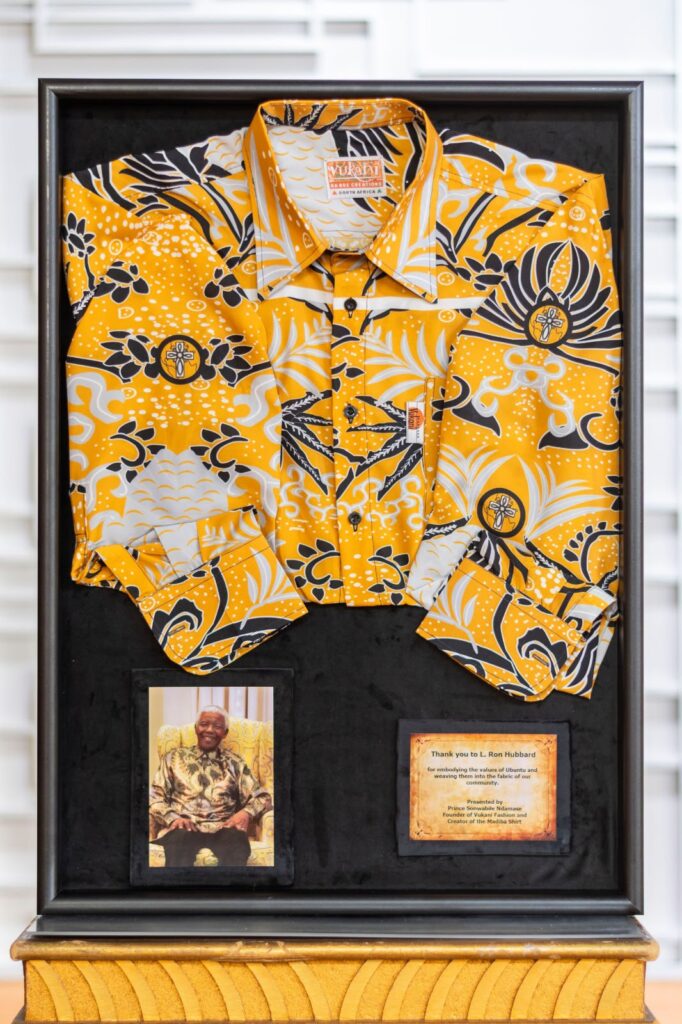
“For me, the shirt is never just a garment. It is a site of dialogue. It is where memory and material meet.”
On Mandela’s decision to set aside the formal suit, Ndamase was direct about what that choice achieved for a country in need of healing.
He showed us that strength does not have to hide behind imitation… that authenticity can carry authority in a way that no uniform ever can.”“At a time when South Africa needed healing, his dress spoke softly, but it spoke clearly. It replaced cold formality with humanity.”
Ndamase also placed his own practice within a much older African tradition of dress as meaning-making — from ancient civilisations to Basotho blankets and Xhosa beadwork — arguing that fashion has always been archive, not vanity.
Fashion, at its best, is not vanity. It is archive. It is continuity. It is transformation made visible.”
He closed with a warning against treating heritage as ornamental, and a reminder of where identity actually lives.
“Heritage is also what we wear. What we speak. What we pass on. What we choose to keep alive.”
PART 3
From Soweto to Lagos: Africa Is United
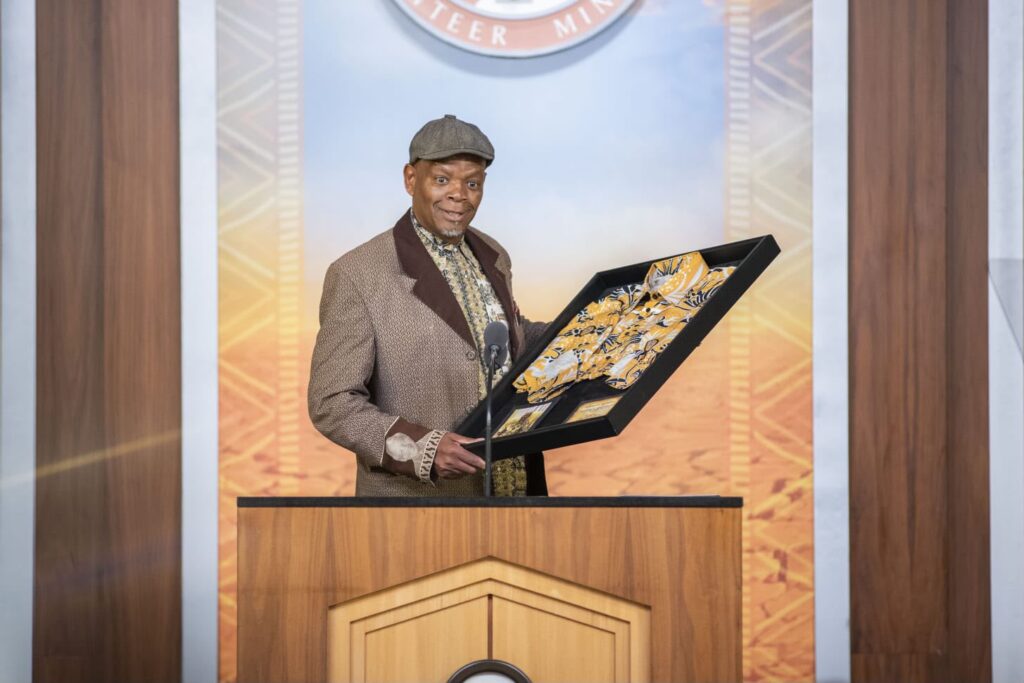
On 26 September 2026, the Women African Tourism Board (WATB) will stand alongside the Annual Vukani Fashion Awards for Threads of Unity 2026 — a celebration bringing South Africa and Nigeria together on Vilakazi Street through fashion, heritage and cultural diplomacy. Five designers from South Africa and five from Nigeria will share one stage, sending one message: Africa is united.
At the centre of the gathering is Ndamase himself — the creative force organisers describe as having carried the story, identity and artistry of Mzansi far beyond South Africa’s borders. The choice of venue is deliberate. Vilakazi Street is not just a tourist landmark; it is the street where Ndamase first asked Mama Winnie for a chance, and where the Madiba shirt’s story effectively began. Threads of Unity returns him to that same ground to honour both his legacy and hers.
The organisers frame the day as more than a fashion show: it is fashion, awards, panel conversations, cultural diplomacy, South Africa–Nigeria collaboration, heritage storytelling and the celebration of African legends, all on one street, in one afternoon. The event doubles as a tribute to the enduring legacy of Mama Winnie Madikizela-Mandela and a platform to educate and empower the next generation of designers, models, stylists, photographers and creative entrepreneurs.
THREADS OF UNITY 2026
When: Saturday, 26 September 2026
Where: Vilakazi Street, Soweto
Theme: “From Soweto to Lagos” — heritage to the future, Africa to the world
Line-up: 5 South African designers x 5 Nigerian designers, awards, panel conversations
Hosts: Women African Tourism Board (WATB) x Annual Vukani Fashion Awards
#ThreadsOfUnity2026 • #VukaniFashionAwards • #SonwabileNdamase • #AfricaIsUnited
The organisers put it simply: giants must receive their flowers while they can still smell them. For a designer who once had to walk away from a curriculum that had no room for him, and who went on to dress a president, build an industry, and export a distinctly South African idea of dignity to the world, Threads of Unity 2026 is exactly that — a homecoming, on the street where it all began.
From a backyard label in the 1980s to a global symbol of leadership, from Vilakazi Street to Atlanta, Sonwabile Ndamase’s career is a reminder of what this Heritage Month asks us to remember: that identity, once claimed with confidence, does not just survive — it travels, it inspires, and it clothes the future.
Hb